
Washington/New Delhi: US President Donald Trump has held up India as the example America should follow, praising the country’s 7 per cent GDP growth and relatively low interest rates while renewing his attack on the US Federal Reserve.
Speaking to reporters at the White House on Friday, Trump argued the American economy could grow by as much as 20 per cent if the central bank cut borrowing costs. “If you look at India, they have low interest rates and they have a 7 per cent GDP. We’d have a 14%, 15%, maybe even a 20% GDP,” he said.
What Trump said at the White House
Trump accused the Federal Reserve of keeping borrowing costs high even as the US economy posts strong numbers, saying the central bank was taking a political approach and that strong figures should mean cheaper credit, not costlier borrowing.
“It’s really a sad thing when you do so great and then they (Fed) raise the interest rate,” he said. He also claimed lower rates would help America reduce its national debt, saying: “We’d have a GDP of 15 or 20 per cent, not 4 per cent.”
The numbers behind the claim
Trump’s comparison rests on two numbers: India’s growth of around 7 per cent, and borrowing costs he described as low. The growth figure is broadly in line with official estimates. The Reserve Bank of India has projected GDP growth of 7.1 per cent for the financial year ending March 2027, after the economy grew 7.8 per cent in the April-June quarter.
The rate part is less neat. The RBI raised its repo rate by 25 basis points to 5.50 per cent in October, citing rising inflation, which puts India’s policy rate above the Fed’s 3.75 to 4 per cent range.
- India GDP growth: around 7 per cent, with the RBI projecting 7.1 per cent for FY27
- RBI repo rate: 5.50 per cent after a 25 basis point hike in October
- US Fed funds rate: 3.75 to 4 per cent after a September hike
- US GDP growth cited by Trump: around 4 per cent
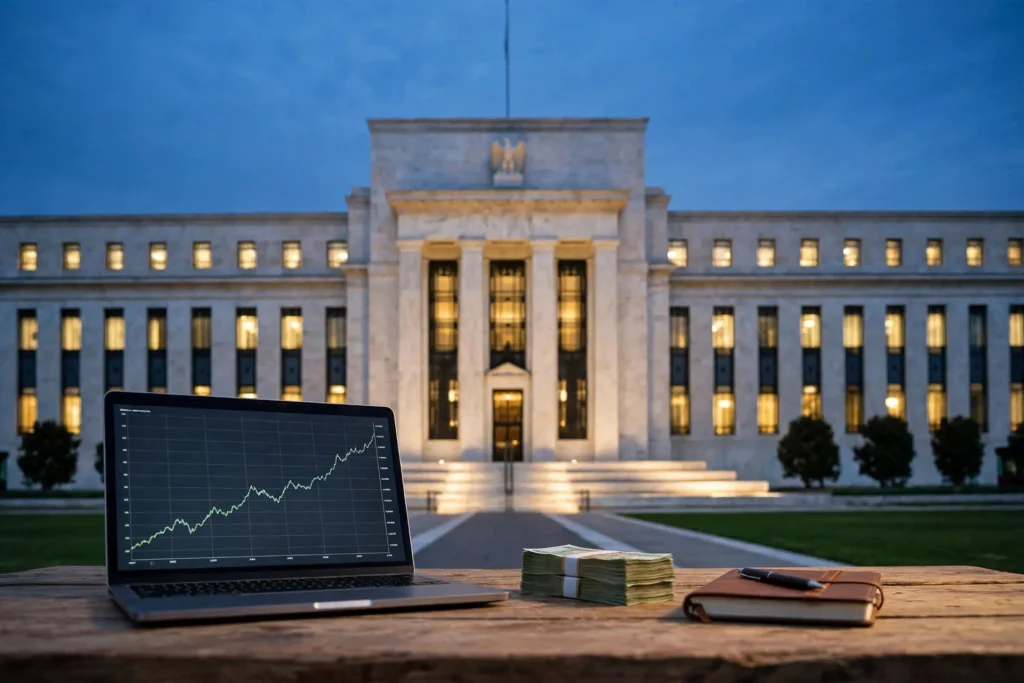
A sharp turn from the “dead economy” jibe
Trump’s praise is a notable change from July 2025, when he called the Indian economy a “dead economy” during a trade dispute. The contrast has been picked up widely in India, where his latest remarks are being read as recognition of the country’s growth run.
What the forecasters say about India in 2027
Goldman Sachs expects India’s real GDP growth to moderate to 7.2 per cent in 2027 from an estimated 7.9 per cent in 2026. The bank sees consumer price inflation rising to 5.7 per cent in 2027 from an estimated 4.6 per cent in 2026, which could push the RBI to raise the repo rate to 6.25 per cent by the end of 2027. It also expects the rupee to steady near 96 to the dollar over the next year.
Amundi Investment Institute, in its 2027 outlook released this month, also sees growth holding around 7 per cent, supported by domestic demand, infrastructure spending and manufacturing. But it warns that rising energy prices, a widening current account deficit and inflation averaging around 5 per cent could cloud the picture, and says the RBI may have to raise rates towards the end of 2026 or in early 2027. Investment is picking up too, with NSE 500 capital spending up 17 per cent in 2026.
Why it matters
For Indian readers, the significance is less about American rates and more about the spotlight. The world’s largest economy is now using India’s growth as its benchmark in a domestic policy fight.
But the praise comes with a catch for households and businesses at home. Trump’s version treats low rates and fast growth as a simple pair. In practice, India’s central bank has been moving in the opposite direction, raising rates to contain inflation, and two of the world’s biggest forecasters expect at least one more hike before the end of 2027. If inflation stays near 5.7 per cent, Indian borrowing costs are more likely to rise than fall.
The rupee is the other number to watch. Goldman Sachs expects it to settle near 96 to the dollar, and a weaker currency makes imported energy costlier, which feeds straight into the inflation the RBI is fighting. Trump’s 15 to 20 per cent claim is his own assertion, not an established forecast. What is established is the 7 per cent figure at the heart of his argument.
FAQs
What did Trump say about India?
He said India has low rates and 7 per cent GDP growth, and the US could grow 14 to 20 per cent if the Fed cut rates.
When did he say it?
At a White House press conference on Friday, November 20, 2026.
Is India’s repo rate really lower than the US rate?
No. The RBI’s repo rate is 5.50 per cent after an October hike, above the Fed’s 3.75 to 4 per cent range.
What growth does the RBI expect?
GDP growth of 7.1 per cent for the financial year ending March 2027.
What is Goldman Sachs forecasting for 2027?
Growth of 7.2 per cent, inflation of 5.7 per cent, and the repo rate rising to 6.25 per cent by the end of 2027.
India’s growth story is now a reference point in Washington’s biggest economic argument.