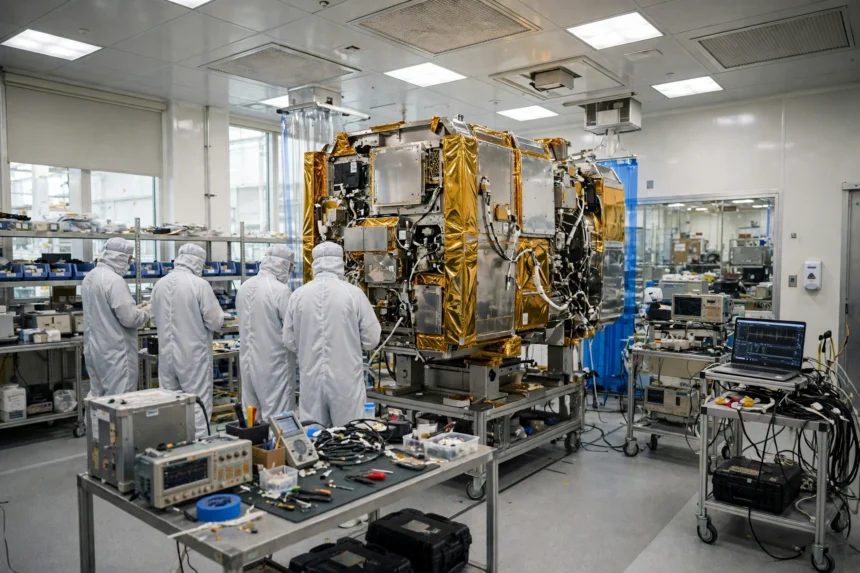
Bengaluru has won a closely watched contest in Indian spacetech. Pixxel, the Bengaluru-based maker of hyperspectral imaging satellites, has chosen the city for GigaPixxel, a 250,000 sq ft satellite manufacturing facility near Kempegowda International Airport, after Andhra Pradesh and Tamil Nadu both tried to bring the project to their states.
With a proposed investment of Rs 350 crore and inauguration targeted for March or April 2027, GigaPixxel is set to become one of India’s largest private satellite factories.
What GigaPixxel will look like
The facility will come up on six acres of land near the airport on Bengaluru’s outskirts, and it is already under construction. Pixxel plans to build around 50 satellites in parallel by mid-2027, scale that to 100 by the end of 2027, and reach 200 at a time by mid-2028.
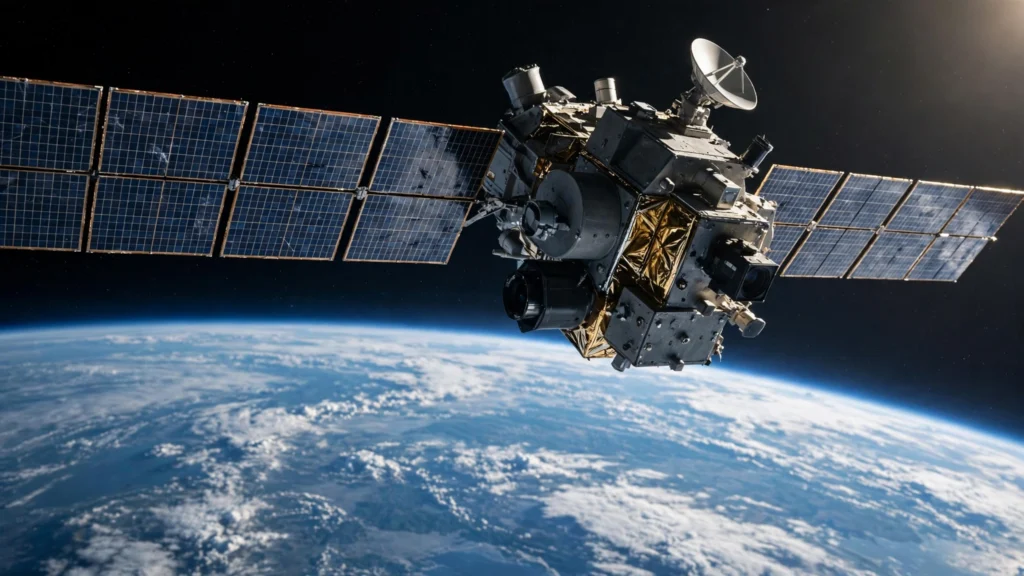
Pixxel builds hyperspectral imaging satellites, which capture images of the Earth across hundreds of light wavelengths and can pick up details invisible to ordinary cameras. The data is used for agriculture, forestry, mining, oil and gas monitoring, and defence, and Pixxel serves government and commercial customers in India and overseas.
Why Bengaluru won the race
The location was not a foregone conclusion. Andhra Pradesh and Tamil Nadu both courted the company, but Pixxel picked Karnataka, where its existing operations and the surrounding aerospace ecosystem are already based.
The state moved quickly. Pixxel’s application seeking six acres of land for the project, involving an investment of Rs 350 crore, was received on November 3, 2026, and was approved within two weeks by the State Level Single Window Clearance Committee, Industries Minister M B Patil said on Tuesday.
Karnataka’s IT and BT Minister Priyank Kharge welcomed the decision, saying the facility would be a significant addition to the state’s spacetech ecosystem, which already includes ISRO centres, DRDO laboratories, private space companies and a deep supplier base. “We have finalised Bengaluru as the location for GigaPixxel. We expect the facility to become operational sometime next year,” founder and chief executive Awais Ahmed told The Economic Times.
From MegaPixxel to GigaPixxel
Pixxel was founded in 2019 by Awais Ahmed and chief technology officer Kshitij Khandelwal, and the new plant is the next step in a rapid run.
- January 2024: Pixxel opened MegaPixxel, its spacecraft assembly, integration and testing facility of more than 30,000 sq ft in Bengaluru, inaugurated by then ISRO chairman S Somanath.
- September 2026: Pixxel raised USD 100 million in a Series C round led by Temasek and Seraphim, taking its total funding to USD 195 million. Expanding manufacturing capacity in India and the US was one of four priorities for the fresh capital.
- November 2026: Karnataka clears the six-acre GigaPixxel proposal within two weeks, and the company confirms Bengaluru as the location.
- 2027: GigaPixxel is targeted to open in March or April, around the time Pixxel’s first Honeybee satellite is scheduled to launch.
At 250,000 sq ft, GigaPixxel will be eight times the size of MegaPixxel, and the jump in capacity, from a handful of satellites to 50, then 100, then 200 in parallel, shows how fast the company expects demand for its imagery to grow.
Why it matters
This is not just a bigger factory for one startup. Until recently, building satellites at scale in India was largely ISRO’s preserve. Pixxel’s bet, and Karnataka’s quick clearance, signals that private satellite manufacturing is becoming a serious industrial activity in its own right, with states now competing for it the way they once competed for car plants and chip fabs.
For Bengaluru, the win reinforces a cluster effect. The city already hosts ISRO, DRDO labs, aircraft makers and a dense network of precision engineering suppliers, so a satellite factory there can draw on talent and vendors a greenfield site elsewhere could not offer. That is the practical reason Andhra Pradesh and Tamil Nadu lost out, and why the state’s two-week clearance mattered: speed plus ecosystem is a hard combination to beat.
For readers, the payoff is concrete. Hyperspectral data helps farmers spot crop stress early, helps governments track deforestation and water use, and helps energy companies monitor pipelines and mines. More satellites built faster in India means that data gets cheaper and more frequent, and more of it is produced by an Indian company rather than bought from abroad. The test now is execution: a March or April 2027 opening leaves little slack, and the ramp to 200 satellites in parallel will demand engineers, clean-room capacity and a supply chain that can keep pace.
FAQs
What is GigaPixxel?
GigaPixxel is Pixxel’s upcoming satellite manufacturing facility near Kempegowda International Airport in Bengaluru, with a built-up area of 250,000 sq ft.
How many satellites will it build?
Around 50 satellites in parallel at first, scaling to 100 by the end of 2027 and 200 by mid-2028.
When will it open?
The facility is under construction and is targeted for inauguration in March or April 2027, with operations expected to begin sometime in 2027.
How much is Pixxel investing?
Rs 350 crore, on six acres of land cleared by Karnataka’s single-window committee within two weeks of the application.
What does Pixxel do?
Pixxel is a Bengaluru spacetech startup founded in 2019 that builds hyperspectral imaging satellites, used in agriculture, mining, energy, forestry and defence.
Pixxel’s Bengaluru pick is a vote of confidence in the city’s spacetech cluster, and a sign that India’s private space industry is moving from prototypes to production lines.