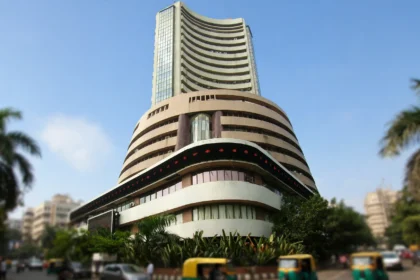
India’s National Stock Exchange has climbed to a place no Indian exchange has held before. On Thursday, November 26, the NSE became the world’s third-largest listed stock exchange operator by market capitalisation, overtaking Germany’s Deutsche Boerse and the London Stock Exchange in the same trading session.
The exchange’s market value now stands at about $64.1 billion, close to Rs 6 lakh crore, ahead of Deutsche Boerse at $63.4 billion and the London Stock Exchange at $62.4 billion. Only two exchange operators in the world are now worth more: the CME Group of the United States at $111.6 billion and Intercontinental Exchange, the parent of the New York Stock Exchange, at $99.4 billion.
The milestone came on a day when NSE shares touched a fresh post-listing high of Rs 2,400. The stock opened at Rs 2,317.65 and rose as much as 3.5 percent during the session, extending gains for a second straight day.
A record day for the shares
NSE shares have been on a strong run through November, gaining in 14 of the 18 trading sessions so far this month, and up about 38 percent over the past month, according to market data.
The exchange made its stock market debut only two months ago, on September 24, 2026. It listed at Rs 1,800 a share, a small premium over its issue price of Rs 1,785. From that listing price, the stock has now gained roughly a third in about nine weeks.
Thursday’s rise also pushed the NSE to a new position at home. It is now India’s ninth-largest listed company by market value, ahead of Larsen and Toubro, Life Insurance Corporation of India, Kotak Mahindra Bank and Infosys.

Who NSE overtook, and who is still ahead
The global ranking of listed exchange operators now looks like this:
- CME Group (US): $111.6 billion
- Intercontinental Exchange (US): $99.4 billion
- National Stock Exchange (India): $64.1 billion
- Deutsche Boerse (Germany): $63.4 billion
- London Stock Exchange (UK): $62.4 billion
- Nasdaq (US): $59.4 billion
- Hong Kong Exchanges and Clearing: $57.1 billion
The ranking measures the market value of the exchange companies themselves, not the combined value of the companies listed on them. By that measure, the NSE has moved past some of the oldest and best-known names in global finance.
From fifth to third in five days
The speed of the climb is part of the story. Just five days ago, on November 21, the NSE was the world’s fifth-largest listed exchange, valued at about $59.7 billion. In less than a week, a rally of roughly $4.4 billion in market value has carried it two places higher.
That puts the exchange’s own listing in perspective. When the NSE went public in September, it was already one of India’s largest listings. Two months on, its shares have kept setting new highs, and the market is now valuing the exchange operator itself at a level that would have seemed ambitious at the time of the debut.
Why it matters
An exchange’s own market value is a rough proxy for how investors see the future of a country’s capital markets. The NSE earns its money from trading, listing and data fees, so a rising valuation is, in effect, a bet that Indian markets will keep growing, that more companies will list, and that trading volumes will stay high.
For ordinary investors, the milestone matters in a more direct way. The NSE’s rise to India’s ninth-largest listed company means it now sits in the same league as the country’s biggest banks and industrial groups. A bigger, more valuable exchange also tends to mean deeper markets and better technology, which eventually shows up in lower costs and better access for retail investors.
There is a wider signal too. The London Stock Exchange and Deutsche Boerse are institutions with histories running back centuries. That an Indian exchange founded in the early 1990s now outranks both is a marker of how quickly India’s financial markets have grown, and of how much global capital now flows through Mumbai.
At the same time, the ranking can move fast in either direction. The gap between the NSE and Deutsche Boerse is less than $1 billion, so a single weak session could hand the third spot back.
What happens next
Traders will watch whether the NSE can hold on to third place in the coming sessions, and whether the rally in its shares has further to run. The next test comes with the December trading data, which will show whether the surge in volumes that powered the November rally is holding up.
FAQs
How big is the NSE now?
About $64.1 billion, or close to Rs 6 lakh crore, making it the world’s third-largest listed exchange operator by market capitalisation.
Which exchanges is the NSE ahead of?
Deutsche Boerse of Germany ($63.4 billion), the London Stock Exchange ($62.4 billion), Nasdaq ($59.4 billion) and Hong Kong Exchanges and Clearing ($57.1 billion).
Which exchanges are still bigger?
Only two: the CME Group of the United States at $111.6 billion and Intercontinental Exchange, the parent of the New York Stock Exchange, at $99.4 billion.
When did the NSE list on the stock market?
September 24, 2026, at Rs 1,800 a share, against an issue price of Rs 1,785. The shares hit a record Rs 2,400 on November 26.
Where does the NSE rank among Indian companies?
It is now India’s ninth-largest listed company by market value, ahead of Larsen and Toubro, LIC, Kotak Mahindra Bank and Infosys.
The NSE’s rise to third in the world is a milestone for Indian markets, and the coming weeks will show whether it can hold the spot.