


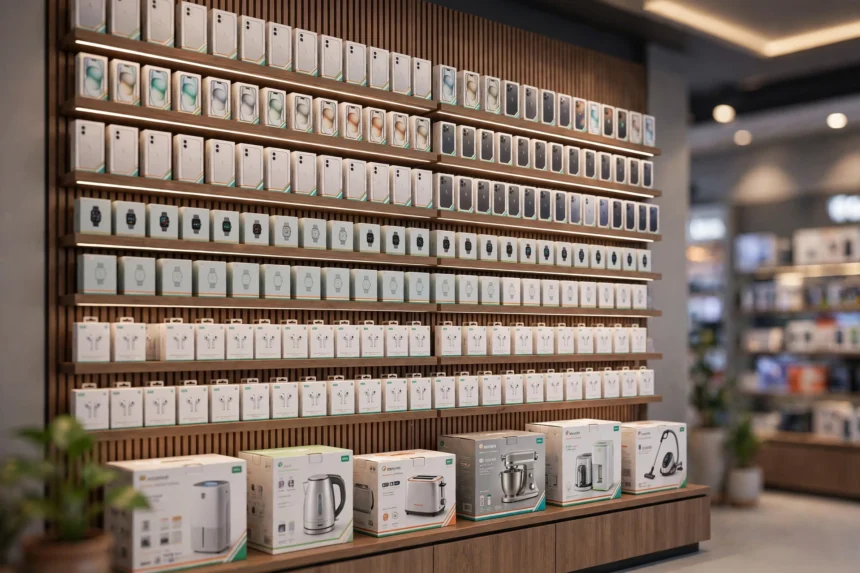
India’s electronics story has always had a strange split. On one side, the country makes and buys more phones, wearables and appliances than almost anyone else on the planet. On the other, the brand names on those boxes rarely belong to Indian companies. That gap was the star of the show at the India Mobile Congress on Saturday, where the industry released a new report card on homegrown tech brands, and the numbers tell a story of both promise and unfinished work.
The report comes from Viksit Tech 47, or VT47, a new spotlight programme at the IMC that positions itself as a launchpad for Indian-owned consumer technology brands. Unveiled at the tenth edition of the congress in New Delhi, it carries an index of 129 Indian-owned brands across gadgets, devices, appliances and connected cars. Together, the report says, these brands earn more than Rs 60,000 crore a year. Sounds big, until you do the math the report itself invites.
The 129 brands that must punch above their weight
With 129 brands splitting Rs 60,000 crore, the average Indian tech brand earns just Rs 465 crore a year. Only 14 of them earn more than Rs 500 crore, and only two clearly cross Rs 2,000 crore. Compare that with India’s total electronics production of Rs 13.11 lakh crore in FY2025-26, and the picture is stark: the value in Indian electronics still flows mostly to global brands and contract manufacturers, not to Indian names on the box.
The report was released by Pankaj Mohindroo, chairman of the India Cellular and Electronics Association, alongside industry leaders from Lava International, MediaTek India, Mivi and Qubo. Techarc prepared the report as the knowledge partner, and the programme also announced its first set of award winners, positioning the awards as a recurring recognition for brands building toward the Viksit Bharat 2047 vision.
What the growth projections actually say
The report lays out two scenarios, and both are worth a careful read. At a projected growth rate of 13 per cent a year, Indian homegrown brands could collectively earn Rs 1.11 lakh crore by FY2031 and Rs 2.04 lakh crore by FY2036. If they gain market share in smart and connected segments faster, at 16 per cent a year, those figures could reach Rs 1.26 lakh crore and Rs 2.65 lakh crore respectively.
Here is the honest reading: even the optimistic scenario keeps Indian brands at a fraction of total electronics production. The report is not predicting Indian brands will dominate Indian shelves by 2036. It is saying they can become meaningfully larger players, if they move up the value chain from assembling devices to owning design, software and brand equity. That is a fair ambition, and arguably the only one that matters, because brand value is where the margins live.
Why this lands at IMC 2026
The tenth edition of the India Mobile Congress, which wrapped up on Saturday under the theme Scale Without Boundaries, was full of signals pointing in this direction. The concluding day focused on AI for agriculture, autonomous agents for 5G networks and rural connectivity, all framed around the idea of India as not just a market but a technology maker. Union Minister of State for Communications Chandra Sekhar Pemmasani told the gathering that India is moving from being one of the world’s largest telecom markets to becoming an important telecom technology nation.
That framing matters. For a decade, the policy conversation was about making in India, and it worked: electronics production crossed Rs 13 lakh crore. The next decade’s question is different. It is about whether the brands Indians buy, the patents they file and the design languages they export can also be Indian. VT47 is the first attempt at measuring that second question systematically.
Where the opportunity is real
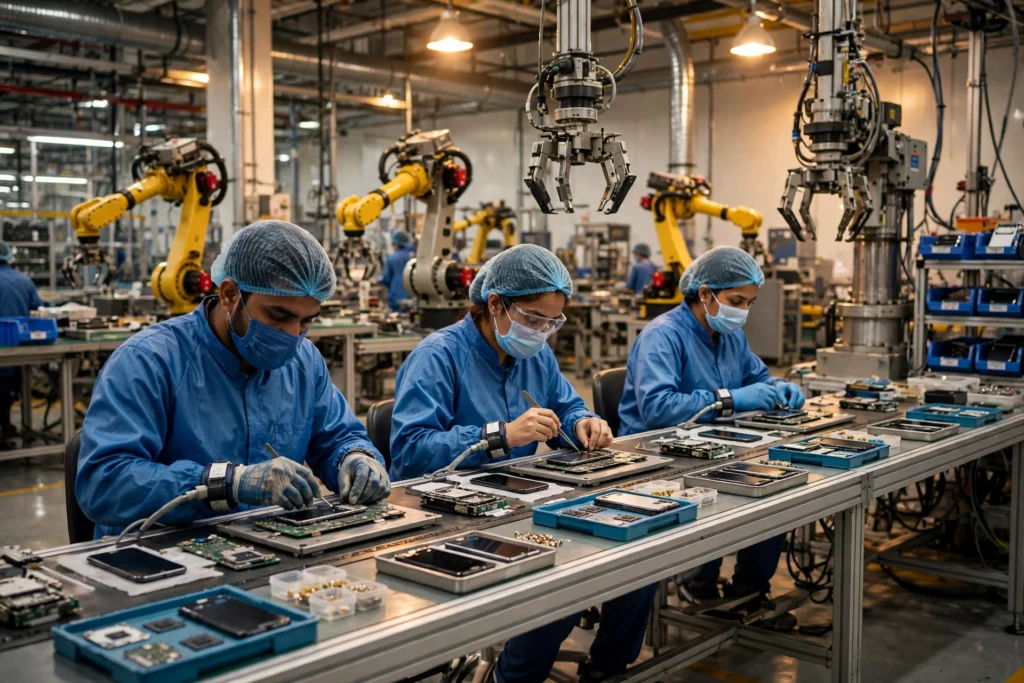
Look at where Indian brands already hold their own: affordable smartwatches, true wireless earbuds, connected home devices and feature-rich budget phones. Companies like Lava, Mivi, boAt, Noise and Qubo have shown that Indian consumers will buy local when the product, pricing and after-sales support are right. The leap the report wants is from these categories into higher-margin territory, such as premium smartphones, connected cars and smart appliances, where Indian brands are currently thin on the ground.
Two tailwinds help. Component costs are pushing global brands to raise prices, which opens pricing gaps for domestic players to exploit, a point executives from Xiaomi, Motorola and iQOO themselves acknowledged on the sidelines of the Qualcomm event at IMC. And the government’s production-linked incentive schemes have built genuine manufacturing muscle that brands can now ride on instead of importing finished goods.
The uncomfortable question nobody can skip
A report can index brands and project revenue, but it cannot fix the hard parts: design capability, R&D spending and access to capital. Indian consumer tech brands still spend a fraction of their revenues on research compared with global peers, and contract manufacturing margins are thin by nature. The VT47 awards and index are a good nudge, but the real test will be whether any of these 129 brands can cross the Rs 5,000 crore mark in the next decade. Two cross Rs 2,000 crore today. The road to Rs 1.26 lakh crore runs through that bottleneck.
Still, credit where it is due. This is the first time the industry has put a number, a name and a deadline on the Indian-brand ambition. A decade ago, the idea of 129 Indian-owned gadget brands earning Rs 60,000 crore would have sounded optimistic. Now it is the baseline. The next report will tell us whether the baseline is moving.
FAQs
What is the Viksit Tech 47 report?
It is the first edition of a report released on October 10, 2026, at India Mobile Congress 2026, indexing 129 Indian-owned consumer technology brands across gadgets, devices, appliances and connected cars, with revenue data and growth projections.
How much do Indian gadget brands earn today?
The report pegs combined annual revenue at over Rs 60,000 crore, averaging Rs 465 crore per brand, against India’s total electronics production of Rs 13.11 lakh crore in FY2025-26.
What are the report’s projections for 2031 and 2036?
At a 13 per cent annual growth rate, Indian homegrown brands could earn Rs 1.11 lakh crore by FY2031 and Rs 2.04 lakh crore by FY2036; in a faster 16 per cent scenario, those figures could reach Rs 1.26 lakh crore by FY2031 and Rs 2.65 lakh crore by FY2036.
Who released the report?
Viksit Tech 47, a spotlight programme of India Mobile Congress, with Techarc as knowledge partner, released by ICEA chairman Pankaj Mohindroo and leaders from Lava, MediaTek India, Mivi and Qubo.
Why does this matter for consumers?
Stronger Indian brands mean more competition, better pricing and products designed for Indian needs, plus jobs and R&D investment that stay in the country.
Published by Informeia News Desk. Follow our Technology section for daily updates from IMC 2026 and beyond.