Beijing has fired the latest shot in the global technology war, and this time the weapon is its own know-how. On Friday, October 16, China’s Ministry of Commerce and Ministry of Science and Technology unveiled a sweeping draft plan to ban or restrict the export of 40 cutting-edge technologies, spanning artificial intelligence, solar manufacturing and biotechnology. The announcement landed without fanfare, but its ripples will be felt from New Delhi to Washington.
The plan, issued as “Announcement No. 48”, is the most ambitious revision yet of China’s technology export catalogue. Fourteen technologies would be barred from export altogether. Another 26 would need a government licence before they can be sold or transferred abroad. Public comment on the draft is open until November 15, but a temporary registration requirement for exporters has already kicked in.
What is in the draft plan
The catalogue divides the 40 technologies into three battlegrounds of the modern economy. Twenty-three of the entries are artificial intelligence technologies, including foundation models, intelligent agents and computing clusters. Twelve cover photovoltaics and solar manufacturing. Five fall under biomedicine.
Among the items proposed for a complete prohibition are perovskite and tandem solar-cell module manufacturing technologies, AI systems that can generate or mutate malicious code on their own, and the core technology behind large AI models trained on sensitive national data. Also on the banned list: AI agents built for sensitive settings such as national defence and critical infrastructure, and certain platforms related to cell and gene therapy.
Banned versus restricted
The line between prohibition and restriction is where the fine print gets interesting. The 26 technologies slated for restricted exports would still leave China, but only with a licence. They include polysilicon engineering technologies used to make solar cells, where the production line has an annual output of at least 30,000 tonnes. AI models with two trillion parameters or more could face restrictions, a threshold that already captures leading Chinese systems. Chip design technology, including designs for AI processors and memory chips, is also on the list.
Crucially, the draft draws a line between selling know-how and selling products. Technologies already in the public domain through open-source releases or academic papers are excluded. Ordinary API or app access to Chinese AI models is not affected either; what triggers the controls is the overseas transfer of the controlled technology itself.
Registration starts now
Exporters cannot wait for the final rules. Alongside the draft, the two ministries introduced interim measures that take effect immediately: exporters of the listed technologies must register relevant transfers before export. That covers technology ownership transfers, licensing deals abroad, and ownership changes that place control of China-based technology with foreign entities, including transactions already underway but unfinished. Simplified licensing procedures will apply to certain international cooperation activities.
Why India should pay attention
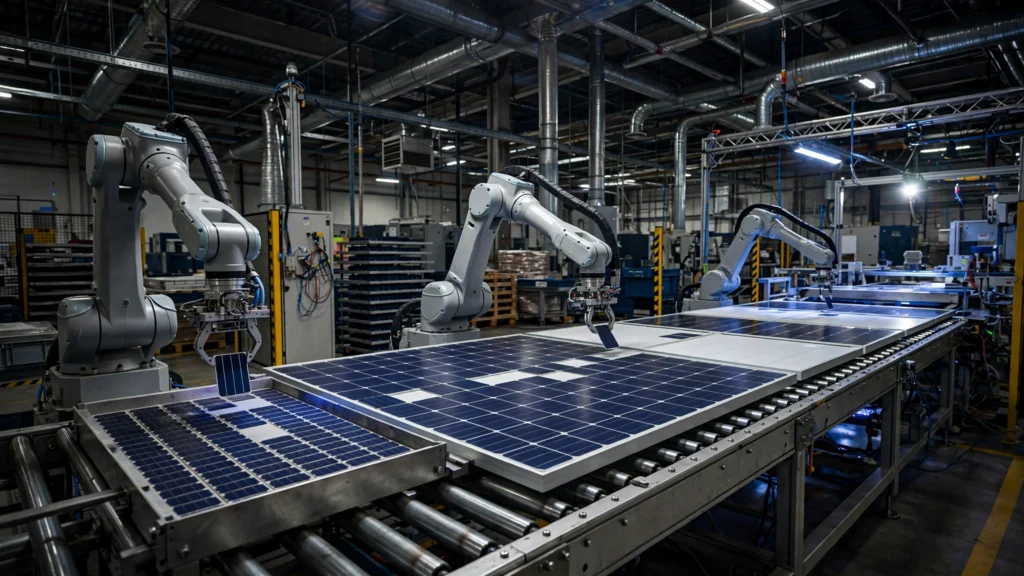
For India, the solar section of the draft is the one to watch. India is racing to build its own solar manufacturing base and climb the value chain, and the new controls on next-generation solar manufacturing technologies could complicate efforts by countries including India to reduce their dependence on China. The draft does not restrict most solar exports, but the choke point is precisely where India wants to go: advanced cell and module technologies.
There is precedent for this kind of pressure. China’s earlier curbs on rare-earth exports disrupted supply chains in India and the United States, forcing companies to scramble for alternative sources. A similar tightening on solar know-how would test how far India’s own manufacturing push can go without Chinese inputs.
The bigger picture
The move comes as trade and technology tensions between Beijing and Washington continue to simmer, with both governments now routinely using export controls to protect strategic capabilities. Chinese officials cited national security and the need to prevent the misuse of sensitive technologies, saying the goal is to establish security safeguards and keep AI under human control. The ministries stressed that the changes are not aimed at any particular country or company.
Analysts see a deeper tension at work. For years, China has pushed its technology companies to expand globally, and Chinese firms have become formidable competitors in electric vehicles, solar equipment, AI models and computing infrastructure. But the more strategic these technologies become, the harder it is for Beijing to treat their overseas transfer as an ordinary commercial decision. The draft reflects that dilemma: compete everywhere, but control what truly matters.
What happens next
With public consultation running until November 15, the final scope of the curbs could still change, and industry groups on both sides are expected to lobby hard. For businesses planning cross-border licensing or overseas production, the immediate task is compliance with the interim registration requirement. The longer question is whether this marks a permanent narrowing of China’s technology openness, or the opening move in a negotiation the rest of the world cannot afford to ignore.
Frequently asked questions
What is China’s Announcement No. 48?
It is a draft plan issued on October 16 by China’s commerce and science ministries proposing to ban or restrict exports of 40 key technologies across AI, solar manufacturing and biomedicine.
Which technologies face a complete export ban?
Fourteen technologies, including perovskite solar-cell manufacturing tech, AI systems that can write or mutate malicious code, core technology of large AI models trained on sensitive data, and some cell and gene therapy platforms.
Will open-source AI models be affected?
No. Technologies already in the public domain through open-source releases or academic papers are excluded, and ordinary API or app access is unaffected.
How does this affect India?
Curbs on next-generation solar manufacturing technology could complicate India’s efforts to reduce dependence on China and build its own solar supply chain, following the disruption earlier rare-earth curbs caused.
When will the final rules take effect?
Public comment runs until November 15, 2026. Meanwhile, an interim registration requirement for covered technology transfers is already in force.
Stay with Informeia as we track how these curbs shape the global technology race.