Students studying under the Madhya Pradesh Board of Secondary Education will see a different question paper this academic year. The board has revised the internal-choice rules for Classes 9 to 12, scrapping alternative questions in two-mark questions while adding fresh choices in vocational papers. The changes take effect from the 2026-27 session and will shape how lakhs of students attempt their board exams in 2027.
The MP Board announced the revision through an official notification dated October 15, 2026, issued by the board secretary from Bhopal. Schools across the state have been asked to brief students on the new pattern well before the pre-board season begins.
What exactly has changed
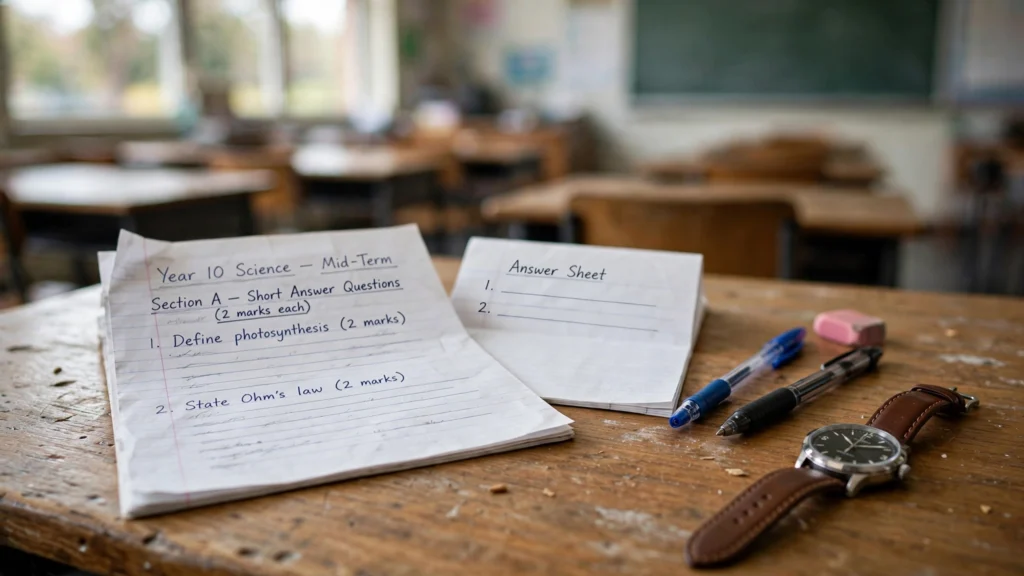
The central change is simple: two-mark, very short-answer questions in main subjects will no longer carry internal choices. Until now, students often got an “either/or” option even in these short questions, letting them skip a question they were unsure about. From 2026-27, every two-mark question in the main subjects must be attempted, with no alternative offered.
That said, the board has not removed choices entirely. Here is how the revised pattern looks:
- 2-mark questions (main subjects): internal choice removed
- 3-mark questions (main subjects): internal choice continues
- 4-mark questions (main subjects): internal choice continues
- 5-mark questions (NSQF subjects): internal choice introduced
- 7-mark questions (NSQF subjects): internal choice introduced
The new choices in five-mark and seven-mark questions apply to subjects offered under the National Skills Qualifications Framework, which covers vocational and skill-based courses. In effect, the board has tightened the pattern for core academics while giving vocational students more breathing room.
Why the board made this move
According to the notification, the changes follow decisions taken at the board’s Curriculum Committee meeting on August 20, 2025, which were then approved at the Executive Committee meeting on August 28, 2025. The board’s reasoning, as reflected in the circular, is to bring more consistency to how different question types are attempted.
Teachers who have seen the circular say the logic is not hard to guess. Two-mark questions usually test direct recall or a single concept, and the board seems to believe students should not be able to dodge any of them. Longer questions, where a student writes structured answers, retain their alternatives because they test broader understanding and take more time.
How this affects students preparing for 2027
For Classes 10 and 12 students appearing for the 2027 board examinations, the message is straightforward: prepare every chapter, because the safety net in short questions is gone. Very short-answer questions typically cover definitions, formulas, dates and one-line concepts, and students who earlier relied on internal choice to skip weak topics will now need complete coverage.
Coaching teachers suggest students rework their revision plans. Earlier, if two options were given in a two-mark question, students banked on at least one familiar topic. Now there is no such fallback in the shortest questions, a Bhopal-based school teacher noted while discussing the circular. The practical advice doing the rounds is to treat every two-mark question in sample papers as compulsory and practise them without looking for alternatives.
Students in NSQF subjects, meanwhile, get a small advantage. The newly introduced internal choices in five-mark and seven-mark questions mean vocational students can pick the question they are more confident about in the longest sections of their papers.
What schools and students should do next
The board has advised students to check the question-paper pattern prescribed for their specific subjects and classes rather than assuming one rule applies everywhere. Since the changes draw a clear line between main subjects and NSQF subjects, mixing up the two could cost marks.
Schools are expected to align their unit tests and pre-board papers with the revised pattern so students are not caught off guard in the final examinations. Parents should also note that the notification deals only with the question-paper pattern; it announces no change to the examination schedule.
The revised rules apply to examinations conducted from the 2026-27 academic session, which covers the board exams scheduled for 2027. Students can refer to the official MPBSE notice for the detailed, subject-wise breakup.
FAQs
When will the new MP Board exam pattern apply?
The revised internal-choice rules apply from the 2026-27 academic session, covering Classes 9 to 12 board and school examinations.
Are internal choices removed from all questions?
No. Choices are removed only from two-mark questions in main subjects. They continue in three-mark and four-mark questions, and have been newly introduced in five-mark and seven-mark questions for NSQF subjects.
What are NSQF subjects?
NSQF stands for the National Skills Qualifications Framework. These are vocational and skill-based subjects, and their question papers follow a different pattern from the main academic subjects.
Where can students read the official notification?
The changes were announced in a notification dated October 15, 2026, issued by the MPBSE secretary from Bhopal. Students should check the official MPBSE website for the full notice.
Does this change the 2027 board exam dates?
No. The notification covers only the question-paper pattern. There is no announced change to the examination schedule.
The bottom line for students is simple: revise everything, especially the short stuff. The MP Board has closed one small loophole and opened another for vocational students, and the 2027 papers will be the first real test of the new rules.