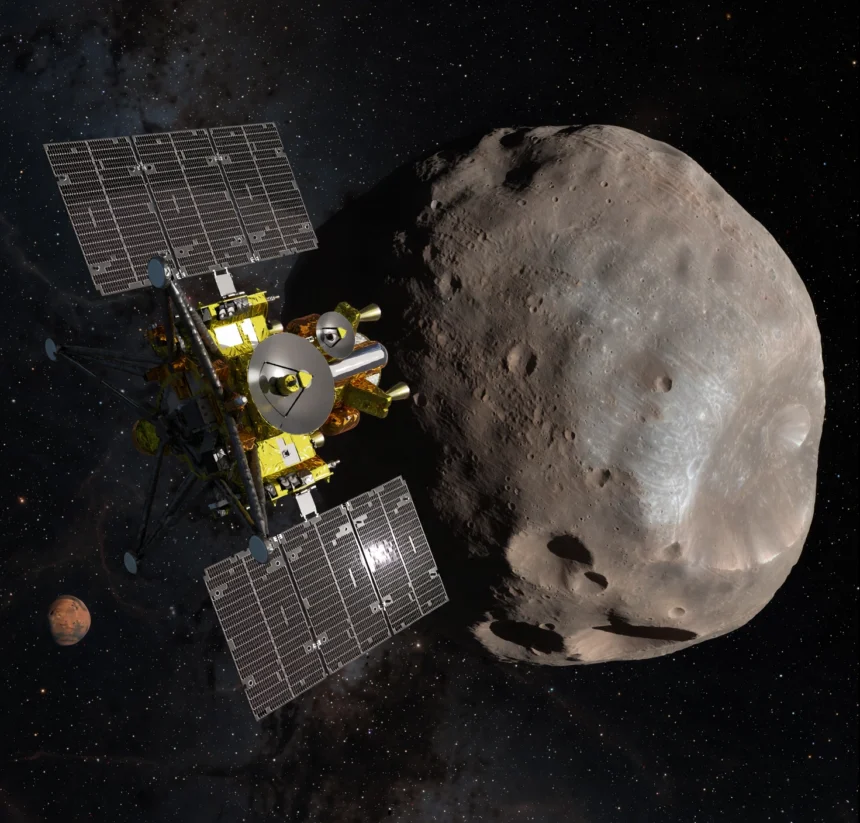
TANEGASHIMA, Japan: Long before the first fishing boats left the harbour on Tuesday morning, the sky above Japan’s Tanegashima island tore open with light. At 4:41 am local time, a 63-metre H3 rocket climbed through the dark carrying the Martian Moons eXploration probe, known as MMX, the first mission ever designed to bring home a piece of the Martian system.
For JAXA, the Japan Aerospace Exploration Agency, this was a moment years in the making. If every step goes to plan from here, a small capsule will parachute into the Australian desert in 2031 carrying at least 10 grams of rock and sand from Phobos, the larger of Mars’ two tiny moons. No spacecraft has ever returned a sample from anywhere in the Mars system before.
“There’s a lot of adrenaline, a lot of excitement and a lot of wow,” NASA scientist Tom Statler, who serves as a program executive for the mission, said as the rocket cleared the pad. The launch, streamed live by JAXA, appeared to go exactly as planned, with the four solid boosters peeling away in pairs in the first two minutes of flight.
A decade-long journey begins with one roar
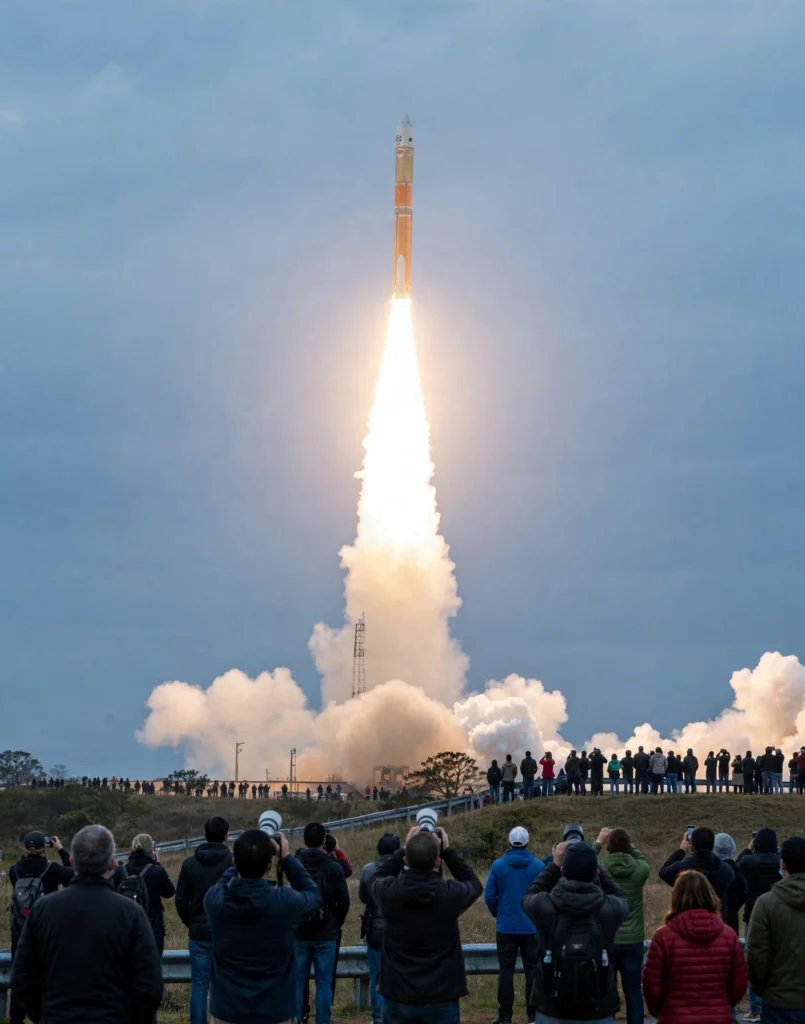
The rocket, designated H3 Flight No. 10, lifted off from the Yoshinobu Launch Complex at the Tanegashima Space Center in Kagoshima Prefecture. It was the tenth flight of Japan’s flagship H3 launcher, a vehicle jointly developed by JAXA and Mitsubishi Heavy Industries, and a meaningful vote of confidence in it. The H3’s debut in March 2023 ended in failure when its second-stage engine refused to ignite, and another flight failed in December 2025 before the vehicle returned to reliable service in June 2026.
This time, the powerful H3-24L configuration, fitted with two liquid-fuelled LE-9 main engines and four solid rocket boosters, carried its heaviest payload yet: the roughly 4,200-kilogram MMX spacecraft, made up of three separate modules that will handle the cruise, the landing, and the long trip home.
Why Phobos, and why now
Mars has two moons, Phobos and Deimos, and both are deeply strange. Phobos is a dark, lumpy, cratered rock only about 22 kilometres across. It races around Mars in a near-perfect circle, completing an orbit in less than eight hours. Deimos is even smaller, around 13 kilometres wide. Despite decades of photographs from orbiters and rovers, scientists still cannot agree on where they came from.
One theory says they are captured asteroids, ancient wanderers that Mars’ gravity snared billions of years ago. Another says they were born from the debris of a colossal impact that tore material off young Mars. “What are these little space potatoes? We can’t explain Phobos or Deimos right now. They shouldn’t exist, but they do,” NASA research scientist Abigail Fraeman said ahead of the launch.
Answering that question matters far beyond Mars. The moons may hold clues about how water and organic compounds were distributed across the early Solar System, the same process that may have made Earth habitable. JAXA also sees MMX as a stepping stone to crewed Mars exploration, calling Phobos a potential “natural space station” for future round trips.
How MMX will grab a piece of another world
MMX will spend about a year cruising to Mars, entering orbit around the planet in August 2027 and settling alongside Phobos a month later. From there, the hard part begins. The spacecraft will survey Phobos from orbit, then attempt to touch down on its surface once or twice in 2030 to collect its prize.
- Two ways to sample: MMX carries two sampling systems, including a drill designed to bite about 2 centimetres beneath the surface, where the soil is untouched by space radiation.
- A tiny hitchhiker: In early 2029, MMX will deploy Idefix, a small rover built by France’s CNES and Germany’s DLR, to roam Phobos’ surface and observe up close. (Idefix is the French name for Dogmatix, the loyal dog from the Asterix comics.)
- A laser laboratory: A miniaturised laser built by the Fraunhofer Institute in Germany will zap Phobos’ rocks on the spot, reading their composition with a Raman spectrometer from millions of kilometres away.
- Deimos gets a flyby: The smaller moon will be studied from a distance as MMX heads home. There will be no landing there.
The five-year road to Earth
After its sampling work is done, the return module will break away and begin the long voyage home. In 2031, it will release a re-entry capsule over Australia’s Woomera Prohibited Area, the same remote desert where JAXA’s Hayabusa2 capsule delivered asteroid samples in December 2020. Recovery teams have used that zone before, and JAXA knows the drill.
The mission comes with a serious price tag and a genuinely global crew. JAXA has spent around $350 million to get this far, with NASA contributing about $87 million alongside a scientific instrument, communications support, and a technology demonstration. The European Space Agency, France’s CNES, Germany’s DLR, and Spain’s INTA are all partners too.
Frequently asked questions
When will the Phobos samples reach Earth?
The return capsule is scheduled to land in Australia in 2031, about five years after launch.
How much of Phobos will MMX bring back?
At least 10 grams of material, collected by two different sampling systems during one or two landings in 2030.
Has anything from Mars ever been returned before?
No. MMX would be the first mission to return samples from the Martian system, and the first to collect material from a moon other than Earth’s own.
Will MMX land on Deimos too?
No. Deimos will be observed during a flyby on the way home, but all landings target Phobos.
What is the Idefix rover?
A small rover built by the French and German space agencies that will land on Phobos in early 2029 to scout the surface before the main sampling attempts.
For now, MMX is a bright dot climbing away from Earth, already on its way. In the control rooms at Tanegashima, the cheering has faded and the real work, the slow, patient science of a five-year round trip, has begun.