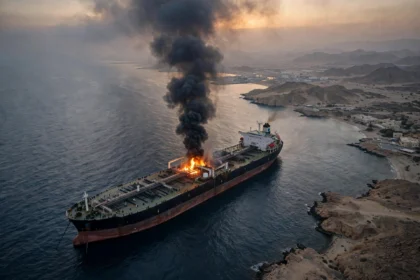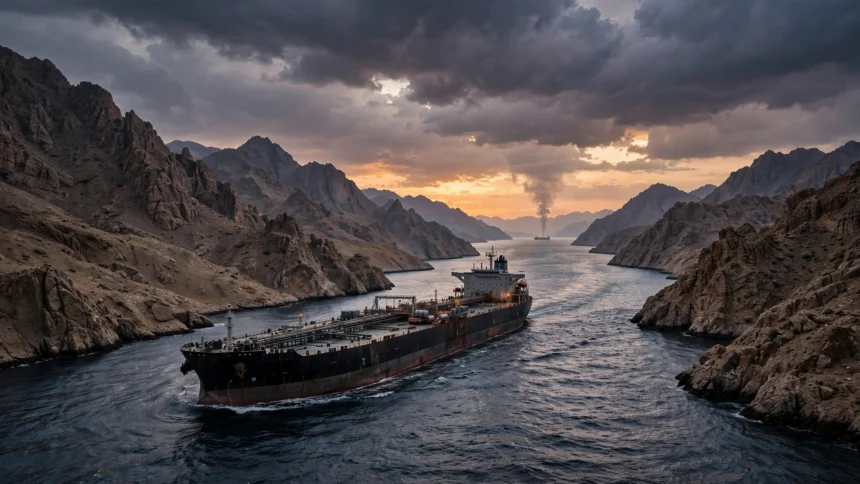
It was a Friday that families across India will remember with relief. A crude oil tanker carrying 15 Indian seafarers was struck by a projectile in the Strait of Hormuz, one of the most dangerous shipping lanes in the world right now. By evening, Union minister Sarbananda Sonowal had the news that mattered most: every single one of them was safe.
The vessel, the MT ST 3, was hit on October 16 while transiting the strait at the mouth of the Persian Gulf. Sonowal said the government was monitoring the situation and staying in close contact with the ship’s management company to keep track of the crew’s safety and wellbeing.
Two attacks, two countries, 24 Indians safe
The Hormuz incident was not the only one on India’s radar this week. In a separate attack on October 14, the chemical tanker YARA J was hit by a drone at Sulina Anchorage in Romania, near the mouth of the Danube. Nine Indian seafarers were on board. They too escaped unhurt.
Taken together, the two strikes affected 24 Indian nationals. All are safe, with no casualties or injuries reported, Sonowal confirmed on X on Friday night.
A pattern that is becoming hard to ignore
The attack on the MT ST 3 is part of a grim week for shipping. A day earlier, the Singapore-registered container ship GFS Pride caught fire and sank in the strait after being hit by a projectile; all 21 crew were evacuated safely.
Earlier this month, a vessel owned by Dubai shipping company Onex was struck by a projectile in the strait. Twelve crew members on the MT On Peace were injured in that attack, including 11 Indians, according to the Ministry of External Affairs. On October 11 the MEA described the recurring attacks on commercial shipping as deeply concerning, warning they risk escalating an already unstable situation.
Why the Strait of Hormuz matters so much
The strait is a narrow channel between Iran and Oman, and it is the passage through which a huge share of the world’s oil moves. Before the conflict began, roughly a fifth of global oil consumption passed through it every day. When tankers get hit there, the shockwave travels fast: crude prices have surged past 100 dollars a barrel in the United States.
Attacks in October alone have already broken records, carried out with drones, missiles and sea mines, and at least two ships have sunk. Iranian forces have said the strait will stay effectively closed until Washington respects what Tehran calls the rights of the Iranian people.
For India, the stakes are personal as well as economic. Indian seafarers crew a large portion of the world’s merchant fleet, and India imports the bulk of its crude through sea lanes that run through the region. Every flare-up in the strait raises the cost of India’s oil bill and puts Indian workers directly in harm’s way.
Trump raises the stakes again
Adding to the tension, US President Donald Trump has raised the possibility of striking Iran’s nuclear facilities again, including a fortified site known as Pickaxe Mountain. He ruled out nuclear weapons and ground troops, but US officials cited by CNN said the Pentagon is weighing strike packages that could include the GBU-43/B, the largest non-nuclear bomb in the American arsenal.
Experts quoted by Al Jazeera question what such a strike would achieve, noting it may not destroy Iran’s deeply buried underground nuclear sites. But the threat alone has been enough to keep markets on edge and complicate any diplomatic opening.
Iran, for its part, has demanded an American withdrawal from the region as a condition for reopening the strait. Iran’s army chief Amir Hatami said traffic through the waterway remained very limited and under the supervision of Iran’s army and the Revolutionary Guard.
What happens next
India’s response has been diplomatic and focused on its citizens: monitoring both incidents, pressing ship operators for updates, and condemning attacks on commercial shipping. Shipping companies, meanwhile, are recalculating. Record attack levels in October have pushed up insurance costs and freight rates, and some routes are being avoided altogether, which keeps fuel prices elevated for consumers everywhere, including in India.
The relief that all 24 Indian seafarers came through this week unharmed does not change the underlying math. As long as tankers are targets in the Strait of Hormuz, the men and women who crew them, many of them Indian, will sail in harm’s way every single day.
FAQs
What happened to the MT ST 3?
The crude oil tanker, carrying 15 Indian seafarers, was struck by a projectile in the Strait of Hormuz on October 16. All crew members are safe and no injuries were reported.
Was there another incident involving Indian seafarers this week?
On October 14 the chemical tanker YARA J was hit by a drone at Sulina Anchorage in Romania. Nine Indian seafarers were on board, and all are safe.
How many Indian seafarers were affected in total?
24 Indian nationals across the two vessels, all safe according to Union minister Sarbananda Sonowal.
Why is the Strait of Hormuz so important?
It is the key chokepoint for global oil trade, with roughly a fifth of the world’s oil consumption passing through it before the conflict began. Attacks there push up crude prices and shipping costs worldwide.
What has India said about the attacks?
The Ministry of External Affairs has condemned attacks on commercial shipping as deeply concerning, and the shipping ministry is monitoring the incidents with the vessel operators.
Informeia will keep tracking the situation in the Strait of Hormuz.