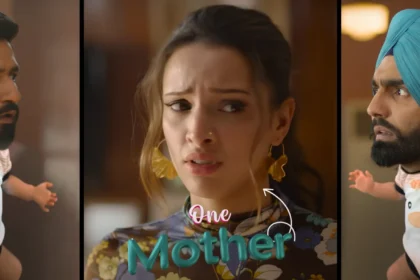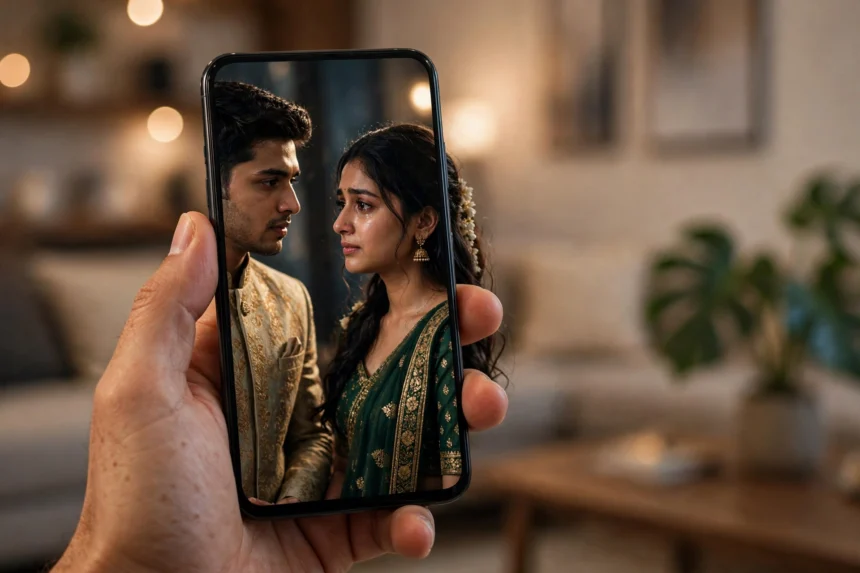
India’s newest television habit is not on a television at all. It is a phone screen, held vertical, and it has quietly become the biggest show in the country. Microdramas, those bite-sized vertical soap operas that run for a minute or two an episode, are now racking up a staggering 1 billion episode views every single day across the ShareChat network alone, according to figures shared by the company. And now the format wants to do something television never could: sell you the heroine’s outfit while you are still crying over the plot twist.
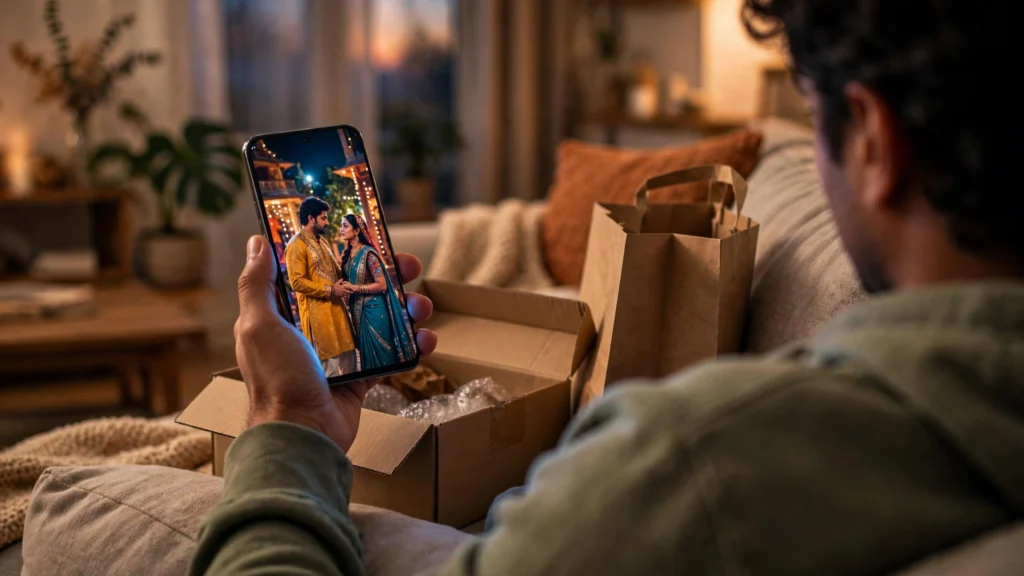
This week, ShareChat and its short-video sibling Moj rolled out a new feature called “Shop the Scene.” The idea is disarmingly simple. As a romantic drama unfolds on your screen, a small interactive cue lets you buy the saree the heroine is wearing, or the earphones the hero is holding, without pausing the story. Products become part of the narrative rather than an interruption to it, and the purchase happens in the middle of the binge.
Why this moment matters
The timing is deliberate. The festive season is when India’s microdrama audience goes into overdrive. According to Kantar’s State of Microdrama in India report, nearly 55 percent of microdrama viewers watch more content during festivals. With Diwali shopping already in full swing, ShareChat and Moj are positioning cliffhangers as the new checkout page.
The scale of the format is hard to argue with. ShareChat, Moj and Quick TV together say they deliver over 1 billion daily episode plays, which works out to more than 720 million minutes of content consumed every single day. Neha Markanda, the chief business officer of ShareChat, Moj and Quick TV, noted that 80 percent of audiences prefer microdrama, on par with reels, while 86 percent spend more than 15 minutes watching every day. Perhaps most surprising is who is watching: 68 percent of viewers belong to households earning over Rs 10 lakh annually, which shreds the lazy assumption that this is only a small-town pastime.
The industry calls it the fastest-growing category
Independent data backs the momentum. Ormax StreamView has called microdramas the fastest-growing content category in India, with viewership up 50 percent since 2025, driven by smartphone penetration and social media recommendations. The ShareChat, Moj and Kantar report puts monthly reach at around 100 million viewers and daily episode views at nearly 1.2 billion across the wider ecosystem.
GSN Aditya, COO of the Eloelo Group, which runs the microdrama platform Story TV, puts the appeal down to density. People want the story to start quickly, keep moving and give them a reason to tap “next episode.” Story TV alone says its users watch for more than 95 minutes a day, with peaks in the morning, early evening and late night. As Aditya puts it, that is real primetime behaviour, just on a mobile screen.
Shopping enters the storyline
The “Shop the Scene” feature sits alongside a wider suite of festive-season ad formats announced this week. These include a Regional AR Lens, pincode-based webcards that connect regional audiences with local brand offers, and custom Superlikes that let viewers engage with brands while watching. There are also bespoke brand campaigns featuring actors showcasing products relevant to the show’s plot, placed between episodes, often right at a cliffhanger so the story and the brand flow together.
Early numbers from the company are striking. These in-episode campaigns have recorded three times higher engagement and one and a half times higher click-through rates than conventional benchmarks. The company has not specified the exact benchmarks it measured against, and its billion-view claims have not been independently verified, but the direction of travel is unmistakable: entertainment and commerce are collapsing into a single screen.
How the microdrama money machine works
Behind the creative surge sits a ruthless little economy:
- The coin gate: the first 5 to 10 episodes are free, then a cliffhanger paywall kicks in, with unlocks priced from 25 paise to Rs 10.
- Rewarded ads: watch a 30-second ad, unlock the next episode.
- Micro-subscriptions: plans around Rs 29 a week or Rs 99 a month for coins, early access and ad-free viewing.
- Brand integration: a fintech app or an e-commerce product written into the plot at the moment of conflict.
- Now, shoppable scenes: tap the heroine’s outfit and buy it through two large e-commerce partners (names not disclosed).
Production is cheap, a full 90-episode series can cost as little as Rs 10 to 50 lakh, and AI is trimming costs further with reported savings of 20 to 25 percent on scripting, dubbing and regional localisation. The upside is serious: microdrama ad revenue in India is projected to reach Rs 5,000 to 5,500 crore by FY32.
India versus the world
The global blueprint was set by apps like ReelShort and DramaBox, which built the model on pay-per-episode coin packs where binging a 60-episode series can cost $20 to 40. Indian players like Kuku TV, Story TV, Quick TV and FreeReels play a volume game instead: free episodes, ad impressions, lower revenue per user. Local stories win too. DramaBox’s early Hindi dubs of Chinese dramas failed to connect with India’s cultural context, while native Hindi, Tamil, Telugu, Malayalam, Kannada and Bhojpuri stories thrive.
Over 55 percent of the audience lives in rural India, and Tier II and III towns are driving the steepest growth. About three quarters of viewers prefer ad-supported free viewing over paying upfront, which is exactly why shopping inside the story, rather than a paywall in front of it, looks like the winning monetisation move.
FAQs
What is “Shop the Scene”?
It is a new feature on ShareChat and Moj microdramas that lets viewers buy products shown in a scene, like an outfit or gadget, in real time while watching, through e-commerce partners.
How popular are microdramas in India right now?
The format reaches roughly 100 million monthly viewers. The ShareChat network reports 1 billion daily episode views, and independent trackers like Ormax call it India’s fastest-growing content category.
Are microdramas free to watch?
Mostly. The first episodes are free, with cliffhanger paywalls, rewarded ads and cheap micro-subscriptions for the rest. Around 75 percent of Indian viewers prefer ad-supported free viewing.
Who watches microdramas?
The audience cuts across India. More than 55 percent live in rural areas, growth is steepest in Tier II and III towns, and 68 percent come from households earning over Rs 10 lakh a year.
Will shopping ruin the stories?
That is the industry’s big bet in reverse. By weaving products into the plot at emotional high points, platforms claim engagement actually rises. The next few festival weeks will be the real test.
The living room television is not dying, but it has competition for attention that fits in a pocket. As microdramas learn to sell while they thrill, the line between watching a story and shopping through one is getting thinner by the episode.