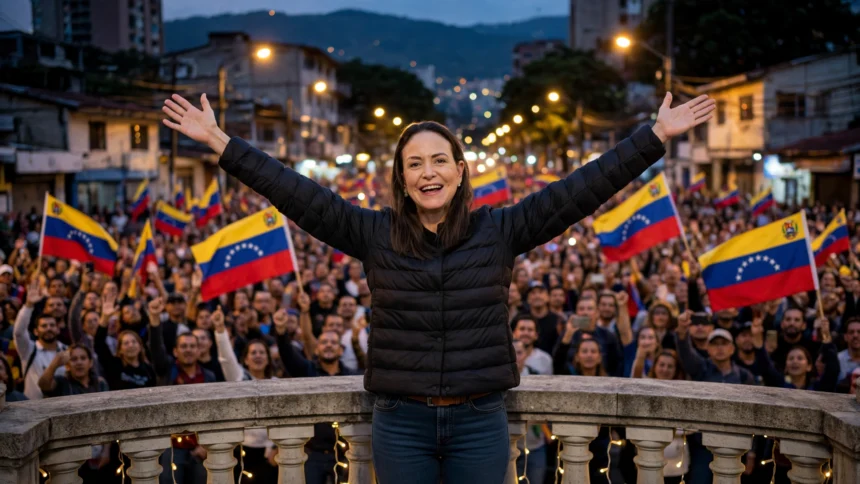
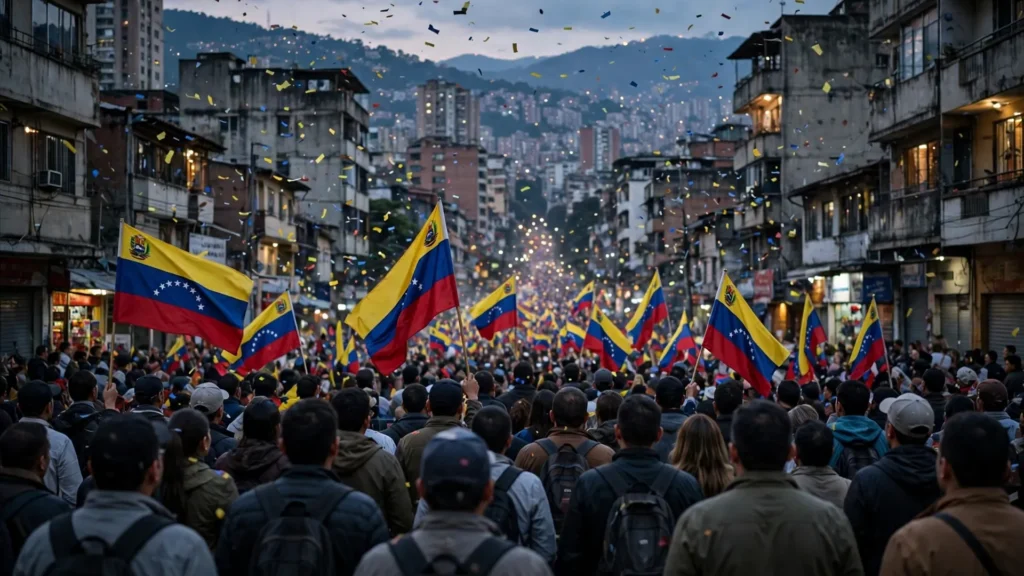
Caracas erupted on Sunday night as Venezuelan opposition leader Maria Corina Machado came home. After 10 months in exile, the Nobel Peace Prize winner stood through the sunroof of an SUV, waving to tens of thousands of supporters who had waited for hours along the road into the capital.
Her return, announced with just four words on social media, has already shaken up Venezuela’s fragile political transition. “Estoy aqui. Con ustedes,” she wrote early on Sunday. “I am here. With you.”
By Sunday evening she was in Caracas, and on Monday she posted again: “Finalmente, Caracas, estoy aqui.” Finally, Caracas, I am here.
A day of emotion, from church to capital
Machado’s first stop after crossing back into Venezuela was a church, not a rally stage. She appeared at the Sanctuary of the Divina Pastora in Santa Rosa, in the western state of Lara, about 400 km west of Caracas, to give thanks for her return. Crowds pressed around her inside the church, chanting her name, singing the national anthem and shouting “liberty”.
From there, she set off for Caracas in a caravan that took around eight hours, slowed by the sheer number of people lining the route. Supporters handed her rosaries, waved flags and ran alongside her car. “This country is giving lessons to everyone,” she shouted to the crowd as her convoy entered the capital.
One man, tears in his eyes, ran beside her vehicle and pleaded: “The future of my children is in your hands. Please!” It was the kind of raw, unscripted moment that has defined Machado’s bond with her supporters for years.
Why she left, and why now
Machado, 60, has been the face of Venezuela’s opposition for more than a decade. She was barred from challenging Nicolas Maduro in the disputed 2024 presidential election, so her ally Edmundo Gonzalez Urrutia ran in her place. The opposition published voting tallies it said showed Gonzalez had won by a wide margin, but Maduro claimed victory and stayed in power.
Machado spent more than a year mostly in hiding after that election, then secretly left Venezuela in late 2025 to receive the 2025 Nobel Peace Prize. She has been in exile ever since, lobbying governments abroad while, according to her party, trying at least seven times to get home.
Her return follows a dramatic change in Venezuela itself. In January, US forces removed Maduro from power and flew him to the United States to face federal charges, including narco-terrorism conspiracy. He has pleaded not guilty. His deputy, Delcy Rodriguez, took over as interim president with Washington’s backing.
Washington’s awkward balancing act
Machado’s comeback puts the Trump administration in a delicate spot. President Donald Trump has repeatedly praised Rodriguez and welcomed oil and business deals between US companies and the interim government. In September, he said it was too soon to talk about democratic elections in Venezuela.
Asked about Machado’s return on Sunday, Trump said he had not known about her plans, but wished her well. “She’s a very nice woman,” he said. “I hope she’s safe.” He has also noted, more than once, that she presented him with her Nobel Peace Prize medal during a White House meeting in January.
Secretary of State Marco Rubio struck a warmer note, saying the conditions for her safe return were “the direct result of the US supported reconciliation talks which has already seen hundreds of political prisoners freed and hundreds of political opposition figures return from exile”.
Gonzalez, who fled Venezuela in 2024, celebrated her return online and said he would join her soon. “Our sovereign voice returns with her to lead and guide this process,” he wrote.
What happens next
Machado has not yet given a formal speech since her return, but she is expected to speak publicly later this week. Her advisers say she plans to meet survivors of the devastating twin earthquakes that struck Venezuela in June, along with the families of political prisoners.
The bigger question is elections. Machado has said a presidential vote should happen in 2027. But the talks now under way between the Rodriguez government and other opposition groups, talks that do not include Machado’s Vente Venezuela movement, are focused first on remaking the electoral council and the top court, both still staffed by ruling party loyalists.
Analysts say Machado must now walk a tightrope: pushing for the elections her supporters demand without clashing with a US-backed process she is not part of. For now, both she and Rodriguez are expected to avoid open confrontation, since each needs Washington’s backing.
What is already clear is that Machado can still draw a crowd. After nearly a year away, tens of thousands turned out for her in a single day. For a country waiting to see what its transition really looks like, that is a message in itself.
FAQs
Who is Maria Corina Machado?
She is Venezuela’s best-known opposition leader and the winner of the 2025 Nobel Peace Prize, awarded for her campaign for democratic rights and free elections.
Why was she in exile?
After the disputed 2024 election, she spent more than a year in hiding and then left Venezuela in late 2025 to receive her Nobel Prize, staying abroad for 10 months while several return attempts failed.
How did she return?
She announced her return on social media on Sunday, October 25, appeared at a church in Lara state, then travelled to Caracas in a caravan greeted by tens of thousands of supporters. Her team has not disclosed how she entered the country.
What does her return mean for Venezuela?
It raises pressure for a clear electoral timeline, with Machado pushing for a presidential vote in 2027, while US-backed talks on electoral reforms continue without her movement.
What has Donald Trump said?
Trump called Machado “a very nice woman” and said he hopes she stays safe, while continuing to back interim President Delcy Rodriguez and the current transition process.
Machado’s homecoming is only the opening chapter. The weeks ahead will show whether her return speeds up Venezuela’s path to elections, or simply adds another powerful voice to an already crowded transition.