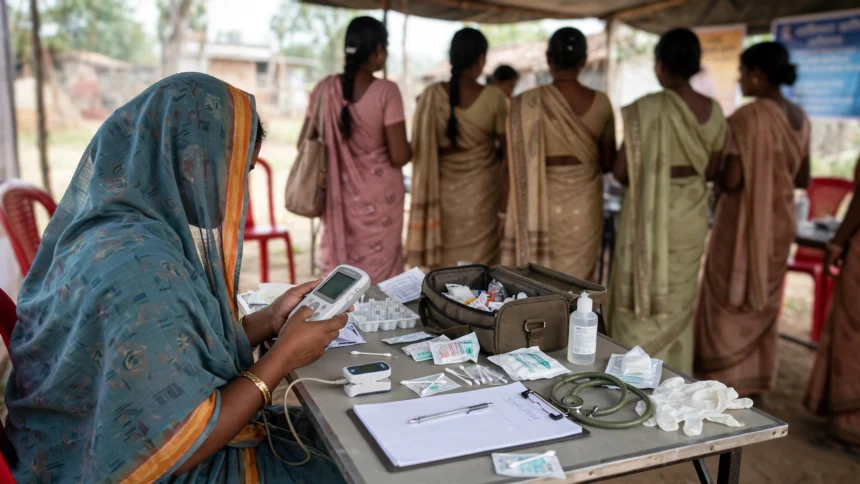
In a village health camp in Madhya Pradesh, a small box plugged into a laptop’s USB port did something no distant city laboratory could do on the spot. It read a cervical swab, checked it for four warning signs of cancer, and gave an answer during the same visit. In a community trial covering 801 women across 36 villages, the device, called KayaCervi, flagged every single case that the standard laboratory test later confirmed.
The results, published in the journal Scientific Reports by a team led by researchers at the All India Institute of Medical Sciences (AIIMS) Bhopal, show how screening could reach women who live far from a laboratory and rarely return for a second visit.
The village trial behind the headline
The community phase ran in villages across Bhopal and Seoni districts. Health teams collected 867 cervical swab samples from women over the age of 30. Sixty-six samples degraded before analysis, leaving 801 women whose results could be compared properly.
Every woman also received liquid-based cytology, the standard laboratory test. It confirmed abnormal cells in 10 women, and KayaCervi flagged all 10. Of the 791 women the laboratory test cleared, the device correctly cleared 775 and raised false alarms for 16. That works out to 100 percent sensitivity and 98 percent specificity, with 98 percent overall agreement. Every negative result proved correct, but fewer than 4 in 10 positive results turned out to be real cases.
How the small box works
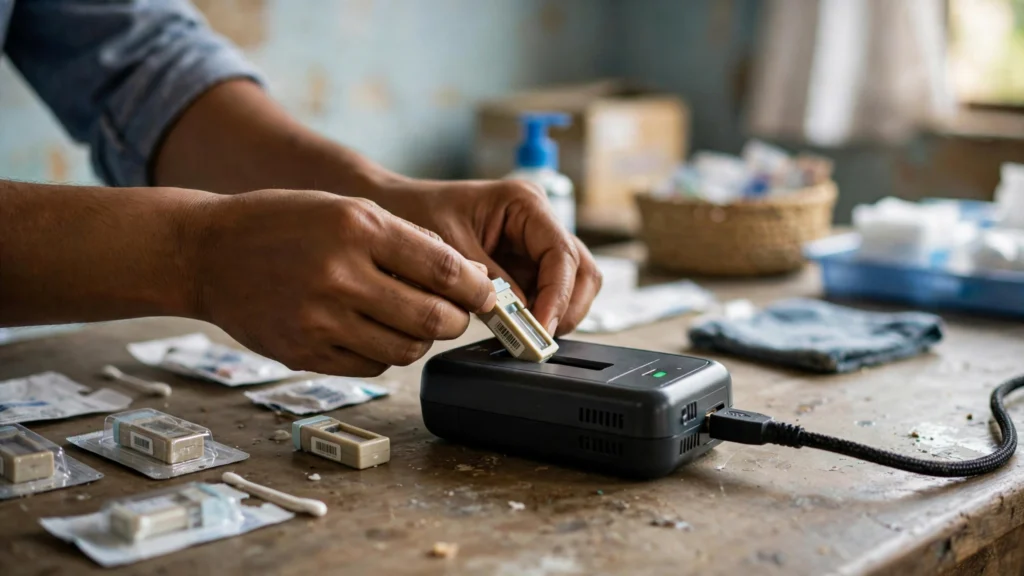
KayaCervi has three parts: a cartridge, a reader and software. A swab sample goes into the cartridge, where a membrane captures target proteins. The reader shines light on the cartridge and records the glow, and the software turns that glow into a positive or negative result. The unit measures about 6 by 12 by 3 inches and draws power from a laptop’s USB port, so it needs no wall socket.
The device checks one swab for four markers at once. Two of them, p16INK4a and Ki-67, rise when cervical cells start dividing abnormally. The other two come from HPV types 16 and 18, the virus types behind most cervical cancers worldwide. The team chose them after testing 10 candidate proteins in swab samples from 200 hospital patients at AIIMS Bhopal between April 2024 and March 2025. The community study was supportedby a Department of Health Research grant.
Why screening misses so many women
Cervical cancer grows slowly, which gives doctors time to act. Caught early, abnormal cell changes can be treated before they turn into cancer. The trouble is reaching every woman in time. A Pap smear needs a trained expert and a microscope, and the paper notes its sensitivity is only around 51 percent. HPV DNA tests need special machines, and results can take days or weeks, during which some women never return for their reports.
The gap is stark. Cervical cancer caused about 280,000 deaths worldwide in 2024, according to the World Health Organization, with low and middle income countries carrying the heaviest load. Under the WHO elimination plan, countries aim by 2030 to vaccinate 90 percent of girls, screen 70 percent of women, and treat 90 percent of those found with precancer or cancer. Testing lags most in rural regions.
What the numbers do not prove yet
The researchers are candid that this is promising field data, not a finished product. With only 10 confirmed cases, the 100 percent sensitivity figure carries wide uncertainty, and a bigger trial could shift it. The paper also reports 98 percent specificity in its detailed results but 86 to 90 percent in its abstract and conclusion, a mismatch the authors have yet to clarify. And while the paper declares no conflicts of interest, one co-author is listed as chief scientific officer of EazeBio, a disclosure question that deserves an answer. For now, any positive result would still need a follow-up laboratory test. The device is a screening tool, not a diagnosis.
What happens next
The authors call for larger multicentre studies with fixed cut-off values before the device can be trusted at scale. Those trials will show whether the reader performs as well elsewhere as it did in 36 villages in Madhya Pradesh. If it does, health workers could screen far more women each year from a village hall, without a laboratory down the road.
Frequently asked questions
What is KayaCervi? A portable, USB-powered cervical cancer screening device developed by a team led by AIIMS Bhopal. It tests a cervical swab for four biomarkers and gives a result on site.
How accurate was it in the trial? Among 801 women, it flagged all 10 cases confirmed by the laboratory test and correctly cleared 775 of 791 healthy women: 100 percent sensitivity and 98 percent specificity in that trial.
Does a positive result mean cancer? No. It is a screening tool, not a diagnosis. A positive result needs a follow-up laboratory test, and in the trial fewer than 4 in 10 positive results were confirmed cases.
Is it available at clinics now? Not yet. Larger multicentre trials are needed first, so for now it remains a promising tool under study rather than a routine clinic test.
The story of KayaCervi is still at its early chapters. But in 36 villages, a box the size of a lunch container has shown what screening could look like when the laboratory travels to the woman, instead of the other way round.