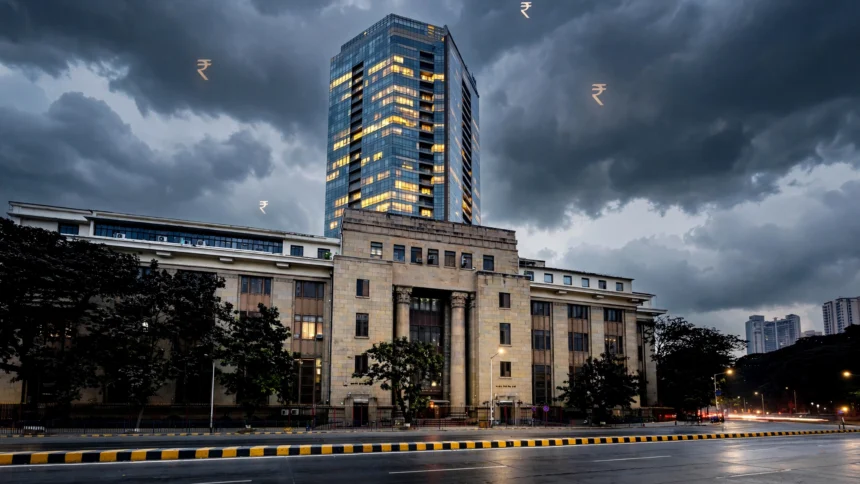
New Delhi: India’s industry has thrown its weight behind the central bank and the Finance Ministry in the battle to stabilise the rupee, even as a former Reserve Bank governor cautioned that fighting the currency’s fundamentals would ultimately prove futile.
The Associated Chambers of Commerce and Industry of India (ASSOCHAM) on Monday backed the recent coordinated measures taken by the RBI and the government to support the rupee and strengthen investor confidence, calling it the right approach to attract durable foreign capital flows.
The industry body’s endorsement comes days after the rupee staged a smart recovery of nearly two per cent from near-record lows of 96 to 97 against the dollar last week, after the RBI unveiled a package of measures to curb dollar demand and speculative bets against the currency.
What the RBI did last week
The RBI’s reported intervention package included a special dollar window for public-sector oil marketing companies, a Foreign Exchange Risk Reserve (FERR), tighter restrictions on forex derivatives, an open market operation sale and higher daily cash reserve ratio maintenance requirements for banks.
ASSOCHAM President Nirmal K. Minda said the chamber appreciated the coordinated actions of the RBI and the government to maintain macroeconomic stability amid global uncertainty. His remarks were framed as a response to former RBI Governor D. Subbarao’s recent observations that the rupee’s long-term strength would depend on attracting sustained capital flows backed by strong fundamentals.
“We fully align with Dr. Subbarao’s emphasis on durable flows based on fundamentals, and note with appreciation the steps already taken by the government and the RBI,” Minda said.
The chamber pointed to the successful completion of the $133 billion Foreign Currency Non-Resident (Bank) deposit mobilisation window, which closed on August 31, as evidence that the policy machinery was working.
Subbarao: don’t fight the fundamentals
In an interview with The Economic Times on the sidelines of the SuperReturn Middle East event in Dubai, Subbarao, who led the RBI from 2008 to 2013, argued that trying to correct the rupee to a level that does not reflect economic fundamentals through costly, distortionary short-term measures would “ultimately prove futile”.
“The RBI should allow the rupee to find its level while managing the trajectory, rather than trying to control it at a particular level, which would be distortionary and costly, and it will eventually return to its fundamental level,” he said.
The rupee will strengthen, he added, when the country attracts durable capital flows based on fundamentals rather than borrowed resources. On the $133 billion FCNR(B) inflow, he noted: “The market knows that these are borrowed resources and it is a costly proposition.”
Subbarao rejected the idea that the rupee was falling only because of current account pressures from oil prices and high import bills. That was the proximate cause, he said, but capital outflows had been a structural cause of the depreciation. He pointed to global pull factors like investment opportunities in artificial intelligence, advanced manufacturing, semiconductors and climate change, which have drawn money away from India.
Tax predictability is the real battle, say both sides
On one point, the industry body and the former governor are in complete agreement: India’s tax regime needs to become more predictable if long-term foreign capital is to stay.
Subbarao said one of the most common complaints he hears from international investors is that India is “less predictable and more arbitrary in its regulation and interpretation of tax laws”. He called for perception and reputation management, and a tax structure comparable with other major economies.
“We cannot expect investment to come to India simply because we are a fast-growing economy. Investors also want assurances, and the taxation regime is important,” he said.
ASSOCHAM echoed that view, calling for continued tax rationalisation, simpler interpretation of tax provisions and specific measures that incentivise longer-term equity investment over short-term speculative flows. The chamber welcomed the Income-tax Amendment Ordinance, 2026, which exempts foreign portfolio investor investments in government securities from taxes on interest income and capital gains with effect from April 1, 2026.
It also welcomed Finance Minister Nirmala Sitharaman’s recent indication that investor feedback on long-term capital gains tax and securities transaction tax would be factored into consultations for the 2027-28 Budget.
Growth numbers look solid, jobs don’t
ASSOCHAM’s Chief Economist S.P. Sharma said India’s macroeconomic fundamentals remained strong, citing healthy foreign exchange reserves, the RBI’s projected GDP growth of 7.1 per cent for FY27 and efforts to keep inflation under control through calibrated monetary tightening.
The RBI raised the benchmark repo rate by 25 basis points to 5.5 per cent earlier this month amid rising inflationary pressures. Wholesale price inflation rose to a 30-month high of 11.4 per cent in September under the new series, driven mainly by food and fuel.
Subbarao, however, struck a cautionary note. Monetary policy was unlikely to be effective against supply-driven inflation such as food and fuel, he said, and could be “costly in terms of lower growth”. He also said India’s 7.8 per cent growth was not translating into enough productive jobs because the gains were unevenly distributed across the economy.
“While the economy has grown, the benefits have not been widely shared,” he said. “As a result, people are not experiencing the benefits of growth as widely as they should and jobs are not being created in sufficient numbers.”
For now, the immediate focus remains the currency. The industry body said it would continue working with the government, the RBI and market regulator SEBI to strengthen India’s appeal as a destination for long-term global capital. With emerging-market currencies under pressure from a stronger dollar and elevated US yields, India’s proactive stance could become a differentiator in attracting institutional flows.
FAQs
Why did the rupee fall to record lows?
A stronger dollar, elevated US yields and capital outflows pulled the rupee to near-record lows of 96 to 97 per dollar last week, though RBI measures have since helped it recover nearly two per cent.
What measures did the RBI take to support the rupee?
A special dollar window for oil marketing companies, a Foreign Exchange Risk Reserve, tighter forex-derivative restrictions, an OMO sale and higher daily CRR maintenance requirements.
What is the $133 billion FCNR(B) window?
A special deposit scheme that mobilised about $133 billion in foreign currency non-resident deposits before closing on August 31. Former RBI governor Subbarao called such inflows “borrowed resources” and a costly proposition.
What did ASSOCHAM ask the government for?
Continued tax rationalisation, simpler interpretation of tax provisions, and measures that reward long-term equity investment over short-term speculative flows.
Will there be another repo rate hike?
The RBI raised the repo rate to 5.5 per cent earlier this month in a calibrated tightening move. Market watchers are split on whether one more hike is coming, as inflation data remains the deciding factor.
Stay with Informeia for the latest updates on the rupee, RBI policy and India’s economy.