
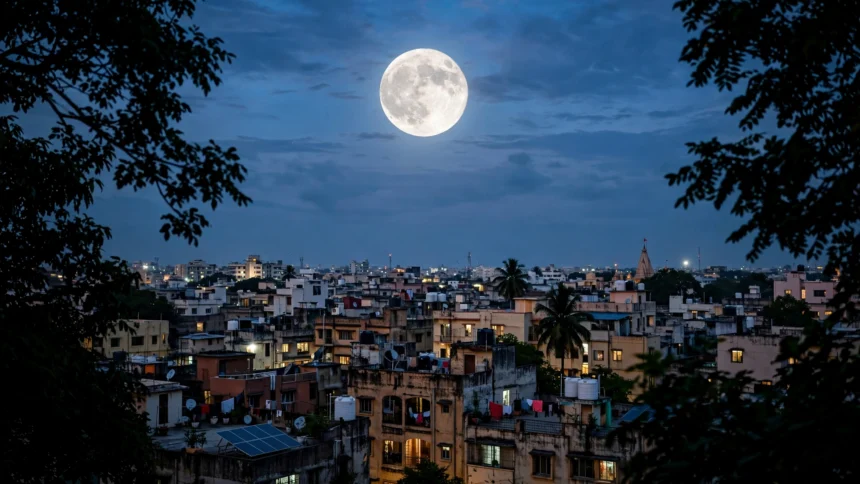
Look up tonight, because the Moon is putting on its best show of the month. The Beaver Supermoon reaches peak illumination on Tuesday, November 24, 2026, at 8:23 PM IST, and it will hang big and bright in the eastern sky right after sunset. You do not need a telescope or a trip out of town to enjoy it. A clear view of the eastern horizon is enough.
What makes tonight special is not just the full Moon itself. It arrives close to perigee, the point in its orbit where the Moon comes nearest to Earth, at about 3,60,700 km, against an average of around 3,84,400 km. That is why a supermoon looks a touch larger and shines a little brighter than an ordinary full Moon. Tonight it also keeps company with the Pleiades, the star cluster known as the Seven Sisters, which will sit remarkably close to the Moon in the constellation Taurus.
When to watch the Beaver Supermoon in India
The Moon becomes astronomically full at 14:53 UTC, which works out to 8:23 PM IST. But you do not have to wait for that exact minute. It rises in the east around sunset, in New Delhi at roughly 4:56 PM, and will already look full through the evening. The most dramatic moment is moonrise itself, when the Moon sits low on the horizon and looks larger and warmer in colour, glowing yellow-orange before it climbs higher and turns white.
For the best view, find a spot with an open eastern horizon: a rooftop, a beach, the edge of a lake, or any open ground away from tall buildings. In north India, late November haze and smog can soften the Moon’s colour and contrast, so a clear evening matters more than the exact time you step out. The Moon will look full to the naked eye on the nights of November 23, 24 and 25, so if clouds spoil tonight, tomorrow is a decent second chance.
Why it is called the Beaver Moon
November’s full Moon takes its name from an old North American tradition. This was the time of year when beavers built their winter dams before the waters froze, and when trappers set their traps before the swamps iced over.
This year the name carries an extra touch of timing for India. The supermoon rises on the same night as Guru Nanak Jayanti, which falls on Kartik Purnima, the full moon day of the month of Kartik. So while gurudwaras glow with lights and kirtans tonight, the brightest Moon of the month will be glowing above them.
The Pleiades put on a show beside the Moon
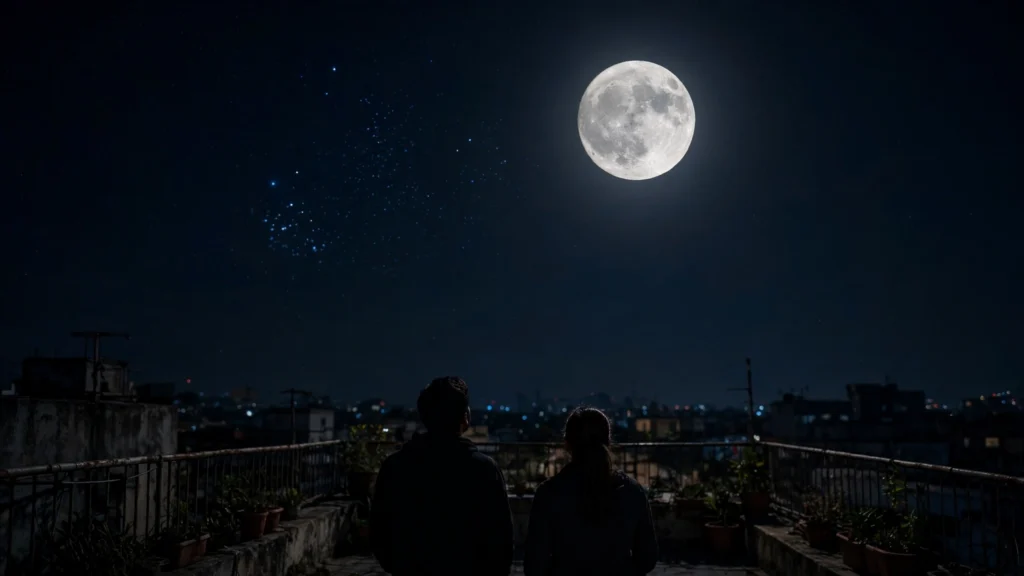
One of the night’s highlights is the Moon’s close encounter with the Pleiades. On November 24, the Moon and the Seven Sisters will appear separated by just 0.9 degrees in the sky, less than the width of two full Moons side by side.
There is a catch, though. The supermoon’s glare can wash out the fainter stars of the cluster, so spotting all seven sisters will take some effort. Look a little after moonrise, when the Moon is still low, and let your eyes adjust for a few minutes. Binoculars help if you have them: they reveal the cluster’s blue-white stars and the Moon’s craters in the same view.
How to photograph the supermoon
- Include a foreground: a building, a tree or a skyline gives the Moon scale and makes the photo far more interesting than a lone disc in a black sky.
- Do not use digital zoom alone: it softens the image. Use optical zoom if your phone has it, and tap the Moon on screen to set focus and exposure.
- Try the moonrise window: shoot in the first 20 to 30 minutes after moonrise, when the Moon looks largest.
Why it matters
A supermoon is not a rare event on its own. There are usually three or four in a year, and the next one follows on December 24. What makes tonight worth stepping outside is the combination: a supermoon at its brightest, a close pass by one of the sky’s most famous star clusters, and a full moon night that already carries meaning for millions celebrating Guru Nanak Jayanti. It is one of those evenings when astronomy and everyday life line up, and all it asks of you is a few minutes after sunset.
FAQs
What time does the Beaver Supermoon peak in India?
At 8:23 PM IST on Tuesday, November 24, 2026. It will look full through the evening and on the nights before and after.
Do I need a telescope to see the supermoon?
No. It is clearly visible to the naked eye. Binoculars help with the Pleiades cluster and lunar surface detail, but they are optional.
Why does the supermoon look bigger?
It is near perigee, its closest point to Earth, at about 3,60,700 km, against an average of about 3,84,400 km. It appears slightly larger and brighter than an average full Moon.
What are the Pleiades, and can I see them tonight?
The Pleiades, or Seven Sisters, are a bright star cluster in Taurus. Tonight they sit about 0.9 degrees from the Moon, though the Moon’s glare may hide the fainter stars.
When is the next supermoon?
The next supermoon follows on December 24, 2026, exactly a month after tonight’s.
Step outside after sunset tonight and look east. It will not disappoint.