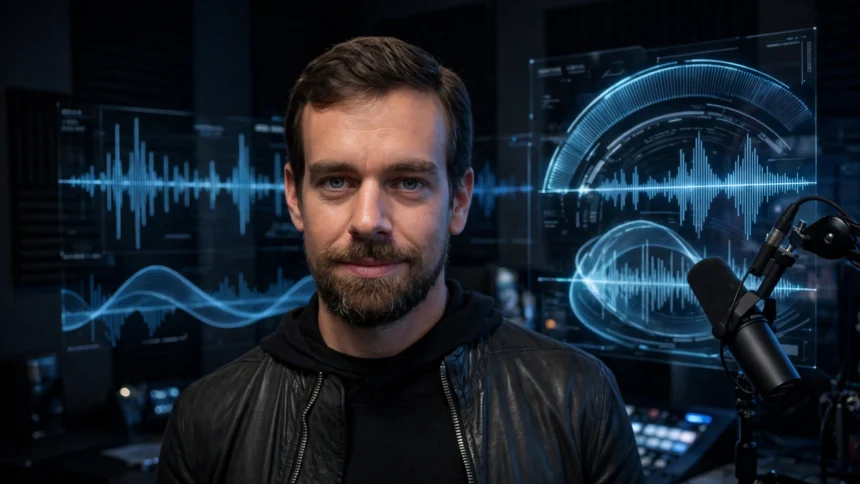
Jack Dorsey has never been shy about big bets. The Twitter co-founder has now put his fintech company Block behind an AI that does not type, does not read, and does not transcribe. It just talks. Block unveiled Dessa on October 23, a voice model the company calls the most authentic full-duplex speech model ever built. In plain words, Dessa listens and speaks at the same time, the way people do in a real conversation. Dorsey announced it himself on X, writing that talking with it feels like talking with a person, full of emotion, nuance, pauses, and a natural cadence. It is an audacious claim, and the AI world is paying attention.
What “full-duplex” actually means
Every voice assistant you have used works in steps. You speak, the assistant converts your speech into text, sends that text to a language model, gets an answer, and converts the answer back into speech. It works, but it is slow, and it throws away most of what makes speech human: the pauses, the laughs, the tone, the interruptions. Dessa skips all of that. It is a single model that takes in sound and puts out sound, doing both at once. You can interrupt it, laugh mid-sentence, or murmur a quick yes, and it reacts the way a person would. There is no text anywhere in the loop.
Trained the way babies learn
The most radical part is how Dessa was built. According to Block, the model was trained from scratch on nothing but real human conversations. There was no text data and no pretrained model underneath. Dessa learned language by listening, the way a child does. The Dessa team’s own description puts it simply: babies learn to talk without ever seeing a word written down, and the team wanted to see if a model could too. It can, they say, though it is very hard. The training ran on a single NVIDIA GB200 NVL72 rack. That is serious computing power, but it is tiny compared with the giant clusters used to train frontier text models.
Small enough for a laptop
Here is the part that has engineers talking. Dessa runs locally on a MacBook Pro with an M4 Max chip or better, and Block claims inference runs faster than real time, with no latency. Voice AI that can hold a natural conversation without leaning on a data centre is a genuine shift. It hints at a future where talking AI lives on your own devices, private and instant, rather than in someone else’s cloud.
The demos: brilliant, then strange
Block has released recorded demos, and they are the only evidence of Dessa’s abilities so far. Some exchanges sound startlingly natural. In one, Dessa discusses Christopher Nolan’s films with a human speaker, though it suddenly detours into Bryan Singer’s Superman films. In another, a person describes a surprise trip to Paris, and Dessa responds with what sounds like teary gratitude. The team also shared Dessa playing a voice-based guessing game, and holding a conversation with OpenAI’s GPT-Live-1 voice model, where Dessa comes across as the more natural of the two. Not everything lands. In one clip, Dessa initially mistakes its human speaker for someone named Ronaldo. Project lead Ragavan Thurairatnam has called Dessa the GPT-3 moment for voice.
Why the team says this matters
Beyond the demos, the Dessa team frames the project as a safety story. Today’s voice AI, they argue, wastes the medium: it flattens everything said into text and cannot keep up with human timing. Most powerful AI models cannot hear how a user feels, the company claims, and that is potentially dangerous. Imagine being in serious pain while a voice AI has no idea and just keeps going. Dessa, built out of curiosity and a search for better understanding between humans and AI, is presented as a step toward fixing that.
What happens next
For now, Dessa is a research preview behind a waitlist. Block has published no parameter count, no API, no pricing, no model weights, and no formal evaluations. Early access is going to a small group of AI safety researchers. That is deliberate. The company wants to study how a model that sounds this human behaves in the wild before giving it to everyone. If the demos are anything to go by, the waitlist will be long.
Frequently Asked Questions
What is Dessa?
Dessa is Block’s full-duplex speech-to-speech AI model, unveiled by Jack Dorsey on October 23, 2026. It talks and listens at the same time, without converting speech into text.
How is Dessa different from Siri or Alexa?
Traditional assistants transcribe speech to text first and work in steps. Dessa processes audio directly, so it can be interrupted and can react to pauses, tone, and emotion mid-conversation.
Can I try Dessa now?
Not yet. It is in research preview behind a public waitlist, with early access for a small group of AI safety researchers.
What hardware does Dessa need?
Block says it runs locally on a MacBook Pro M4 Max or better, at faster-than-real-time speed, with no cloud needed for inference.
Who built Dessa?
A small AI research lab at Block, the company behind Square and Cash App, led by Ragavan Thurairatnam and reporting to Jack Dorsey.
Voice AI just found its voice. Whether Dessa lives up to the hype will depend on what it does outside the demo room. We will be watching.