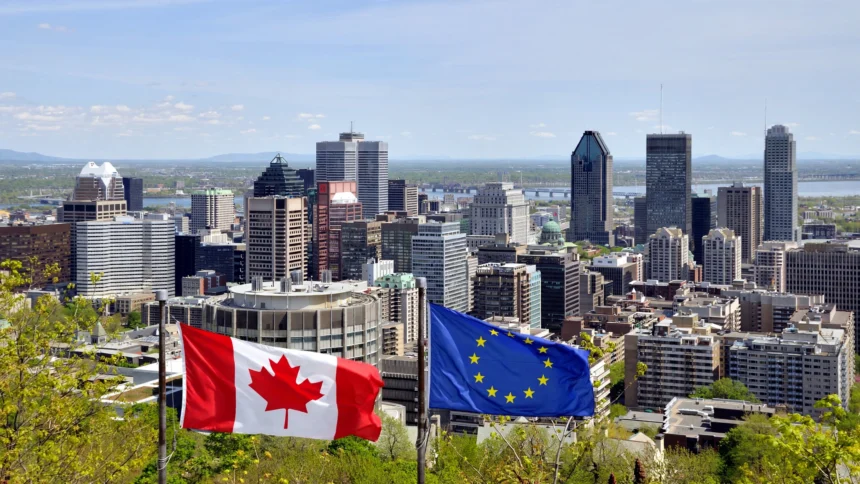
Montreal set the stage on October 30 for one of the clearest shifts in Western diplomacy in recent years, as Canada and the European Union formally launched a new partnership they are calling the Alliance for the Future. After two days of talks, Canadian Prime Minister Mark Carney hosted European Commission President Ursula von der Leyen and European Council President Antonio Costa for a summit that produced more than 20 measures, a digital trade deal, and a major new commitment on Ukraine.
The headline for Kyiv came quickly. Canada agreed to join the European Union’s 90 billion euro support loan for Ukraine, with an initial contribution of 500 million euros. The loan is designed to help bridge Ukraine’s budget gap in 2027, a year when Kyiv still expects a shortfall of tens of billions of euros even after money already promised by the EU is taken into account. Canadian officials also said participation in the mechanism would let Ukraine buy military equipment from Canadian defence companies using EU funds.
For Ottawa and Brussels, the summit was about much more than one loan. Both sides want a partnership that can withstand trade shocks and supply chain pressure. Von der Leyen stressed the alliance was not against anyone else, but for common strength.
What the Alliance for the Future actually covers
The alliance is deliberately broad, covering six areas: trade and regulatory cooperation, digital and research technology, critical resources and energy, financial services, security and preparedness, and people-to-people ties. That breadth is the point. Instead of a single trade deal, Canada and the EU are trying to align policies in the areas that now decide economic security, from minerals and semiconductors to artificial intelligence, energy, vaccines, and space communications.
Two concrete deals show how that will work. The first is a digital trade agreement, aimed at making online trade faster and cheaper. The second allows the European Investment Bank to back Canadian critical mineral projects, which could unlock the investment Canada needs to turn its mineral reserves into working mines.
AI, satellites, and a new kind of membership
Artificial intelligence was the other big thread running through the summit. Both Canada and Europe are playing catch-up with the United States and China in AI, and both sides agreed to deepen cooperation on AI infrastructure, safety, and regulation. Europe said it was ready to open its supercomputing infrastructure to Canadian researchers, industry, and start-ups.
The timing was notable. Just a day before the summit closed, Ottawa announced a 1.6 billion Canadian dollar investment in the Canadian AI firm Cohere, which recently partnered with Germany’s Aleph Alpha. Carney pointed to that partnership as an example of what Europe and Canada could build together. Cooperation will also extend to satellite connectivity and navigation, quantum technology, and energy, and the two sides discussed Canadian participation in EU programmes such as the Erasmus student exchange scheme and the Galileo satellite navigation system.
One phrase has already sparked debate: associate member. Von der Leyen has said Canada would become the EU’s first associate member, the closest possible partnership short of full membership. The term has no legal basis in EU treaties, and some member states, including Germany, have opposed it. Even so, Brussels argues it captures policy alignment and participation in selected EU programmes beyond a standard free trade agreement.
Why this is happening now
Canada and the EU already share a free trade agreement, but both sides have sought closer ties since Donald Trump’s return to the White House upended relations with Washington’s traditional allies. US tariffs have hit key Canadian sectors, while trade pressure has rattled European capitals as well. Trump has dismissed the idea of closer EU-Canada ties, but that reaction has only underlined why Ottawa and Brussels see value in building options beyond Washington.
The alliance is also designed to stay open. Von der Leyen described Canada and the EU as the nucleus of a larger Alliance for the Future, open to other trusted partners such as Japan, South Korea, and Australia. Alongside Canada’s initial 500 million euros for Ukraine, Norway pledged 9 billion dollars for 2027 earlier in October, and Britain announced a 13 billion dollar pledge on October 28, its largest ever. What happens next will test whether Montreal was a turning point or just a well-staged summit, but the signal is unmistakable: two old partners have decided that in an uncertain world, they would rather face shocks together.
FAQs
What is the Alliance for the Future?
It is the new Canada-EU partnership launched in Montreal on October 30, 2026, covering trade, digital technology, critical minerals, energy, security, and people-to-people ties, with more than 20 measures agreed.
How much is Canada contributing to the Ukraine loan?
Canada will make an initial contribution of 500 million euros to the EU’s 90 billion euro Ukraine support loan, with further direct support possible later.
What deals were signed at the Montreal summit?
A digital trade deal and a pact allowing the European Investment Bank to back Canadian critical mineral projects, alongside wider cooperation on AI, satellites, and quantum technology.
Is Canada joining the European Union?
No. Associate member is a political term used by EU leaders to describe the closest possible partnership short of full membership. It has no legal basis in EU treaties and is contested by some member states.