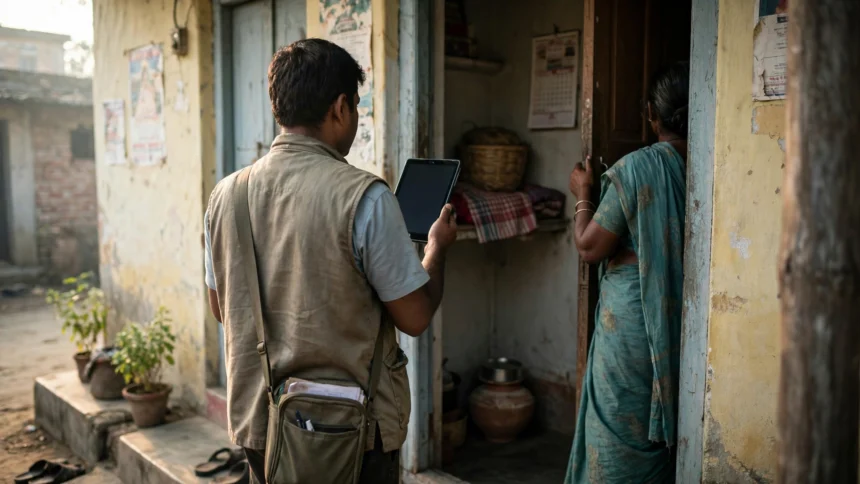
India’s first digital Census has run into its first big argument over a question that looks simple on paper: what is your religion? The self-enumeration portal for Census 2027 went live on Monday, November 16, for four states, and within hours a drop-down list under the “Others” religion category had set off a row that is still growing. The government has now replaced it with a much shorter set of predictive text suggestions, dropping more than 200 entries.
For a count that will shape policy and representation for the next decade, the way the question is asked matters as much as the answers it collects.
What happened on the portal
The population enumeration phase of Census 2027 opened its self-enumeration portal on November 16, 2026, for four states that go to the polls in 2027: Uttar Pradesh, Uttarakhand, Goa and Punjab. For the first time, households can fill in their Census form online before an enumerator visits to verify it. The portal opens for the rest of the country in January 2027.
The religion question lists seven broad categories: Hindu, Muslim, Christian, Sikh, Buddhist, Jain and “Others”. On the first day, choosing “Others” brought up a drop-down menu with at least 287 entries, including ISKCON, Ramkrishna Paramhans, Sanatan, Ramdev, Gorak Nath, Shia, Sunni, Bishnoi, Vaishnaw, Sarna, Methodist and Pentecostal. Several of these are sects or devotional identities that earlier Censuses had counted within the six major religions, while some had never been recorded as separate entries before.
The drop-down was removed within hours of The Hindu sending a query to the Union Home Ministry. A government official told the newspaper the list had been prepared as predictive text entries to help avoid spelling variations, and that how the entries appeared as a drop-down box was being inquired into. The Registrar General and Census Commissioner of India (RG&CCI) said the “Others” category still allows a respondent to write any other religion, as in previous Censuses.
76 entries remain, over 200 dropped
An examination of the portal this week shows the change. The “Other” religions list now appears as predictive text suggestions rather than a drop-down menu, and it contains just 76 entries. More than 200 entries visible on November 16 have been removed, including Satguru, Ramdev, ISKCON, Ramkrishna Paramhans, Gorak Nath, Sanatan, Bishnoi, Vaishnaw, Shia and Sunni.
Nearly all of the 76 entries that remain were already recorded in the 2011 Census data on what people wrote as their faith under the “Other” column. Five entries in the new list, however, do not feature in the 2011 or 2001 Census tables for “Other religions and persuasions”. The category itself is small, under 1 percent of the population in 2011, but it is also one of the most sensitive parts of the count, because it is where smaller faiths, sects and tribal religions are recorded.
Opposition leaders and the All India Other Backward Classes Students’ Association raised concerns on Tuesday, November 17. Some outlets argue the 287 names were never meant as official recognition of 287 separate religions, only as spelling suggestions. The government maintains the seven broad options are unchanged and no new religion has been officially recognised.
Why it matters
The row is about more than a software menu. Census data on religion feeds into welfare targeting and the drawing of political boundaries, and the classification choices made now will be locked into the record for years. A drop-down list, even an unintended one, nudges people towards the options it shows and away from the ones it does not. Free text lets people describe their faith in their own words, but it produces spelling variations that are harder to tabulate. That is the tension the RG&CCI was trying to manage with predictive text: fewer spelling errors, but a list that still shapes what people pick.
The episode also exposes the risks of digitising a sensitive question at national scale. In earlier Censuses, an enumerator wrote down what a household said. In Census 2027, a screen suggests the answer before the household finishes typing it. When the suggestion list quietly changes from 287 entries to 76, the data changes with it, and the public only finds out because a newspaper asked.
There is a practical angle too. The self-enumeration window is short, and the four states where the portal is live are all heading into elections in 2027. Any confusion about how faith is recorded there will be read politically, whatever the technical explanation. Publishing the full list of 76 suggestions would cost the government little and would settle much of the argument.
What happens next
- January 2027: the self-enumeration portal opens for the rest of the country, after its trial run in the four poll-bound states.
- March 1, 2027: the Census reference date, 00:00 hours, for most of the country; October 1, 2026, for Ladakh and snow-bound areas.
- House-to-house phase: enumerators will visit households to verify the self-enumerated details, and how they handle the “Others” column in person will matter as much as the portal’s design.
- The list to watch: whether the 76 entries stay, whether the RG&CCI publishes the reasoning behind them, and whether any faith groups ask for names to be added or removed.
Census 2027 is the largest administrative exercise India undertakes, and its credibility rests on millions of small interactions like this one: a person, a screen, and a question about who they are.
FAQs
What is the Census 2027 religion row about?
The portal briefly showed a 287-entry drop-down under “Others” on November 16. It was removed the same day, and now shows 76 entries as predictive text suggestions.
Can people still write any religion they want?
Yes, according to the Registrar General and Census Commissioner of India. The “Others” category allows a respondent to write any other religion, as in previous Censuses. The 76 entries are suggestions, not a closed list.
Which states can self-enumerate now?
Uttar Pradesh, Uttarakhand, Goa and Punjab. The portal opens for the rest of the country in January 2027.
When is Census 2027 counted?
The reference date is 00:00 hours on March 1, 2027, for most of the country; October 1, 2026, for Ladakh and snow-bound areas of Jammu and Kashmir, Himachal Pradesh and Uttarakhand.
Why does the “Other religions” category matter if it is under 1 percent?
It is where smaller faiths, sects and tribal religions are recorded. Even a small category shapes how religious diversity is measured, and classification choices feed into policy and representation for years.
Census 2027 is India’s first digital Census. The self-enumeration portal is live at se.census.gov.in for the four states named above.