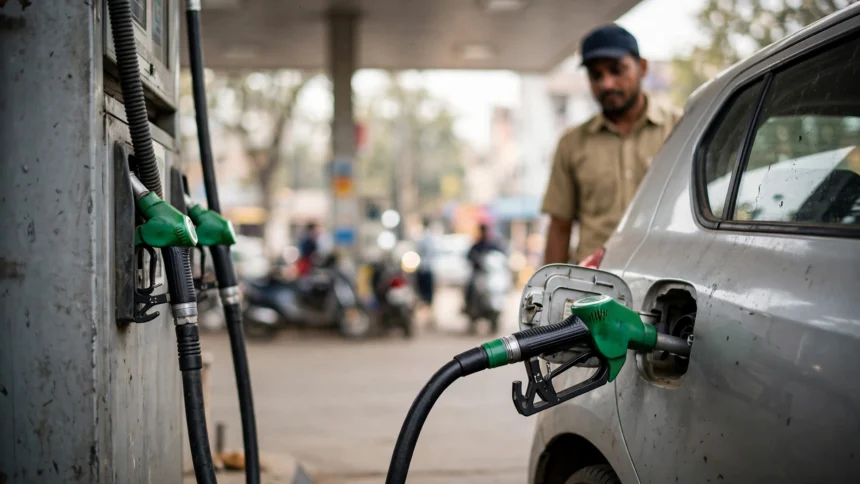
The Centre has pushed back firmly against claims that petrol sold in Karnataka contains far more ethanol than allowed, saying a nationwide quality check of 893 samples found every one of them within the prescribed limit. The statement, issued by the Ministry of Petroleum and Natural Gas on Saturday, 7 November, turns a state-versus-Centre testing dispute into a test of how fuel quality is actually measured in India.
Karnataka’s Department of Food, Civil Supplies, Consumer Affairs and Legal Metrology had said in a press release that petrol collected from certain retail outlets in the state contained between 26 per cent and 31 per cent ethanol. That is well above the 20 per cent nominal blend sold as E20 petrol across the country.
What the nationwide check found
The ministry said the three public sector oil marketing companies, Indian Oil Corporation, Bharat Petroleum Corporation and Hindustan Petroleum Corporation, had tested 893 E20 samples drawn from depots and retail outlets across 27 states and Union Territories. The exercise was run by the OMC and Centre for High Technology Quality Coordination Cell, and the samples were tested under IS 17021, Annex C, at refinery and oil company quality control laboratories.
All 893 samples were found to contain ethanol within the prescribed 19 to 21 per cent range. The sample split was 330 from Indian Oil, 280 from Bharat Petroleum and 283 from Hindustan Petroleum.
Karnataka was covered in the same exercise. All 56 samples tested in the state, drawn from different locations and covering all three oil companies, complied with the specifications, recording ethanol content between 19 per cent and 20 per cent, with an average of 19.30 per cent. That directly contradicts the state government’s reported findings of 26 to 31 per cent blending.
Why the two sides disagree
The oil companies have not simply disputed the numbers. They have questioned the sampling and testing methodology behind Karnataka’s October 2026 exercise. According to the ministry, the samples in that exercise were drawn without the participation of oil company representatives, and the reported findings rely on certificates from a third-party laboratory rather than testing at a laboratory specified under the Control Order.
The Motor Spirit and High Speed Diesel (Regulation of Supply, Distribution and Prevention of Malpractices) Order, 2005, issued under the Essential Commodities Act, 1955, read with the Marketing Discipline Guidelines 2024, lays down the procedures for collecting, retaining, testing and communicating fuel quality results. The oil companies say the reported certificates did not contain the complete technical details required to validate the ethanol figures under the prescribed procedures.
Under IS 17021:2018, including Amendment No. 3 issued in August 2025, ethanol content in E20 fuel must be determined through prescribed methods: Fourier Transform Infrared Spectroscopy under ASTM D5845, water extraction under Annex C, or gas chromatography under ASTM D4815 or D6839. The ministry has sought joint verification of the disputed samples, so the two sets of figures remain attributed to their respective sources until that process is complete.
What E20 means for motorists
Ethanol blending is meant to cut crude oil imports, reduce emissions and give sugarcane and grain farmers an additional market, and India reached the 20 per cent blending target ahead of schedule.
For vehicle owners, the practical question is whether the fuel in the tank matches the specification. The ministry’s statement is meant to reassure them that it does, at least according to the oil companies’ own quality monitoring. The dispute also underlines why testing procedure matters as much as the result: a sample collected outside the prescribed process, or tested at a laboratory that is not authorised under the Control Order, can produce a figure that the other side will not accept.
Until joint verification is done, motorists in Karnataka and elsewhere have two conflicting accounts of the same fuel. What is not in dispute is the scale of the Centre’s check: 893 samples, 27 states and Union Territories, and a reported compliance rate of 100 per cent against the 19 to 21 per cent band.
FAQs
What is E20 petrol?
E20 is petrol blended with a nominal 20 per cent ethanol by volume. It is the standard petrol blend sold across India.
What ethanol range is allowed in E20?
The Bureau of Indian Standards specification IS 17021 prescribes an ethanol content of 19 to 21 per cent.
What did Karnataka claim?
Karnataka’s food and civil supplies department said petrol at certain outlets in the state contained 26 to 31 per cent ethanol, based on its October 2026 exercise.
What did the Centre’s check find?
The oil companies tested 893 E20 samples from 27 states and Union Territories and found all of them within 19 to 21 per cent. The 56 Karnataka samples averaged 19.30 per cent ethanol.
Why do the two sides disagree?
The oil companies say Karnataka’s samples were drawn without their representatives present and tested at a laboratory not specified under the Control Order, so the results cannot be validated under the prescribed procedures. Joint verification of the disputed samples has been sought.
The dispute now moves to joint verification. For now, the Centre’s message to motorists is clear: the fuel on sale meets the standard.