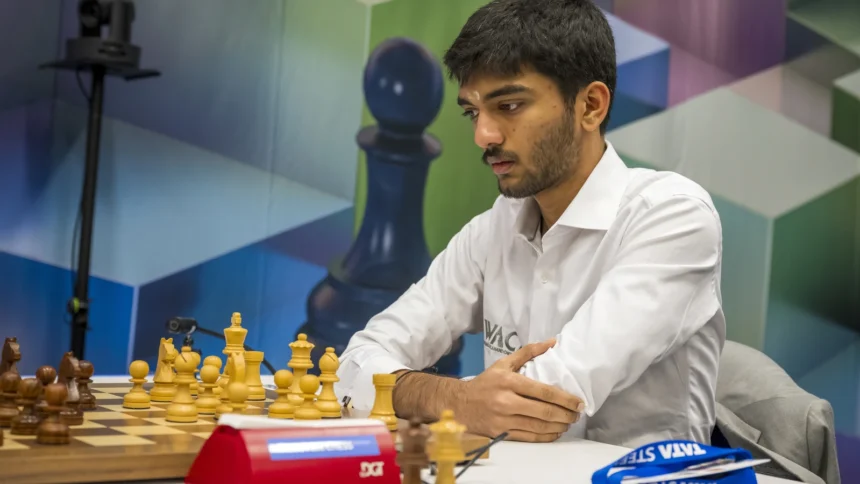
Defending champion D Gukesh opened his World Chess Championship title defence with a hard-fought draw against challenger Javokhir Sindarov in Geneva on Tuesday, surviving serious time trouble with Black to keep the 14-game match level at 0.5-0.5 after 38 moves.
The opening game at the Fondation Martin Bodmer in Cologny, near Geneva, was the first contest of the youngest World Championship match in history. Both players are 20, and the chess world had spent weeks debating whether the out-of-form champion could hold off a challenger unbeaten in 69 classical games.
For one tense evening, Gukesh had the answers.
A surprise opening, then a race against the clock
Sindarov, playing White, opened with 1.e4, and Gukesh answered with the Berlin Defence, an opening he rarely employs. It was a deliberate surprise: the Berlin is famously solid, the same system Vladimir Kramnik used to dethrone Garry Kasparov in 2000, and Gukesh had played it only four times before. All four ended in draws.
Sindarov, though, was ready. The Uzbek blitzed out his preparation and uncorked a novelty on move 13, Ne4, which forced Gukesh into a long think. By move 17 he had burned 36 minutes and 14 seconds on a single move, leaving himself less than 29 minutes for the next 23 moves before the first time control. But the time was not wasted. When Sindarov sacrificed a pawn to stir complications in the queenless middlegame, Gukesh found the accurate replies and his play sped up as the critical lines came into focus.
The draw claim that gave Gukesh an extra minute
The game ended in a threefold repetition, but not before a small piece of theatre. Sindarov tried to claim the draw one move too early, and the arbiter ruled the claim invalid, awarding Gukesh an extra minute. The challenger made the valid claim on the next cycle, and the players shook hands with the score level.
Observers noted a psychological edge for the champion in that exchange. Gukesh, who could have claimed the draw himself at one stage, kept the game going and made Sindarov ask for it twice. After the game, Gukesh said the real work in a match like this lies in preparation. Sindarov felt he had put the champion under pressure but acknowledged that Gukesh defended accurately.
A champion under pressure, a challenger in form
The draw will come as a relief to Gukesh, who has endured a difficult 12 months since winning the title. In 54 classical games over that period he managed just 13 wins against 16 defeats, a run that dragged his rating down to world No. 26. He has won no individual trophy since beating Ding Liren in 2024 to become, at 18, the youngest undisputed world champion in history.
Sindarov, by contrast, arrived in Geneva on a remarkable run. His unbeaten streak of 69 classical games included the FIDE World Cup, the Candidates tournament and Olympiad gold with Uzbekistan, and several leading voices, including Magnus Carlsen, had backed the challenger before the match began.
That is what made Game 1 matter beyond its result. A draw with Black does not win a match, but for a champion who has spent a year being doubted, it was a first, public stand. Gukesh did not collapse, and he left the venue looking more confident than when he arrived.
Why it matters
This match is about more than a title. Gukesh’s 2024 triumph made him the face of a new generation of Indian chess, and a successful defence would confirm that his Singapore win was the start of an era rather than a one-off. A loss would hand the crown to a 20-year-old rival.
For Indian chess, the stakes are just as real. The country now produces world-class players at a pace no other nation matches, and a second straight Indian world champion would underline that depth. The match is 14 classical games, first to 7.5 points, with tie-breaks if the scores are level. The prize fund is USD 2.5 million, with each win worth USD 200,000. And Sindarov turns 21 on 8 December, the day Game 12 is scheduled, so he could theoretically claim the title on his birthday.
What happens next
Game 2 takes place on Wednesday, with Gukesh playing White for the first time in the match. The players will contest two more games over the next two days before the first rest day, after which a rest day follows every three games. The champion will look to use White to take the initiative, while Sindarov will want to show that his preparation and form can still break through.
Thirteen games remain, and on the evidence of the first one, this will be a long, tense fight.
FAQs
What was the result of Game 1?
Gukesh and Sindarov drew in 38 moves at Geneva, leaving the match level at 0.5-0.5.
Where is the match being played?
At the Fondation Martin Bodmer in Cologny, near Geneva, Switzerland.
How many games are in the match?
14 classical games. The first player to reach 7.5 points wins the title, with tie-breaks if the scores are level.
When is Game 2?
On Wednesday, 25 November, with Gukesh playing the White pieces.
What is the prize fund?
USD 2.5 million in total, with each win worth USD 200,000 and the rest shared equally.
Gukesh has made his first stand in Geneva. The next thirteen games will decide whether he keeps his crown.