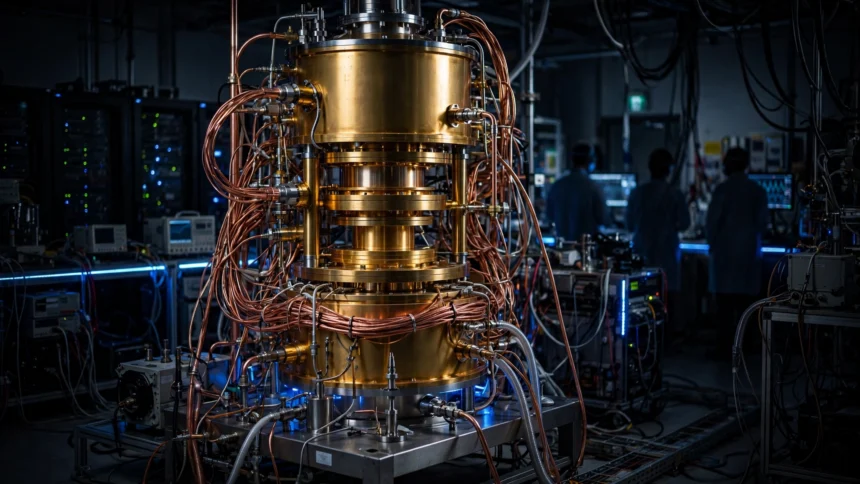
Bengaluru has added another milestone to its claim as India’s research capital. The Indian Institute of Science (IISc) and Samsung Semiconductor India Research (SSIR) on Thursday inaugurated a new Quantum Research Lab on the IISc campus, a facility that will chase one of the hardest problems in modern science: building reliable quantum hardware that works outside a handful of elite labs.
The lab comes at a moment when quantum technology is shifting from academic curiosity to strategic priority. India launched its National Quantum Mission with a budget of over Rs 6,000 crore, and every major tech power is racing to own the chips that could one day crack encryption and model molecules far beyond the reach of today’s machines. For India, the missing link has long been physical infrastructure: the ultra-cold, vibration-free environments where quantum devices actually get built and tested. This lab is meant to close that gap.
What the new lab will actually do
The facility, funded through Samsung’s corporate social responsibility programme, is built around four pillars.
First, qubit characterisation. Qubits, the basic units of quantum information, are famously fragile. They lose their quantum state at the slightest disturbance, a problem called decoherence. Before anyone can build a working quantum computer, researchers must measure, understand and tame this behaviour. The lab will give Indian researchers hands-on access to the instruments needed for that painstaking work.
Second, cryogenic electronics. Quantum devices typically operate at temperatures close to absolute zero, colder than deep space. The electronics that control and read out qubits must survive and function in that environment. Designing such electronics is a discipline of its own, and the lab will focus on building domestic capability in it.
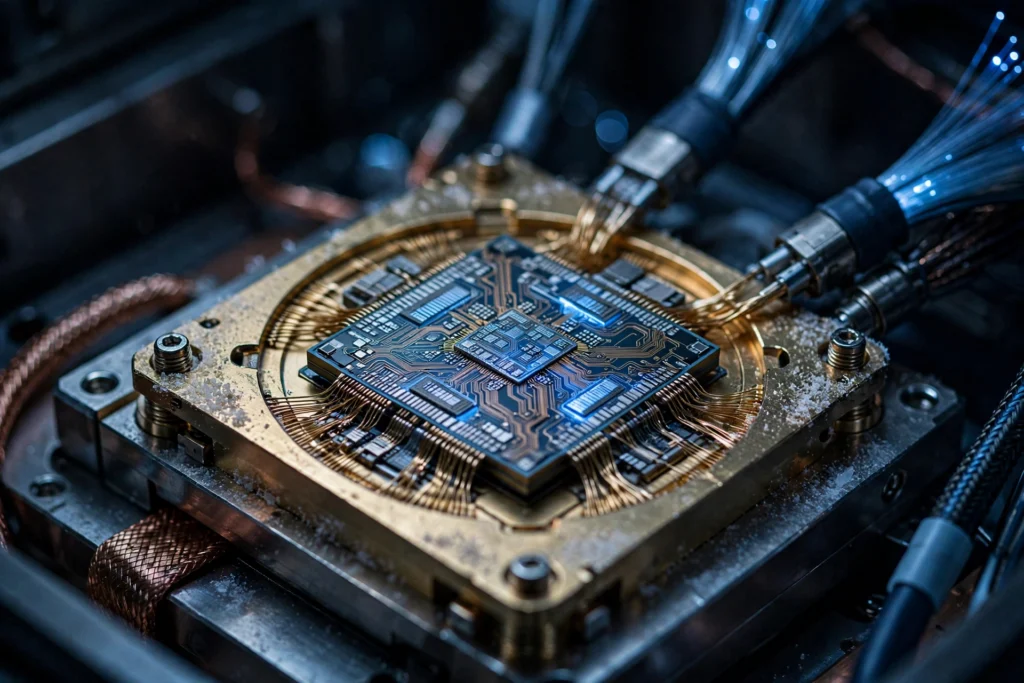
Third, single-photon sources and detectors. Individual particles of light can carry quantum information, making them central to quantum communication and ultra-secure cryptography. Reliable single-photon detectors are among the most in-demand components in the field, and Indian researchers have had limited access to fabrication and testing facilities for them.
Fourth, two-dimensional materials. Materials a single atom thick, such as graphene, behave very differently from their bulk counterparts and could become building blocks of future quantum devices. The lab will explore 2D-material-based devices under cryogenic conditions, a frontier with relatively few established players worldwide.
Opening elite equipment to more researchers
One of the most notable features is the access model. Specialised quantum equipment is expensive to buy and operate, which usually confines it to a small number of well-funded institutions. This lab has been designed to share that infrastructure more widely, giving students and researchers beyond IISc structured training and research exposure.
The partnership also links to the India Semiconductor Workforce Development Program (ISWDP), which addresses skill gaps in device physics, process development, modelling, simulation, characterisation and reliability. Selected training modules will cover quantum materials, cryogenic electronics and qubit technologies.
Prof Mayank Shrivastava, chair of IISc’s Department of Electronic Systems Engineering and the lead for both initiatives, said the goal was to build capability spanning semiconductor education and advanced research, from classroom workflows to 2D-material-based quantum devices like qubits and single-photon detectors.
Why this matters for India’s quantum ambitions
The inauguration lands in a busy week for Indian quantum research. The Manipal Academy’s quantum hub, featuring a 25-qubit system, also began operations this week, and the national mission’s timelines have researchers racing to demonstrate working prototypes. Talent, not just money, is the bottleneck. Quantum hardware engineers are in short supply globally, and countries that train them first will attract the industry partnerships that follow.
What to watch next
- Early research output: Peer-reviewed papers and device demonstrations from the lab over the next 12 to 18 months will show how quickly the facility ramps up.
- Student access numbers: The open-infrastructure promise will be tested by how many researchers from outside IISc actually get time on the equipment.
- Industry partnerships: Whether the lab’s work feeds into Samsung’s own product roadmap or remains purely academic research.
- ISWDP module rollout: The quantum-focused training modules under the workforce programme could become a pipeline of hardware engineers for India’s chip mission.
FAQs
What is the IISc-Samsung Quantum Research Lab?
It is a new research facility at the Indian Institute of Science in Bengaluru, inaugurated this week by IISc and Samsung Semiconductor India Research. It focuses on quantum devices, cryogenic electronics, qubit characterisation and single-photon detectors.
Why is quantum research important for India?
Quantum technologies could transform computing, secure communication and sensing. India is investing over Rs 6,000 crore through its National Quantum Mission, and domestic hardware infrastructure is essential to compete with the US and China.
What are qubits and why are they hard to build?
Qubits are the quantum equivalent of computer bits, but they can exist in multiple states at once. They are extremely fragile and lose their quantum properties with tiny disturbances, so building stable qubits requires ultra-cold, highly controlled environments.
Who will use the new lab?
The lab is designed to serve IISc researchers and, through structured training programmes, students and researchers from other institutions who lack access to such specialised equipment.
Is this linked to India’s semiconductor mission?
Yes. The partnership connects to the India Semiconductor Workforce Development Program, which trains engineers in device physics, chip modelling and characterisation, now extended to quantum materials and devices.
For Informeia readers tracking India’s deep-tech story, quantum hardware is a decade-long race, and the labs starting now will own the breakthroughs of the 2030s.