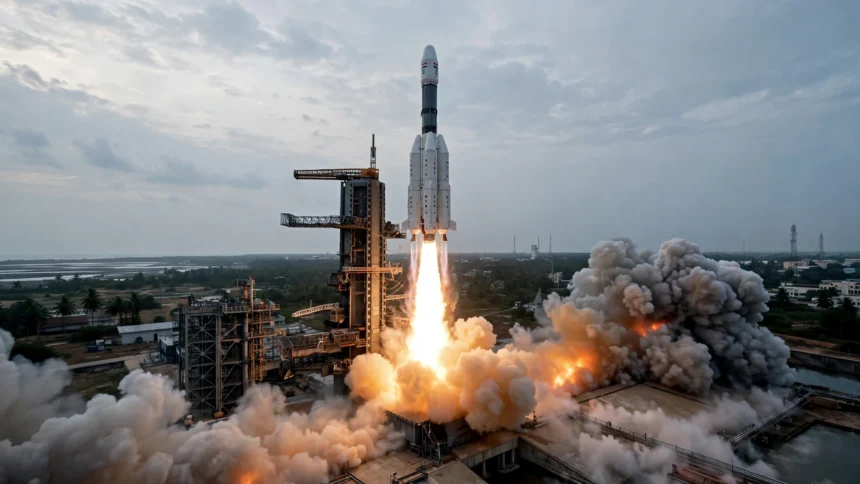
India is five days away from a launch that could quietly fix something millions of people use every day: knowing exactly where they are. ISRO is set to launch its NVS-03 navigation satellite on October 30, 2026, from the Satish Dhawan Space Centre at Sriharikota, on board a GSLV Mk II rocket. If it goes as planned, it will restore something NavIC, India’s own navigation system, has been missing: enough working satellites to stand on its own.
That may sound like a technical detail. It is not. NavIC is meant to give India an independent alternative to foreign navigation networks, for everything from a taxi finding your lane to power grids keeping perfect time. Right now, it cannot quite do that job alone.
Why this launch matters so much
A navigation system needs at least four satellites in view at the same time to work out a full three-dimensional position on its own. By the government’s own account earlier this year, NavIC had only three satellites available for positioning services. One more healthy satellite in the right orbit, and the constellation crosses back over the threshold it needs.
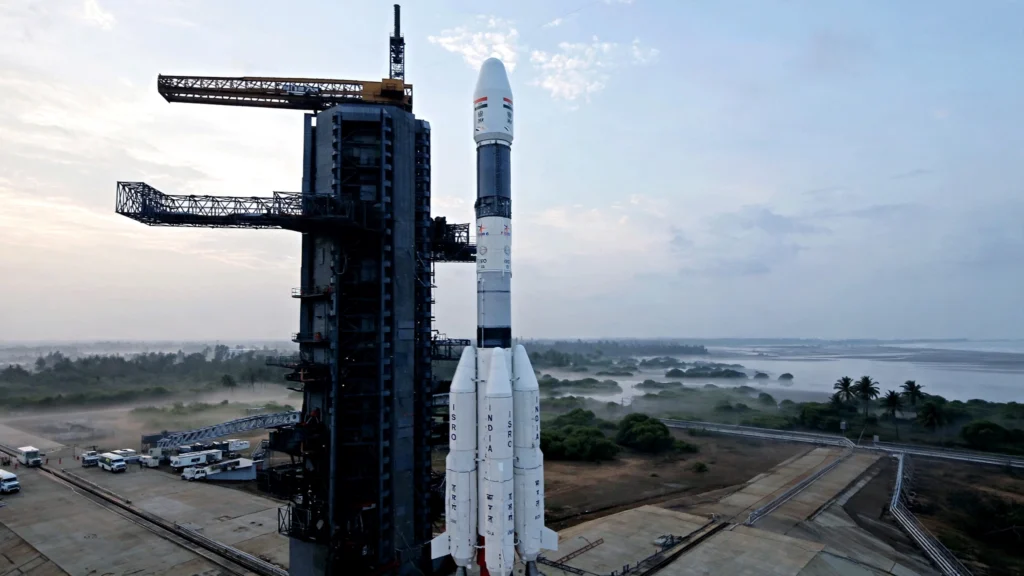
ISRO Chairman Dr V Narayanan has indicated that the October 30 attempt has been cleared, after the mission was tentatively slotted for mid-October. The satellite reached Sriharikota months ago and has been waiting for its window. The successful GSLV Mk II flight that carried the EOS-05 earth observation satellite on September 4 helped clear the path.
The mission, designated GSLV-F18, is also a statement of intent after a difficult stretch. ISRO has taken a deliberately cautious approach to launches in recent months, working through anomalies rather than rushing back to the pad. That caution has had knock-on effects elsewhere, with the first uncrewed test flight of the Gaganyaan human spaceflight programme now expected in late 2026 or early 2027 rather than the middle of this year.
What NVS-03 actually carries
NVS-03 is the third satellite in the second generation of the NavIC series. It weighs 2,232 kg and is designed for a mission life of 12 years, covering India and about 1,500 km beyond its borders.
Every navigation satellite lives or dies by the precision of its atomic clock, the instrument that stamps each signal with an exact time. Earlier NavIC satellites ran into trouble with imported atomic clocks, and clock failures were part of why the constellation weakened. NVS-03 carries an indigenous rubidium atomic clock developed at the Space Applications Centre in Ahmedabad, removing a dependency that had become a weak link.
What changes for ordinary phone users
For most people, the most tangible benefit will be better location accuracy on the devices they already carry. NVS-03 is designed to transmit an L1 frequency signal that works with the radio frequency used in ordinary smartphones. Older NavIC signals needed special receivers, which kept the system out of most consumer handsets.
In practice, that should mean:
- More reliable positioning in dense urban areas and between tall buildings, where signals bounce and confuse apps today.
- Sharper accuracy for maps, cab bookings and delivery tracking.
- Better performance for smartwatches and fitness trackers that log routes and workouts.
- Potentially lower smartphone manufacturing costs over time.
None of this happens the moment the rocket lifts off. After launch, the satellite still has to reach its intended orbit and complete commissioning before it starts contributing. But the L1 signal is the bridge between a strategic space asset and an everyday phone, and that is why this launch is being watched beyond space circles.
The road back after setbacks
NavIC’s troubles did not arrive all at once. Ageing first-generation satellites reached the end of their lives, and the previous second-generation satellite, NVS-02, could not complete its orbit-raising manoeuvre after its launch in January 2025 because of a propulsion problem.
That history is exactly why October 30 carries more weight than a routine launch date. A success restores the minimum working constellation. A failure would leave the system waiting again, with two more satellites, NVS-04 and NVS-05, already lined up to follow and add depth, so that one failure no longer threatens the whole service.
What happens next
After the October 30 launch attempt, the satellite will be placed in a transfer orbit, then gradually raised to its geosynchronous perch, where engineers run checks before declaring it operational. Only then can ISRO confirm that standalone positioning has been restored.
For now, the countdown itself is the news. A homegrown clock, a proven rocket, and a constellation one satellite short of health have all converged on a single date.
Frequently asked questions
When is ISRO launching NVS-03?
On October 30, 2026, from Sriharikota, on a GSLV Mk II rocket designated GSLV-F18.
What is NavIC?
Navigation with Indian Constellation, India’s regional satellite navigation system, covering India and about 1,500 km beyond its borders.
Why does NVS-03 matter for smartphones?
Its L1 signal works with ordinary smartphones, which should improve location accuracy in cities and between tall buildings, and could lower phone manufacturing costs over time.
How many satellites does NavIC need to work alone?
At least four. NavIC had only three available for positioning services earlier this year, and NVS-03 is meant to restore that minimum.
What comes after NVS-03?
Two more second-generation satellites, NVS-04 and NVS-05, are planned to follow and add depth to the constellation.
India has waited for this launch through delays, clock failures and a propulsion setback. On October 30, the wait ends, and the real test begins.