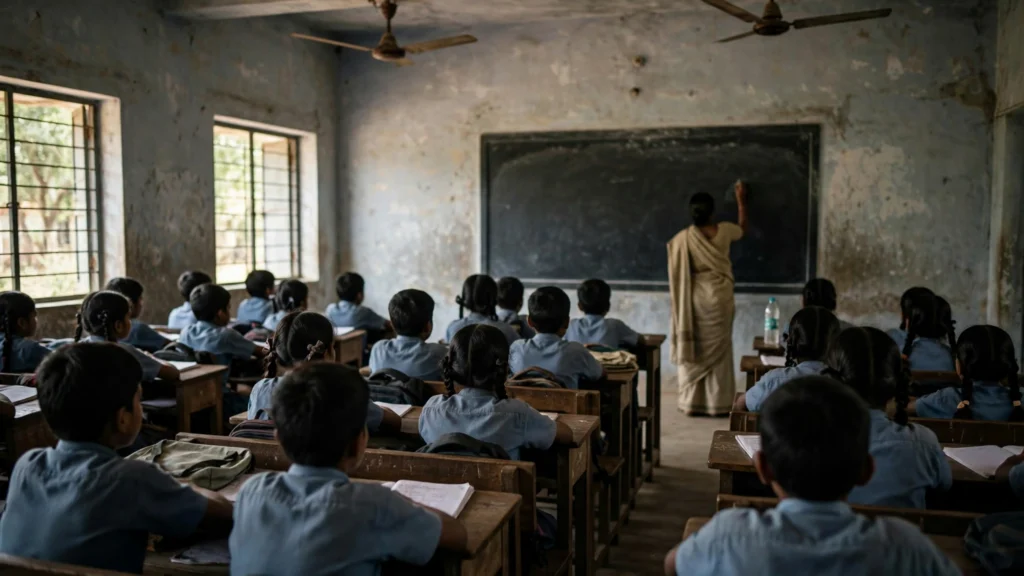
Karnataka has launched a statewide drive to find children who have dropped out of school and bring them back to the classroom. The campaign, which began on Saturday, November 14, will run till November 30 and cover children aged 6 to 18 across the state, from Class 1 right up to II PUC.
The School Education Department is running the exercise through Samagra Shikshana Karnataka (SSK). It is the second such special campaign this year, and officials say the timing is deliberate: midway through the academic year, many families move between districts and states for work, and children often slip out of school in the shift.
How the drive will work
Schools have been told to treat any child who has been absent for more than seven consecutive days, without permission or a valid reason, as an out-of-school child. Teachers and education officials will then go looking for them.
Door-to-door visits are at the heart of the campaign. Teachers will visit homes, talk to parents and try to persuade families to send their children back to school. Schools were also asked to hold meetings with parents and School Development and Monitoring Committees (SDMCs) on November 14, the opening day, to explain the campaign and plan the identification work.
Gram panchayats, local organisations and other government departments have been asked to help find children who have quietly stopped attending. Headmasters have been authorised to spend up to Rs 1,500 from accumulated school funds or available grants on publicity and documentation, and schools must submit photographs of campaign activities and enrolment figures to the department.
Focus on migrant children and child workers
The campaign will pay particular attention to children from migrant families and economically disadvantaged backgrounds. Officials say migration is one of the main reasons children leave school midway through the year.
Attendance officers have been told to coordinate with officials in destination districts whenever a child moves to another district, block or school cluster. In cases of interstate migration, the child’s complete details, along with the Permanent Education Number (PEN), must be forwarded to the state office so schooling can continue in the new location.
Teachers and officials will also visit workplaces to find children who may have left school for work: agricultural fields, shops, hotels and restaurants, brick kilns and lime kilns, and construction sites. They will speak to parents and employers and urge children engaged in work to return to school, with the sharpest focus on families of daily-wage workers, where money troubles and migration most often break a child’s schooling.
A second chance for older teens
For older children who have already left regular schooling, the state has kept a different door open. Students aged 15 to 18 will be encouraged to register for examinations through the Karnataka Open Schooling system, so they can complete their exams without necessarily returning to a conventional classroom.
In the current academic year, more than 1,03,042 school dropout students above the age of 15 were identified across Karnataka, according to figures reported earlier this year. Of these, around 38,469 students aged 15 to 18 had registered for the SSLC examination but did not appear for it, and 64,573 had registered for the II PUC examination but did not write it.
Why Karnataka is doing this now
This academic year, the state government identified 8,344 out-of-school children aged 6 to 14, up from 6,123 the previous year. According to the Karnataka Economic Survey 2025-26, of the 6,123 children identified last year, 85 were brought back into mainstream education through special training and another 3,602 through school-based training, while the process of mainstreaming the rest was still underway when the survey was prepared.
Karnataka recorded a secondary-school dropout rate of 18.1 percent in 2025-26, the highest among states and nearly twice the national average of 9.5 percent, according to UDISE+ data.
Whether the campaign succeeds will depend on more than identification. Finding children is one part of the job; keeping them in class after re-enrolment is the harder part, and that will need follow-up long after November 30.
FAQs
When is the Karnataka school dropout drive being held?
The drive runs from November 14 to November 30, 2026, across all districts of Karnataka.
Which children does the drive cover?
Children aged 6 to 18, studying from Class 1 to II PUC, who have discontinued their education or been absent for more than seven consecutive days without permission.
What happens to children aged 15 to 18 who left school?
They will be encouraged to register for examinations through the Karnataka Open Schooling system, so they can complete their SSLC or II PUC exams.
Who is running the campaign?
The Karnataka School Education Department, through Samagra Shikshana Karnataka (SSK), with the help of teachers, SDMCs, gram panchayats and other departments.
How many out-of-school children has Karnataka identified?
This academic year, 8,344 out-of-school children aged 6 to 14 were identified, up from 6,123 the previous year. More than 1,03,042 dropouts above the age of 15 were also identified this year.
The drive ends on November 30. For the thousands of children it hopes to reach, the real test begins the day after, when they are expected to be back in class and staying there.