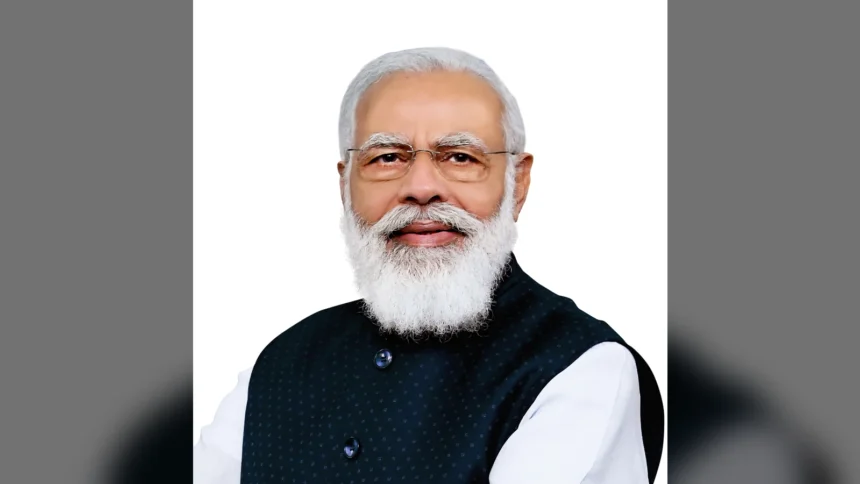
Prime Minister Narendra Modi used Constitution Day on Thursday to make a fresh pitch for women’s reservation in Parliament and state assemblies, telling women across the country that “no force can prevent us from ensuring that justice is done to them”. The message, published as an opinion piece in The Indian Express, came seven months after a Bill to fast-track the 33 per cent quota was defeated in the Lok Sabha.
Marking the day the Constituent Assembly adopted the Constitution on November 26, 1949, Modi paid tribute to Dr B R Ambedkar and Dr Rajendra Prasad. But the sharpest passage in his piece was reserved for the women’s reservation law, and for the Opposition, which he blamed for blocking it.
“The journey of our Constitution would be incomplete without recognising the remarkable women who helped shape it. But what happened earlier this year should fill our hearts with shame,” Modi wrote. “A legislation aimed at giving women adequate representation in legislative bodies was disallowed from being passed by the one Opposition party, once again showing its disdain for constitutional values.”
What Modi said on Constitution Day
The Prime Minister’s message ranged well beyond women’s reservation. He listed constitutional amendments brought in by his government, including GST, constitutional status for the National Commission for Backward Classes, and reservation for Economically Weaker Sections. He also attacked the Congress over the First Amendment of 1951 and the 42nd Amendment passed during the Emergency.
The Bill that fell in April
The backdrop to Modi’s remarks is the defeat of the Constitution (131st Amendment) Bill, 2026, in the Lok Sabha on April 17. The Bill sought to fast-track 33 per cent reservation for women in the Lok Sabha and state assemblies ahead of the 2029 general elections, by expanding the Lok Sabha’s strength from 543 seats to 850 and carrying out delimitation.
After a 21-hour debate across a special three-day sitting, 528 MPs voted. The Bill received 298 votes in favour and 230 against. A constitutional amendment needs a two-thirds majority of members present and voting, which meant 352 votes. The Bill fell short by 54 votes and was declared defeated.
The 2026 Bill was meant to amend the framework set up by the Constitution (106th Amendment) Act, 2023, popularly known as the Nari Shakti Vandan Adhiniyam. That law reserves one-third of seats for women in the Lok Sabha and state assemblies, but its implementation was linked to a census followed by delimitation. The 131st Amendment Bill was designed to get around that wait by increasing the total number of seats, so women-reserved constituencies could be created without disturbing existing representation.
Why it matters
By raising women’s reservation on Constitution Day, the Prime Minister has put the issue at the centre of the run-up to the Winter Session, where the Congress has already indicated it plans a showdown over the Women’s Reservation Act.
For readers, the stakes are practical. As the law stands, the 33 per cent quota cannot take effect until a census and delimitation are completed, so it would not apply before the 2029 general elections. The April defeat closed the shortcut the government had proposed. Unless the government brings a fresh Bill, or the Opposition shifts its stand, the quota remains a law on paper with no date attached.
The numbers from April also show how far apart the two sides are. The government was 54 votes short of the two-thirds mark, which means it would need to win over a substantial bloc of Opposition MPs to pass any similar Bill. That is why the Prime Minister’s message is as much a political challenge as a policy statement: it frames the Opposition’s vote in April as the reason women are still waiting.
A long road for the women’s quota
- November 26, 1949: The Constituent Assembly adopts the Constitution, shaped with the help of women members including Sarojini Naidu and Hansa Mehta.
- September 2023: Parliament passes the Nari Shakti Vandan Adhiniyam, reserving one-third of seats for women, linked to a census and delimitation.
- April 17, 2026: The 131st Amendment Bill, which would have fast-tracked the quota before the 2029 elections, is defeated, 298 votes to 230.
- November 26, 2026: On Constitution Day, PM Modi says no force can stop women’s reservation and blames the Opposition for the April defeat.
FAQs
What did PM Modi say about women’s reservation on Constitution Day?
In an opinion piece published on November 26, 2026, Modi said the journey of the Constitution would be incomplete without recognising the women who shaped it, and assured women that “no force can prevent us from ensuring that justice is done to them”.
Why did the Bill fail in April 2026?
It needed a two-thirds majority in the Lok Sabha. Of the 528 MPs who voted, 298 supported it and 230 opposed it, leaving it 54 votes short of the 352 required.
When will the 33 per cent quota actually apply?
Not before a census and delimitation are completed. The defeated 2026 Bill would have brought it forward to the 2029 general elections.
What happens next?
The Congress has signalled it will raise the Women’s Reservation Act in the Winter Session.
Constitution Day is observed every year on November 26, the day the Constitution was adopted in 1949. This year, the Prime Minister’s message made it clear the argument over women’s reservation is far from settled.