Going to a hospital in India often means long queues, paper files that go missing, and the same tests repeated at every visit. The National Health Authority (NHA) now wants to change that experience, district by district. It plans to set up two fully digitised model hospitals in every district of the country, one run by the government and one private, so that other hospitals can copy what works.
The plan, reported on November 10, builds on the Ayushman Bharat Digital Mission (ABDM), the national programme that links hospitals, clinics, labs and pharmacies through shared digital records.
What a digitised champion hospital will look like
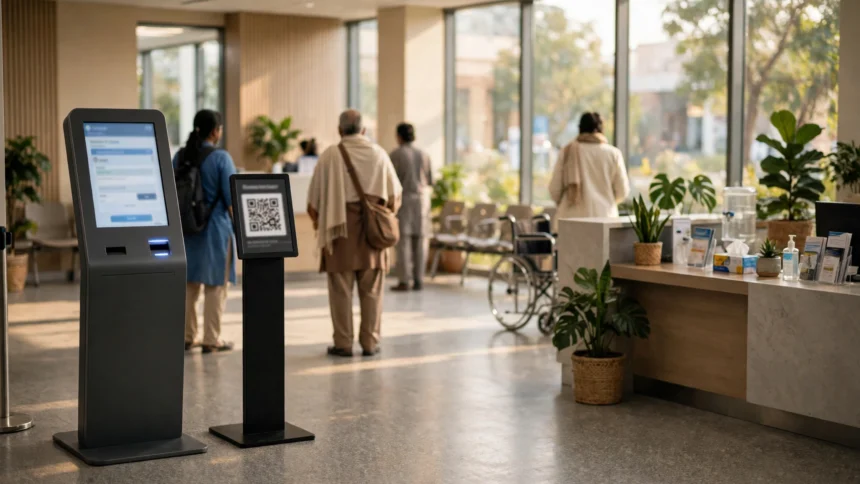
Each of the two hospitals in a district will act as a “champion centre”, a reference point for every other facility nearby. A patient walking in will register with a QR code instead of filling out paper forms at a crowded counter. Their health records, prescriptions, diagnostic reports and pharmacy slips will move through one connected system, so doctors can see the full picture without asking the patient to carry a bundle of old reports.
The NHA has released a guidebook for the overhaul, laying out standard steps from the moment a patient enters the hospital to the time they are discharged. The operational checklist asks hospitals to keep stable internet and working hardware at every counter, and to build integrated digital loops connecting electronic health records, nursing stations, diagnostic laboratories and in-house pharmacy dispensing.
Behind all of this sits the Ayushman Bharat Health Account, or ABHA, a 14-digit health ID that lets people link and share their medical records through digital lockers. Records are shared with doctors only with the patient’s consent. Nearly 99 crore ABHA IDs have been created so far, across about 1.2 million healthcare facilities in the country.
The Tripura model, scaled up to 38 districts
The NHA is not starting from scratch. The plan replicates a model already tried in Tripura, where hospitals linked registration, records, diagnostics and pharmacy services into one workflow. To take that model nationwide, the authority has drawn up a phased implementation framework and named 38 districts across 35 states and Union Territories to lead the rollout.
These 38 model districts will drive end-to-end digital adoption across all local health centres in their areas. State mission directors have been asked to oversee the local rollout, track hospital performance against key operational metrics and manage engagement with everyone involved, from doctors to local administrators.
The benchmarks are strict. Participating centres must reach over 95 percent ABHA saturation among visiting patients, and get 100 percent of local doctors and clinics registered on the national Healthcare Professionals Registry and the Health Facility Registry.

Why it matters for patients
For patients, the promise is practical rather than abstract. Shorter queues at registration, fewer forms to fill, and no more repeating the same blood test because the last hospital’s report never arrived. Consent-based health records mean a doctor in a new city can see a patient’s history in an emergency, instead of starting from zero.
Health technology firms have welcomed the move. Abhishek Trigunait, co-founder and managing director at Improzo, said QR-based registrations, digitised prescriptions and interoperable health records can substantially cut waiting time, paperwork and duplication of tests at the ground level. Dr Vikram Thaploo, chief executive at Apollo TeleHealth, added that digital transformation must go beyond scanning paper forms, and should weave registration, records, diagnostics, prescriptions and follow-up care into one seamless workflow.
Both stressed the same caveat: success will depend on trained staff, reliable connectivity, data security and patient awareness.
What is still unclear
The NHA has not yet disclosed a specific timeline or a budget for the district-level rollout. The programme is understood to be part of the broader ABDM implementation framework currently being discussed with state governments. The health ministry did not respond to queries on the initiative before the report was published.
That leaves the big question open: how quickly will the 38 model districts move from guidebook to working hospitals, and when will the model reach the remaining districts? For now, the framework, the benchmarks and the first 38 districts are in place. Patients will be watching for the part that matters most, shorter queues and records that actually follow them.
FAQs
What is the NHA planning?
Two fully digitised model hospitals in every district, one government-run and one private, to serve as examples other hospitals can replicate.
Which districts will go first?
The NHA has named 38 model districts across 35 states and Union Territories to lead the phased rollout, based on a model already tried in Tripura.
What is ABHA?
The Ayushman Bharat Health Account is a 14-digit health ID that lets people link, access and share their medical records electronically. Nearly 99 crore ABHA IDs exist today.
What changes for patients?
QR-based registration, digital prescriptions and reports, and consent-based sharing of health records, which should mean shorter queues, less paperwork and fewer repeated tests.
When will this reach my district?
The NHA has not announced a timeline or budget yet. The rollout begins with the 38 model districts, and the framework is being discussed with state governments.
The plan is ambitious, and its test will be simple: whether a visit to the hospital starts feeling faster and simpler. That is the standard the 38 model districts will now be judged against.