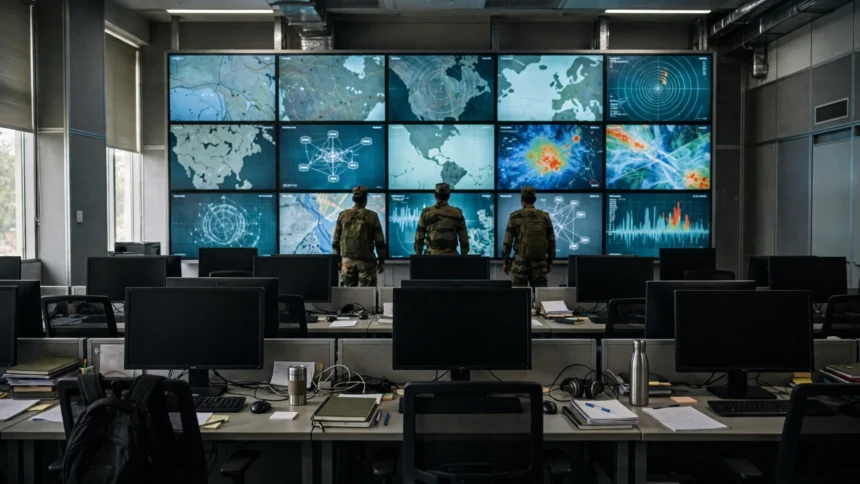
India’s armed forces are getting a homegrown AI layer, and it will be built in India. Bengaluru-based artificial intelligence startup Sarvam announced on Tuesday, October 27, 2026, that it has signed a five year agreement with the Ministry of Defence to design, develop and deploy AI applications across the Army, the Navy and the Air Force.
The agreement is a memorandum of understanding with Headquarters Integrated Defence Staff, or HQ IDS. It is not a single project for one service. It sets up an umbrella framework covering all three services, along with the joint, tri-service and integrated organisations under HQ IDS. The three services will now work from a shared AI foundation instead of building separate systems in separate corners.
Sarvam will build applications for operational work, training and decision support, and will provide technical support after deployment. The focus is decision support, target acquisition and data fusion across what the military calls the sensor-to-shooter loop, the chain that runs from detecting something to deciding what to do about it. Human oversight will stay in place for operational decisions, and the systems will run on sovereign infrastructure in India.
What the five year agreement covers
The MoU is deliberately broad. Rather than locking in one tool, it creates a framework for several projects across the three services, with HQ IDS facilitating the engagement, so lessons from one service can carry over to the others.
- Who signed: Sarvam and Headquarters Integrated Defence Staff, Ministry of Defence
- How long: five years, under a memorandum of understanding
- Who it covers: the Indian Army, the Indian Navy and the Indian Air Force, plus joint, tri-service and integrated organisations under HQ IDS
- What Sarvam will do: design, develop and deploy AI applications, and provide follow-on technical support
- Where it will be used: operational requirements, training and decision support
The three services will get access to the same foundation models, the same agentic infrastructure and the same geospatial and perception systems. If a capability is built for one service, the others can build on it and adapt it, rather than duplicating the underlying work.

Why one shared AI layer matters
Modern military operations generate far more information than any team can read in real time. Sensors, maps, imagery, communications and field reports arrive at once, and the hard part is joining them into a clear picture quickly enough to act on. That joining up is data fusion, one of the three focus areas named in this agreement.
A common AI layer also helps with consistency. When services share models and infrastructure, they share a way of working with the same information. Sarvam and HQ IDS have also talked about building an AI fabric that connects different elements of India’s defence capabilities: fewer isolated tools, more connected systems.
There is a sovereignty argument too: the AI layer is to be built in India and deployed on sovereign infrastructure, so sensitive military work does not depend on foreign systems.
Chanakya, the division that will do the work
The work will be carried out by Chanakya, Sarvam’s firewalled division focused on national security and defence. Firewalled means kept separate from the company’s other commercial work, which is how defence customers usually want sensitive projects handled. Chanakya will apply Sarvam’s AI stack, including foundation models such as Sarvam 105B.
Sarvam builds AI models and products across text, speech, vision and document processing, with a focus on Indian languages and Indian contexts. That background is relevant: defence work is not only about battlefield systems, and training material, documents and multilingual communication all sit inside the same organisations.
Pratyush Kumar, co-founder of Sarvam, put the mission simply. “Sarvam exists to build AI in India, for India. The core of that mission is to put the country’s own intelligence into the systems it depends on. To work with the three services on the nation’s defence is an honour and a privilege,” he said, adding that the company is grateful to HQ IDS for its trust.
Human oversight stays in the loop
One sentence in the announcement deserves attention, because it answers the question many readers will ask first. Human oversight will be retained on operational decisions. The AI is there to support decisions, fuse data and help commanders see the picture faster. It is not presented as a replacement for human judgement, and the sensor-to-shooter loop keeps that human check in place.
As with many framework agreements, the specifics are still to come. The financial terms were not disclosed, and no timeline was given for individual projects. The announcement does not list specific applications, deployment locations or operational timelines. That is normal for a framework MoU, but it means the real test will be in the projects that follow. Watch for the first named projects, and for how quickly capabilities built for one service start appearing in another.
FAQs
What did Sarvam announce on October 27, 2026?
Sarvam announced a five year memorandum of understanding with Headquarters Integrated Defence Staff, Ministry of Defence, to develop and deploy AI applications across the armed forces.
Which services does the agreement cover?
The Indian Army, the Indian Navy and the Indian Air Force, along with joint, tri-service and integrated organisations under HQ IDS.
What kind of AI work will Sarvam do?
Decision support, target acquisition and data fusion across the sensor-to-shooter loop, plus operational and training applications, with technical support after deployment.
Who will carry out the work?
Chanakya, Sarvam’s firewalled division focused on national security and defence, using Sarvam’s AI stack including the Sarvam 105B foundation model.
Will humans stay in control of operational decisions?
Yes. The announcement says human oversight will be retained on operational decisions, and the systems will be deployed on sovereign infrastructure in India.
The announcement is a framework, not a finished system. But frameworks shape what gets built next, and this one puts Indian AI at the heart of how India’s armed forces work with information. The next few projects will show how far it goes.