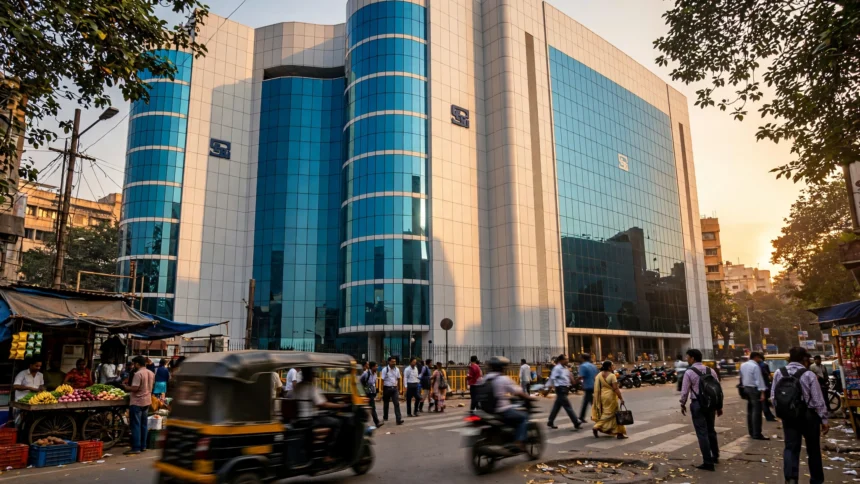
India’s market regulator is preparing to open the doors wider for foreign investors while pushing for thousands of new listings from small and medium companies. Securities and Exchange Board of India (SEBI) Chairman Tuhin Kanta Pandey said on Friday that the regulator will soon release a consultation paper to simplify rules for foreign portfolio investors (FPIs), removing constraints that exist in India but not in other major markets.
Pandey was speaking at the CII Financing Summit 2026 in Mumbai, where Chief Economic Adviser V. Anantha Nageswaran added a second message: India’s capital markets must fund real businesses, not speculation.
What SEBI plans for foreign investors
The centrepiece is a consultation paper that will propose removing FPI compliance requirements which other countries do not impose. “Very soon, we will also release a consultation paper to further simplify FPI operations in India by suggesting removal of some of the other constraints that other countries don’t have, but we do have,” Pandey said.
SEBI has digitised FPI onboarding and enabled net settlement to cut funding costs.
Two changes are already in motion. From December 1, KYC review cycles for applicable FPIs will be extended from one and three years to two and eight years, cutting repetitive compliance work. SEBI is also working to reduce FPI onboarding time to as little as five business days,

2,000 more listings and an IPO framework review
The SEBI chief also set a clear target: at least 2,000 additional listings from the small and medium enterprise segment over the next few years.
India’s primary market is already running hot. In the first seven months of FY27, capital raising reached Rs 9 lakh crore, while 235 IPOs raised Rs 1.5 lakh crore. Markets have also crossed $5 trillion in total value.
SEBI is also reviewing its Issue of Capital and Disclosure Requirements (ICDR) framework, which governs IPOs, follow-on offers, preferential issues and qualified institutional placements, plus the SME IPO framework. A single-fine mechanism is planned so the same lapse does not attract fines from multiple exchanges.
The CEA’s warning: finance must serve the real economy
The other headline from the summit was a sharp caution from CEA Nageswaran. He said India’s financial sector must return to its original purpose of channelling household savings into enterprises that manufacture goods, build infrastructure and generate employment.
“What we have not yet built is a financial system designed to finance the making of real things over 20-25 years,” Nageswaran said, pointing to the imbalance: equity market capitalisation stands at around 130 per cent of GDP, while the corporate bond market is only around 16 per cent.
He flagged the derivatives market as the clearest symptom. Citing SEBI studies, Nageswaran said around 93 per cent of individual equity derivatives traders lost money during the three years to March 2024, with combined losses of Rs 1.8 lakh crore. More than three-quarters of individual traders earned under Rs 5 lakh a year.
“Will finance once again serve the real economy, or will it continue to rule the real economy?” he asked, adding that the answer would determine the stability of India’s markets and its economic growth.
Why it matters
The two speeches, delivered hours apart at the summit, describe opposite sides of one problem. SEBI wants more foreign money and more listed companies. The CEA wants that money to reach factories, warehouses, cold chains and small manufacturers, not to fuel speculative trading.
The timing is significant. Foreign investors pulled money out of India for much of this year, but flows have turned in recent weeks. The rupee strengthened beyond 93 against the US dollar on Friday, its firmest level since April, helped by more than $12 billion of foreign portfolio inflows. If SEBI’s easing keeps that money coming, it could support both the currency and the IPO pipeline. For ordinary investors, the message is mixed: easier FPI rules and 2,000 more SME listings mean more choice and deeper markets, but nine out of ten individual derivatives traders lose money.
What happens next
- Consultation paper soon: SEBI will publish its FPI simplification paper for public feedback, followed by the SME IPO framework decision.
- December 1: Longer KYC review cycles (two and eight years) take effect for applicable FPIs.
- Five-day onboarding: SEBI and RBI work towards a common application form and five-day onboarding.
FAQs
What is SEBI planning for foreign investors?
SEBI will soon release a consultation paper to simplify FPI rules and remove constraints absent in other major markets. It also plans five-day onboarding and longer KYC cycles from December 1.
How many new listings is SEBI targeting?
SEBI Chairman Tuhin Kanta Pandey said the market should aim for at least 2,000 additional listings from the small and medium enterprise segment over the next few years.
How much have IPOs raised this financial year?
In the first seven months of FY27, 235 IPOs raised Rs 1.5 lakh crore and total capital raising hit Rs 9 lakh crore. Markets have crossed $5 trillion in total value.
What did the CEA warn about?
Chief Economic Adviser V. Anantha Nageswaran warned that capital markets are drifting from their core purpose, citing SEBI data that 93 per cent of individual derivatives traders lost Rs 1.8 lakh crore over three years to March 2024.
The direction is clear: easier entry for global investors, more companies on the market, and a warning that the money must reach the real economy.