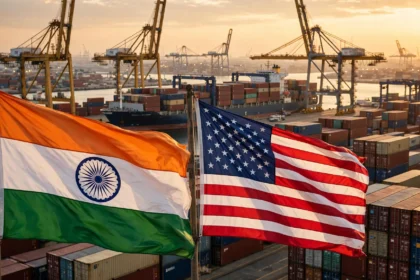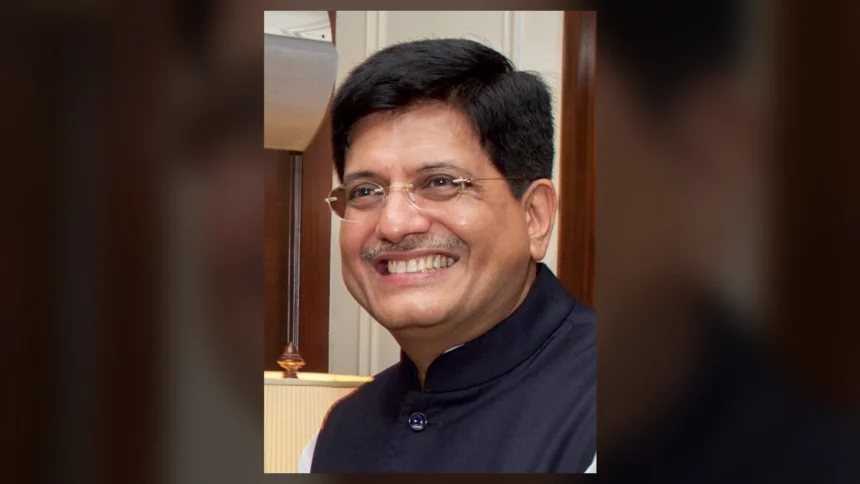
India has secured an assurance from the United States that its goods will enter the American market at lower duties than those paid by competing countries, Commerce and Industry Minister Piyush Goyal said on Sunday. The minister said the understanding was already reached between Prime Minister Narendra Modi and US President Donald Trump, and negotiators are now working to close the first tranche of the bilateral trade agreement by the end of this financial year.
Goyal was speaking to reporters in Cairo, where he is on a two-day visit to Egypt to discuss trade and investment ties. His remarks are the clearest statement yet from the government on the tariff advantage India expects from the deal, and they come the same weekend External Affairs Minister S Jaishankar said the negotiations are at the finishing line.
For Indian exporters, the message matters. The United States is India’s largest trading partner, and lower duties than suppliers from Vietnam, Bangladesh and China would give Indian exporters an edge in textiles, gems and jewellery, leather goods and marine products.
What Goyal actually said
Goyal traced the assurance back to the broad framework agreement the two leaders announced a few months ago. “This was already agreed between the leaders, President Donald Trump and Prime Minister Narendra Modi, when they announced that we have both come to a broad framework agreement a few months ago, and it has been acknowledged that India will get preferential trade access in the US with lower duties than our competitor countries,” he said.
The minister did not put a number on the advantage; the exact edge will depend on the final framework. What he did confirm is the direction of travel: India will pay less than its rivals, not the same, and not more.
The February framework and the long road since
India and the United States finalised the framework for the first phase of their bilateral trade agreement in February 2026. The talks began in February 2025, when PM Modi and President Trump agreed to work towards a trade deal. Under the framework, the US agreed to apply a reciprocal tariff rate on Indian goods, while India agreed to cut duties on a range of American industrial goods and farm products.
The deal was expected to be signed earlier, but changes in the US tariff landscape forced the two sides back to the table. The biggest disruption came when the US Supreme Court struck down President Trump’s reciprocal tariffs, which had formed the basis of the earlier discussions. Washington is now rebuilding its tariff architecture through alternative mechanisms under the Trade Act.
There has also been friction on the ground. The US imposed an additional 10 per cent import duty on several countries, including India, from July 24, 2026, following an investigation into forced labour issues under Section 301 of the US Trade Act. That duty sits on top of existing most-favoured-nation rates.
Why the timing matters now
The two ministers spoke within a day of each other, and the coordination looks deliberate. On Saturday, Jaishankar told the HT Leadership Summit in New Delhi that most outstanding issues have been resolved and the deal is at the last stretch. On Sunday, Goyal added the commercial detail: preferential access, lower duties than competitors, and a target of closing the first tranche by March 31, 2027.
The calendar adds pressure of its own. PM Modi is expected to meet President Trump on the sidelines of the ASEAN and East Asia summits in Manila on November 16 and 17, and the two leaders are also expected to meet at the G20 Summit in Miami in December.
What happens next
Both sides say they are working towards closing the first tranche by the end of the financial year. The finished pact is expected to take the form of a legal text with annexures, including a dedicated chapter on customs and trade facilitation. Services are not part of the first tranche and will be taken up in a second phase.
The real test will be the fine print: the size of India’s tariff advantage, the products it covers, and the conditions attached to it.
FAQs
What is preferential market access?
It means Indian goods will face lower import duties in the US than goods from competing countries. The exact rates will be set in the final trade agreement.
When will the first tranche of the trade deal close?
Both sides are working towards closing it by March 31, 2027, the end of the current financial year. No signing date has been announced yet.
What was the February 2026 framework?
It was the broad agreement for the first phase of the India-US bilateral trade agreement, announced by PM Modi and President Trump. It set the terms for tariff talks but was not itself a signed deal.
Why has the deal taken so long to sign?
Changes in US tariff policy, including the Supreme Court striking down the reciprocal tariffs, forced fresh negotiations. A further 10 per cent US duty imposed in July 2026 also complicated the picture.
Which Indian exporters benefit most?
Labour-intensive sectors that compete directly with suppliers in Vietnam, Bangladesh and China, such as textiles, gems and jewellery, leather goods and marine products, stand to gain the most from lower US duties.
Exporters will watch the Manila meetings closely: movement there makes the March deadline look realistic; without it, the wait stretches on.