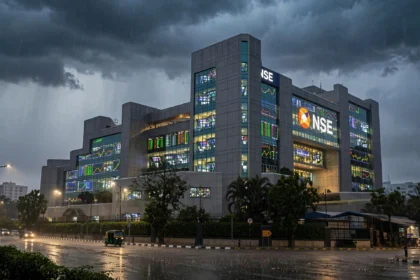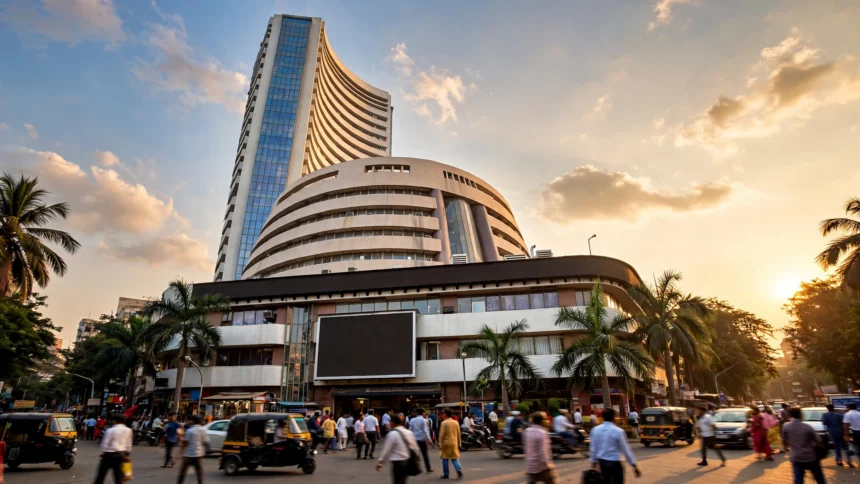
Dalal Street staged a sharp comeback on Thursday, November 19, as the Sensex surged nearly 1,000 points and the Nifty reclaimed the 25,500 mark for the first time in nine months. The rally, led by banks, auto and consumer stocks, erased the losses from the previous session and took both benchmark indices to their highest closing levels since February 2026.
The 30-share BSE Sensex jumped 989.94 points, or 1.21 per cent, to close at 83,021.75. During the day it touched an intraday high of 83,043.87 after opening weak and sliding to 81,698.63 in early trade. The 50-share NSE Nifty climbed 286.35 points, or 1.14 per cent, to end at 25,514.30, its first close above 25,500 since February 23, 2026.
Banks and auto stocks lead the charge
Banking stocks were the biggest contributors to the rally. The Nifty Bank index surged 1,024 points to cross the 63,000 mark for the first time and closed at a record 63,063. HDFC Bank, State Bank of India and ICICI Bank were among the main drivers of the index.
Auto stocks also had a strong day. Falling copper and aluminium prices improved the margin outlook for carmakers, and Maruti Suzuki and Mahindra and Mahindra were among the top Sensex gainers. FMCG names joined in too, with Hindustan Unilever and Axis Bank also featuring among the day’s leading gainers.
The gains were broad-based rather than limited to a handful of heavyweights. The Nifty Midcap index advanced 645 points to close at 61,624, while the Nifty 100 rose 1.18 per cent and the Nifty Smallcap 100 gained 0.75 per cent.
Record foreign inflows power the rally
Foreign institutional investors have been the engine behind the recent recovery. FIIs bought equities worth Rs 5,866.78 crore on Wednesday alone, even as the Sensex fell more than 500 points that day. Their cumulative investments in November have reached a record Rs 94,299 crore, according to exchange data cited by market reports, and Reuters data put November foreign inflows into Indian equities at 11.28 billion dollars.
Easing commodity prices added to the positive mood. Lower crude oil prices eased concerns over inflation and India’s external balances, while softer metal prices lifted the outlook for auto and consumer durable companies. Market watchers also noted that the rally erased all the losses Indian equities had suffered since the onset of the Middle East conflict.
The combined market capitalisation of BSE-listed companies hit a record Rs 512 lakh crore on Thursday.
Companies listed on the exchange have added around Rs 40 lakh crore in market value so far in November.
A sharp turnaround after Wednesday’s fall
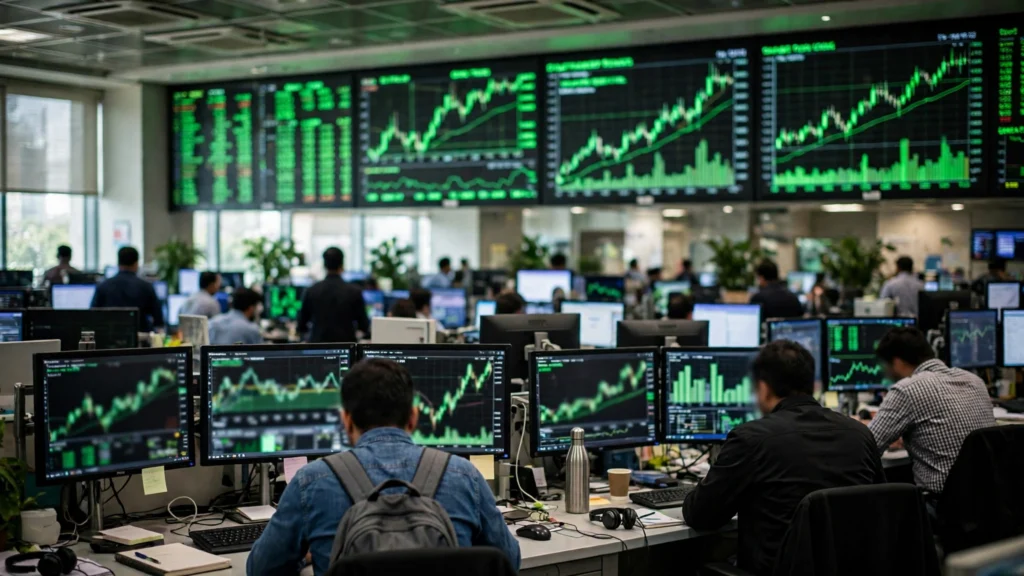
Thursday’s surge stood in sharp contrast to the previous session. On Wednesday, the Sensex had fallen 500.38 points as investors booked profits and worried about US interest rates. The index recovered more than 1,300 points from its intraday low on Thursday, a swing that caught many traders by surprise.
Vinod Nair, head of research at Geojit Investments, said record foreign inflows in November had boosted market liquidity, while lower crude prices eased concerns over future inflation and external balances. He added that banking indices had reached record highs as autos led the rally on improving margins.
Why it matters
For ordinary investors, the rally matters for two reasons. First, the Nifty closing above 25,500 after nearly nine months removes a psychological barrier that had capped the market since February. When an index breaks a level it has failed to hold for months, it often draws fresh money from investors who were waiting on the sidelines.
Second, the breadth of the rally is encouraging. When banks, autos, FMCG and midcaps rise together, it signals confidence across sectors rather than a narrow bet on one or two stocks. The record foreign inflows in November suggest global funds are returning to India after months of caution, and that flow, more than any single day’s gain, is what can sustain a rally.
That said, one strong session does not make a trend. The market fell 500 points on Wednesday and gained nearly 1,000 on Thursday, and such sharp swings cut both ways. Investors should watch whether foreign buying continues and whether the December quarter earnings justify the higher valuations, rather than chasing a single day’s move.
What to watch next
- Whether FIIs keep buying at the current pace, or pause after the record November inflows.
- Crude oil prices and global cues, which have driven much of the recent volatility.
- December quarter earnings and pre-Budget consultations, which will test whether company profits can support the higher market levels.
- The Nifty Bank index, which is at a record high and has led the market higher twice in a week.
FAQs
How much did the Sensex rise on November 19?
The Sensex rose 989.94 points, or 1.21 per cent, to close at 83,021.75, a nine-month high.
What level did the Nifty close at?
The Nifty gained 286.35 points to end at 25,514.30, its first close above 25,500 since February 23, 2026.
Which sectors led the rally?
Banking, auto and FMCG stocks led the gains, with the Nifty Bank closing at a record 63,063.
Why did foreign investors buy so much in November?
Foreign institutional investors have poured a record Rs 94,299 crore into Indian equities in November, drawn by easing commodity prices and India’s growth outlook.
Does one day’s rally mean the market will keep rising?
Not necessarily. The market fell 500 points the day before the rally, so investors should watch foreign flows and earnings before assuming the uptrend will continue.
Indian markets will be watched closely in the coming sessions to see whether Thursday’s record-breaking rally has staying power, or whether it was a one-day burst of buying.