Voters in Ladakh stepped out into freezing cold on Saturday to cast their ballots in the Union Territory’s first panchayat and municipal elections in eight years. Polling began at 8 am across all eight districts and will continue till 5 pm, marking the return of elected grassroots bodies to a region that has had no local government since it became a separate Union Territory in August 2019.
The last local body elections in Ladakh were held in 2018, when the region was still part of the erstwhile state of Jammu and Kashmir. Since then, panchayats and municipal councils have functioned without elected representatives. Saturday’s vote changes that, at least at the village and town level.
What is being voted on today
Polling is being held for 137 sarpanch seats across 192 panchayat halqas. In 55 halqas, sarpanches have already been elected unopposed. Of the 1,428 panch seats, 1,186 candidates were elected unopposed, leaving 242 seats to be decided by today’s vote.
In the towns, all 21 wards of the Leh Municipal Council are going to the polls. In Kargil, four of the 17 municipal wards have already returned representatives unopposed, and voting is taking place in the remaining 13. A direct contest between the BJP and the Congress is expected in several seats, with independent candidates also in the fray.
The Ladakh administration has declared Saturday a public holiday to help people reach polling stations. The entire election process is scheduled to be completed by November 30.
Polling at 15,057 feet
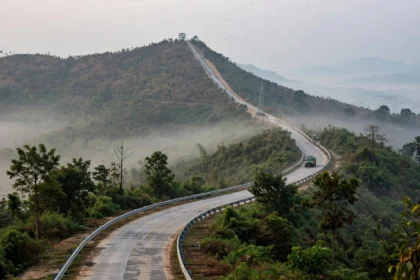
The scale of this election is what sets it apart. Around 1.87 lakh electors are spread across 59,146 square kilometres of high-altitude desert, from Drass at 10,800 feet to Korzok at 15,075 feet. The highest polling station in the Union Territory sits at 15,057 feet.
One booth at Hanley Po village in Changthang district stands at nearly 15,000 feet, around 260 kilometres from Leh, serving a traditional pastoral community. Polling parties carrying electronic voting machines and election material reached their stations on Friday, a day ahead of polling.
Night temperatures in these areas have already fallen to between minus 7 and minus 9 degrees Celsius. District administrations in Leh, Sham, Changthang, Drass, Nubra, Zanskar, Sankoo and Kargil made arrangements for heating at polling stations, along with transport, CCTV cameras and security deployment.

The protest running alongside the vote
The Leh Apex Body, a grouping of social and political organisations in Leh, has been holding a dharna demanding that the Ladakh Autonomous Hill Development Council elections, scheduled for December 4, be postponed until 2027. The group had also sought these polls to be deferred to April or May next year, a demand the administration did not accept.
The Hill Council polls on December 4 will cover all eight districts and are seen as the more politically significant contest. Two Hill Council candidates have already been elected unopposed: Congress candidate Sayed Banoo for the Lotsum seat in the Kargil Hill Council and BJP candidate Dorje Angchuk for the Samad-Kharnak seat in Changthang.
Why it matters
For seven years, decisions about village roads, water supply, street lighting and local budgets in Ladakh were taken by officials without an elected panchayat or council to answer to. That gap is the real story of this election, more than who wins which ward. Elected sarpanches and councillors give residents a direct channel to raise everyday problems, and they give the administration local partners to work with in a region where terrain makes centralised governance slow and expensive.
The timing matters too. Ladakh’s administration carved out six additional districts this year, so the newly elected bodies will work within a redrawn administrative map. And with the Hill Council elections due in less than two weeks, Saturday’s turnout will be read closely as a signal of how Ladakh’s voters are approaching the bigger contest on December 4.
For voters, the immediate stakes are practical. A sarpanch in a remote Changthang village or a councillor in Leh town is the first point of contact for everything from ration cards to road repairs. After eight years without that link, the queues seen at polling stations on Saturday morning suggest people are keen to have it back.
FAQs
When are the Ladakh panchayat and municipal elections being held?
Polling is being held on Saturday, November 21, 2026, from 8 am to 5 pm. The election process will be completed by November 30.
How many seats are going to the polls?
Voting is taking place for 137 sarpanch and 242 panch seats, all 21 wards of the Leh Municipal Council and 13 wards of the Kargil Municipal Council. Fifty-five sarpanches and 1,186 panchs were elected unopposed.
Why are these elections significant?
They are the first local body elections in Ladakh since it became a separate Union Territory in August 2019, and the first in eight years. The last local body polls were held in 2018.
What is the highest polling station in Ladakh?
The highest polling station is at 15,057 feet. A booth has also been set up at Hanley Po village in Changthang district at nearly 15,000 feet, about 260 kilometres from Leh.
What happens next?
After the panchayat and municipal results, Ladakh will vote in the Ladakh Autonomous Hill Development Council elections on December 4 across all eight districts.
Ladakh has waited eight years to elect its village and town representatives. By this evening, when polling closes at 5 pm, the region will know who will speak for its panchayats and councils for the first time since 2019.