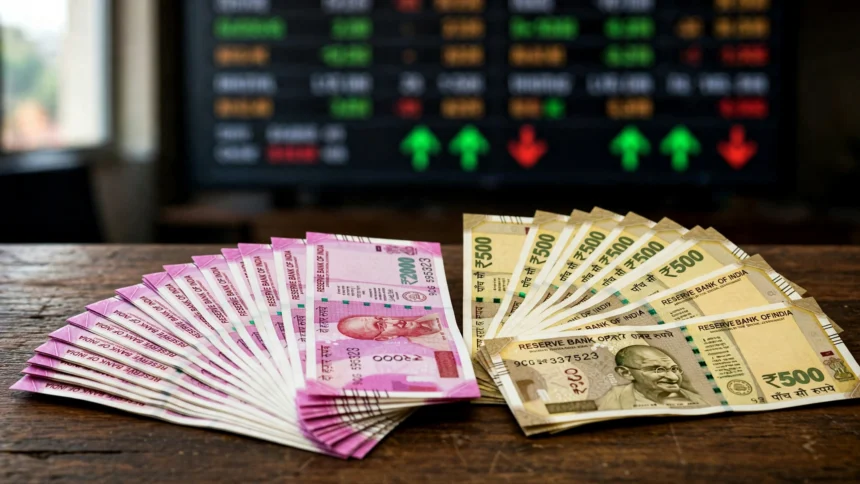
The Indian rupee ended the week on a high note on Friday, closing at 92.67 against the US dollar, its strongest level in more than seven months. The currency crossed the psychologically important 93 mark for the first time since April, powered by record foreign fund inflows and a roaring stock market rally.
At the interbank foreign exchange market, the rupee opened at 93.25 and touched an intraday high of 92.65 before settling at 92.67, up about 65 paise from Thursday’s close of 93.32. It was the fifth straight session of gains for the currency, which has now appreciated more than 1.6 percent in five sessions from its November 13 close of 94.19.
Five sessions, one sharp turnaround
The rupee’s recovery has been swift. Just a week ago, the currency was trading near 94.24 at the start of the week. By Friday’s close it had gained 157 paise, or 1.67 percent, over the week, its strongest weekly rally in five weeks.
The turnaround is even more striking when seen against the year so far. The rupee hit a record low of 96.96 in late May, when its losses for 2026 had stretched to nearly 8 percent. Friday’s close has trimmed that loss to around 3 percent, and the currency has now recovered about 4.6 percent from its May low.
The last time the rupee closed stronger than 93 was April 10, when it ended at 92.83. Friday’s close of 92.67 is its best level since early April.
What pushed the rupee higher
The biggest force behind the rally is foreign money. Overseas investors have poured more than 12 billion dollars into Indian shares so far in November, the largest monthly inflow on record. On Friday alone, foreign portfolio investors bought shares worth Rs 10,308 crore, taking total November inflows past Rs 1.3 lakh crore, according to exchange and depository data.
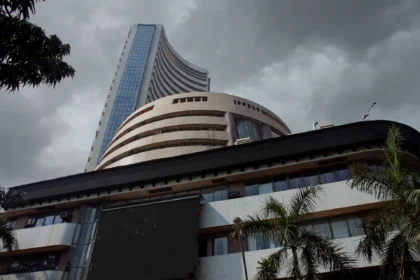
The flood of foreign capital has lifted stocks as well. The Sensex jumped 898 points, or 1.1 percent, on Friday to close at 83,920, its highest close in nine months, while the Nifty 50 settled at 25,800.60. The Sensex has now gained nearly 13 percent in November.
Two other factors helped. Brent crude prices have eased to around 90 to 93 dollars a barrel, lowering India’s import bill, and traders say the Reserve Bank of India has been willing to let the currency strengthen amid the inflows rather than intervening heavily to hold it down. The rupee’s rise is all the more notable because the dollar index, which measures the greenback against six major currencies, is hovering near a 20-month high.

Why it matters
A stronger rupee touches everyday life in ways that go beyond trading screens. For households, it means cheaper imports, and since India buys most of its crude oil from abroad, a firmer currency takes some pressure off fuel prices and imported inflation. That matters right now: retail inflation climbed to 6.09 percent in October, above the Reserve Bank’s upper tolerance limit, so anything that cools import costs helps the inflation fight.
For students studying abroad and families planning foreign travel, a rupee at 92.67 instead of 97 means every dollar costs about four rupees less, a real saving on fees, tickets and living costs. Importers of electronics, machinery and raw materials also pay less in rupee terms.
Exporters face the other side of the coin. IT firms, textile makers and other exporters earn in dollars and convert them into rupees, so a stronger rupee trims their earnings in rupee terms. The same applies to Indians receiving money from relatives working overseas. The balance of winners and losers is exactly why the Reserve Bank watches the pace of the move closely: a steady appreciation is welcome, a sharp one can unsettle exporters.
The rally also signals a wider shift in global money flows. While Asian markets suffered their worst week since 2020 as investors sold AI-linked stocks, Indian equities attracted funds fleeing that sell-off. The rupee’s strength is, in that sense, a vote of confidence in India’s growth story at a moment when global markets look shaky.
What to watch next
Analysts expect the rupee to trade in a range of 92.25 to 93.00 in the near term, with strong support around 91.80 to 92.10. Whether the rally holds will depend on whether foreign inflows keep coming at this pace, and on global cues such as US inflation data and crude oil prices due next week.
One number to keep an eye on is the foreign exchange reserves. RBI data released on Friday showed reserves fell by more than 14 billion dollars in the week ended November 13 to 705.3 billion dollars, their lowest in about three months, partly because of valuation changes in gold and foreign currency assets. A reserves cushion of that size still gives the central bank plenty of room to smooth any sudden swings.
For now, the rupee has done in five sessions what it could not manage in five months: climb back above 93 and stay there. The question for the coming week is whether foreign investors keep buying, or whether profit-taking brings the currency back toward 93.50.
FAQs
What is the rupee’s value against the dollar now?
The rupee closed at 92.67 per dollar on Friday, November 20, 2026, its strongest level in over seven months.
Why did the rupee rise so sharply this week?
Record foreign portfolio inflows of more than 12 billion dollars in November, a strong stock market rally, softer crude oil prices and the Reserve Bank’s willingness to let the currency appreciate all pushed the rupee higher.
When was the last time the rupee was stronger than 93?
The rupee last closed above the 93 mark on April 10, 2026, when it ended at 92.83 against the dollar.
Does a stronger rupee help ordinary people?
Yes, mainly through cheaper imports. It can ease fuel and imported inflation, and it lowers the cost of foreign education, travel and imported goods. Exporters, however, earn fewer rupees for each dollar they bring home.
How far can the rupee rise from here?
Analysts see the rupee trading between 92.25 and 93.00 in the near term. Its path will depend on foreign fund flows, crude prices and global cues next week.
The rupee’s five-day surge caps a remarkable month for Indian markets. Whether the momentum lasts into next week will be clear when trading resumes on Monday.