A 5.3-magnitude earthquake struck eastern Nepal early on Tuesday morning, sending tremors across north Bengal, Sikkim and parts of Bihar and waking thousands of people who rushed out of their homes. There were no immediate reports of casualties or damage, officials said, but the jolt was felt across four countries, a sharp reminder of how earthquake-prone the Himalayan region is.
The quake hit at 7:02 am Indian Standard Time, according to the National Centre for Seismology (NCS), which put the epicentre in Nepal at latitude 27.855 degrees north and longitude 87.909 degrees east, at a depth of 20 kilometres. Tremors were reported from Darjeeling, Jalpaiguri and Cooch Behar in West Bengal, from towns across Sikkim, from several districts of Bihar, and from Bhutan, Bangladesh and China.
What happened this morning
The European-Mediterranean Seismological Centre (EMSC) placed the epicentre in Nepal’s Koshi province, close to Olangchung Gola in Taplejung district, near the Nepal-Tibet border. Its location, about 94 kilometres north-northwest of Darjeeling and 68 kilometres northwest of Gyalshing in Sikkim, put the quake almost on the doorstep of India’s eastern Himalayan towns.
Agencies differed slightly on the size of the quake, which is normal in the first hours after an event. India’s NCS and the EMSC both recorded it at magnitude 5.3, the USGS at 5.4, and Nepal’s National Earthquake Monitoring and Research Centre at 5.6, with depths reported between 10 and 20 kilometres. What all of them agreed on was the timing, the location and the fact that the shaking was widely felt.
In north Bengal, residents said they felt the ground move twice in quick succession. In Darjeeling and Jalpaiguri, people came out of their houses and waited in open spaces until the shaking stopped. Similar scenes were reported from Sikkim, where the epicentre lay only about 61 kilometres north-northwest of Yuksom. By mid-morning, officials said there were no immediate reports of casualties or damage, though checks were still under way. Hours earlier, a separate tremor of magnitude 2.5 had been recorded in Assam’s Karbi Anglong district.
Why the Himalayas shake so often
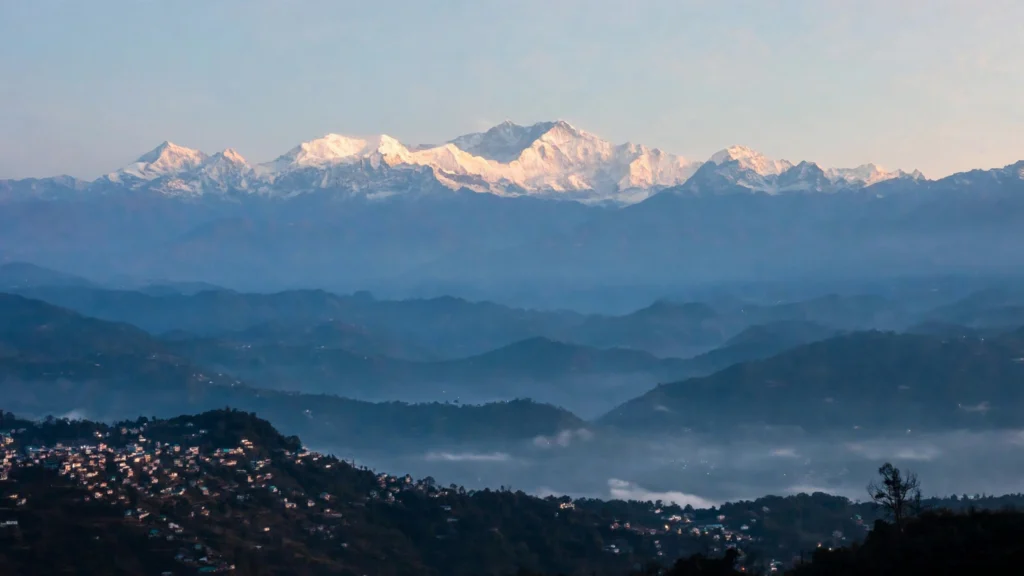
The Himalayas exist because the Indian plate pushes northward into the Eurasian plate at a few centimetres a year. The stress builds up along faults deep beneath the mountains until it is released, suddenly, as an earthquake. That is why the entire Himalayan arc is classified as a high seismic risk zone, and why much of Sikkim and north Bengal falls in Zone IV, the high-damage-risk category on India’s seismic zoning map.
The record shows how destructive that stress can be:
- 1934: A magnitude 8.0 earthquake struck the Bihar-Nepal border region, killing more than 10,000 people and flattening towns on both sides of the border.
- 2011: A magnitude 6.9 earthquake hit Sikkim on September 18, killing more than 100 people and damaging thousands of homes and roads in the hills.
- 2015: The Gorkha earthquake, magnitude 7.8, struck Nepal on April 25, killing nearly 9,000 people. Tremors were felt across northern India.
Scientists have long warned that the central Himalaya has accumulated enough strain for a large earthquake, and that the only uncertainty is when it will happen. Moderate quakes like Tuesday’s do not release that strain in any meaningful way. They do, however, test the region’s warning systems, its buildings and its public awareness.
Why it matters
A magnitude 5.3 quake that causes no damage is easy to forget by lunchtime, but the gap between the region’s seismic risk and its preparedness remains wide. Darjeeling and Gangtok are hill towns built on steep slopes, with dense housing, narrow roads and a large floating population of tourists. A stronger quake in the same spot, or one striking at night or during the tourist season, would be a very different story. The morning’s scenes of people rushing out of their homes show that instinct is sound. What is less certain is whether the buildings they rushed out of are built to withstand the shaking.
The quake also shows how far monitoring has come, and how far it still has to go. The NCS published the quake’s time, location and magnitude within minutes. But early warning, the seconds of notice that can save lives before the shaking arrives, is still limited in the Himalayan region. Early-warning systems that alert cities before the waves arrive exist elsewhere, and India has been building its own. Tuesday’s quake is a reminder that the investment is worth making, because the next one may not be a 5.3.
Finally, the quake is a cross-border event in the truest sense. It happened in Nepal, was felt in India, Bhutan, Bangladesh and China, and was reported by agencies in three countries. Earthquakes do not respect borders, and neither should disaster planning. Shared monitoring data and coordinated relief plans would help all four countries the next time the ground moves.
What happens next
Aftershocks are likely in the coming hours and days. They are usually smaller than the main quake, but they can still be felt, and they can damage buildings already weakened by the first jolt.
During shaking, drop to the ground, take cover under sturdy furniture and hold on until it stops. After it stops, move to open ground, stay away from buildings and power lines, and do not use lifts. A building that shows cracks should be checked by an engineer before anyone goes back inside.
Damage assessment in north Bengal and Sikkim continues through the day. For now, the region can count itself fortunate. The quake was moderate, it struck early in the morning when many people were already awake, and it caused panic rather than destruction. The lesson is the same one the Himalayas have delivered for a century: the ground here will move again, and the time to prepare is between quakes, not during them.
FAQs
How strong was the earthquake?
Magnitude 5.3, according to India’s National Centre for Seismology and the EMSC. The USGS put it at 5.4 and Nepal’s earthquake centre at 5.6; small differences are normal.
Where was the epicentre?
In Nepal’s Koshi province, near Olangchung Gola in Taplejung district, about 94 kilometres from Darjeeling and 61 kilometres from Yuksom in Sikkim.
Which Indian areas felt the tremors?
Darjeeling, Jalpaiguri and Cooch Behar in West Bengal, towns across Sikkim, several districts of Bihar, and also Bhutan, Bangladesh and China.
Were there any casualties?
No. Officials reported no casualties or damage so far, though checks were still under way.
Could there be aftershocks?
Yes, aftershocks are likely in the hours and days after a quake of this size. They are usually smaller than the main shock.