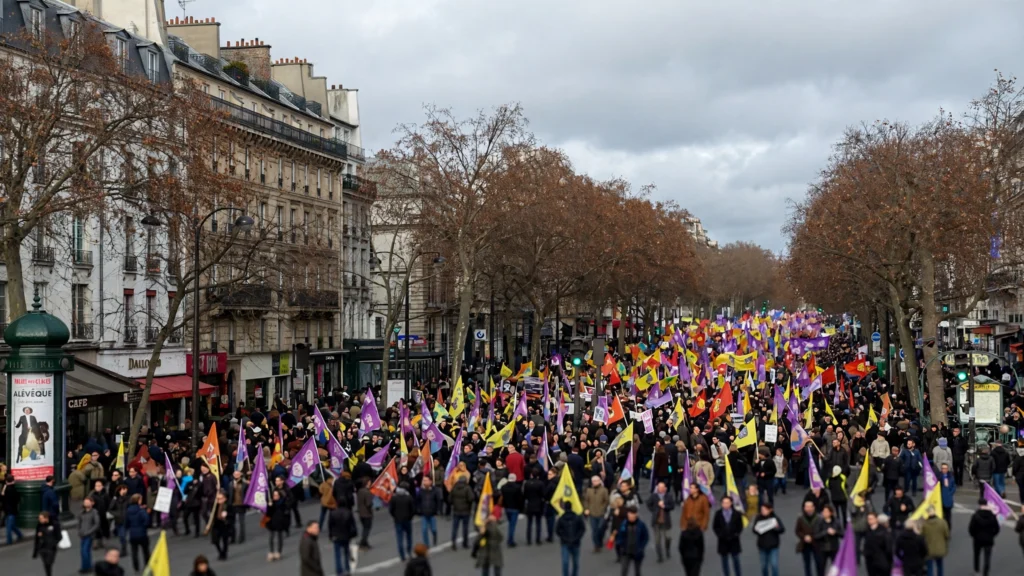
France woke up on Sunday to the aftermath of another turbulent day on its streets. On Saturday, hundreds of thousands of people marched across the country against rising living costs, widening inequality and a struggling public education system, in a second consecutive weekend of mass demonstrations that again ended in clashes between protesters and police.
By the time the Interior Ministry released its first assessment, nearly 1,000 people had been arrested nationwide. Two protesters were seriously injured. And in Paris, Marseille and Lyon, the evening air was thick with tear gas as riot police moved in with water cannon against small groups who had broken away from the main marches.
The scale of the turnout itself became a point of dispute within hours. The Interior Ministry put the nationwide figure at 410,000. The CGT trade union, which helped organise the marches, said it was closer to 800,000. In Paris alone, where the main demonstration gathered on the southeastern outskirts of the capital, estimates ranged from 110,000 to 250,000.
A protest movement that started in a school
What began weeks ago as anger over staff shortages at a high school southeast of Paris has grown into something much larger. Students and teachers were the first to take to the streets last month. Trade unions then joined, and the movement has since absorbed a much wider set of grievances: grocery bills that keep climbing, stagnant wages, underfunded public services and a sense among young people that the system is no longer working for them.
Camille Chesnier, 27, who marched in Paris on Saturday, put it bluntly. Despite an engineering degree and a master’s degree, she remains unemployed, and she said young people are struggling to find jobs and housing because public services are being hollowed out. Her story, echoed by many around her, has become a symbol of the frustration driving the protests.
Organisers have refused to back down. They are calling for continued national strikes and further demonstrations until President Emmanuel Macron’s government addresses their demands on purchasing power, public services and what they call fiscal and social justice.
70,000 police on the streets
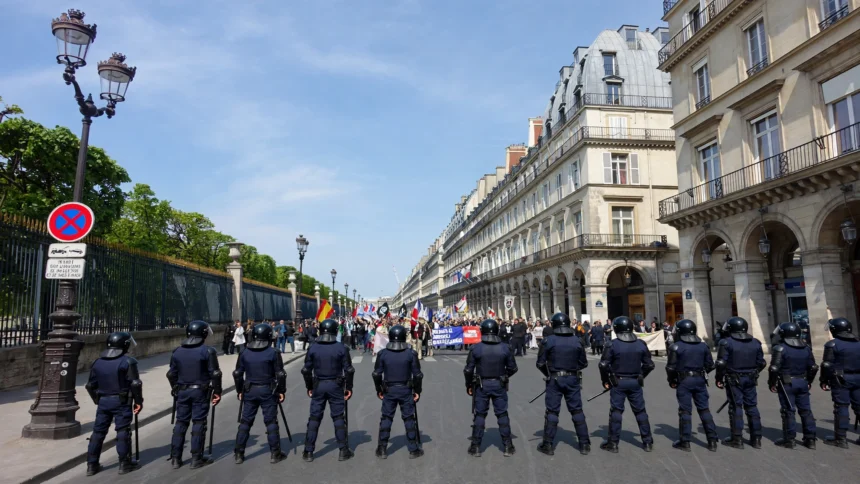
Determined to avoid a repeat of the previous weekend, when public buildings were vandalised, hundreds of shops were looted and 2,700 people were arrested, the government deployed 70,000 police officers and gendarmes across the country on Saturday, backed by armoured vehicles and helicopters. Shopfronts in several city centres were boarded up, and march routes were kept away from central government districts.
For much of the day, the strategy appeared to hold. Most rallies were peaceful. But as evening fell, violence flared in several cities at once.
In Paris, after the main rally ended, riot police fired tear gas and water cannon at a group of around 500 hooded youths near Porte de Vincennes, who eventually dispersed. In Marseille, demonstrators fired mortar fireworks towards officers, set fire to rubbish bins to block roads, and threw rocks and bottles at security forces. Police said several shops were ransacked, including two jewellery stores.
Clashes were also reported in Lyon, Bordeaux, Grenoble, Clermont-Ferrand, Lille, Rennes, Nantes, Toulouse,
Montpellier and Strasbourg.
Nearly 1,000 arrests, two seriously hurt
Interior Minister Laurent Nunez said officers had confronted what he called an extremely elevated level of violence from black-clad ultra-left extremists, and he defended the heavy security presence. He said Saturday’s outcome was more positive than a week earlier, with more police on the streets acting more rapidly, conducting more pre-demonstration checks and better protecting businesses.
But the human cost was real. Two people were seriously injured, Nunez confirmed: one man in Toulouse, who reportedly had fingers blown off, and another person in Clermont-Ferrand. He gave no further details of either case.
There is also growing anger at the crackdown itself. Critics of the government say the scale of the policing, and the arrests, amount to an assault on the right to protest. That argument is likely to sharpen in the weeks ahead.
What happens next
The timing matters. France goes to the polls in about six months to choose a successor to Macron after 10 years in office, and the unrest has cast a shadow over the end of his presidency. The government insists order has been restored. The unions insist the movement is only gathering strength.
For now, the immediate questions are practical ones: whether the arrested protesters will face charges, whether unions follow through on their threat of national strikes, and whether next weekend brings a third round of marches. On all three, France will be watching closely.
- When: Saturday, October 24, 2026, with arrests and official assessments continuing into Sunday.
- Where: Nationwide, with the largest marches in Paris, Marseille, Lyon, Bordeaux, Lille, Toulouse and Nantes.
- Turnout: 410,000 according to the Interior Ministry, around 800,000 according to the CGT union.
- Arrests: Nearly 1,000 nationwide, after 2,700 arrests the previous weekend.
- Security: 70,000 police and gendarmes deployed, with armoured vehicles and helicopters.
FAQs
Why are people protesting in France? The marches began over underfunded schools and staff shortages, but have grown into a broader protest against rising living costs, inequality, stagnant wages and cuts to public services.
How many people took part on Saturday? The Interior Ministry estimated 410,000 nationwide, while the CGT union put the figure at nearly double that. In Paris, estimates ranged from 110,000 to 250,000.
How many people were arrested? Nearly 1,000 people were arrested across France on Saturday, and two protesters were seriously injured, in Toulouse and Clermont-Ferrand.
Was this the first weekend of protests? No. It was the second consecutive weekend of unrest, following rioting on October 17 that saw hundreds of shops looted and 2,700 arrests.
What happens next? Organisers have called for continued national strikes and further demonstrations, while the government says its heavier policing is working. France votes for a new president in about six months.
France has seen this cycle before: a grievance, a march, a crackdown, and a movement that refuses to go away. Whether this weekend marks a peak or a beginning will be decided on the streets in the weeks to come.