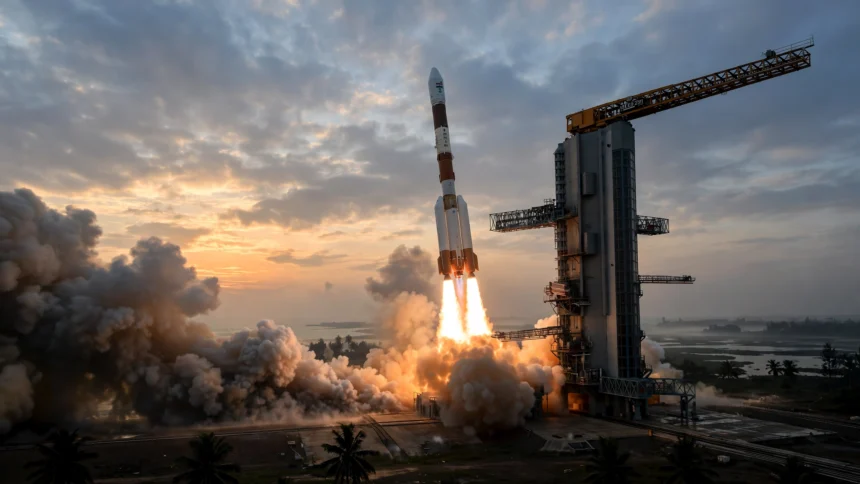
India’s most reliable rocket is about to change hands, at least in part. The first Polar Satellite Launch Vehicle built entirely by Indian industry, PSLV-N1, is ready for its maiden flight in the first quarter of 2027, ISRO chairman V Narayanan said on Tuesday. For more than three decades, ISRO alone built every PSLV. Now a consortium of Hindustan Aeronautics Ltd (HAL) and Larsen and Toubro (L&T) has taken over the job.
What the ISRO chief announced
Speaking on the sidelines of the India International Space Conclave in New Delhi on November 24, Narayanan confirmed the first industry-built PSLV is getting ready for launch in the first three months of 2027. “Earlier it was built only by ISRO through the support of the industry, but now the L&T and HAL consortium has been given five PSLVs,” he said.
India currently has only 56 space assets in orbit, and Narayanan said the country needs far more satellites for communication, navigation and earth observation. “We need to build a lot of space assets. This cannot be done by the government sector alone,” he said.
From supplier to builder: the Rs 860 crore deal
The HAL-L&T consortium won the contract in September 2022 from NewSpace India Ltd (NSIL), ISRO’s commercial arm. The deal, worth Rs 860 crore, covers the end-to-end manufacturing, assembly and integration of five PSLV-XL rockets under a Government-Owned, Contractor-Operated model. ISRO retains ownership of the rockets, while the consortium builds them.
That is a big change from the old arrangement. Until now, private companies supplied parts and subsystems while ISRO did the final assembly itself. Under the new contract, HAL and L&T, in a 52:48 partnership, take responsibility for the whole rocket. The PSLV is a proven design flying since 1993, so the consortium is manufacturing a rocket with a long track record rather than designing a new one.
A timeline that slipped three times
The road to PSLV-N1 has been slower than planned. The original agreement set a 24-month deadline for the first rocket, which meant a rollout by 2024, followed by one rocket every six months. The maiden flight was then pushed to 2025, then to 2026, and now to the first quarter of 2027.
- September 2022: NSIL awards the Rs 860 crore contract to the HAL-L&T consortium for five PSLV rockets.
- 2024: Original deadline for the first industry-built PSLV under the contract. Missed.
- 2025-2026: Launch target pushed back twice as manufacturing and integration took longer than planned.
- Q1 2027: New target confirmed by ISRO chairman V Narayanan on November 24, 2026.
The delays are not unusual for a first-of-its-kind handover. Building a complete launch vehicle meant the consortium had to set up new assembly lines, processes and quality checks. The question now is whether the first flight in early 2027 can put the programme back on a steady rhythm of one rocket every six months.
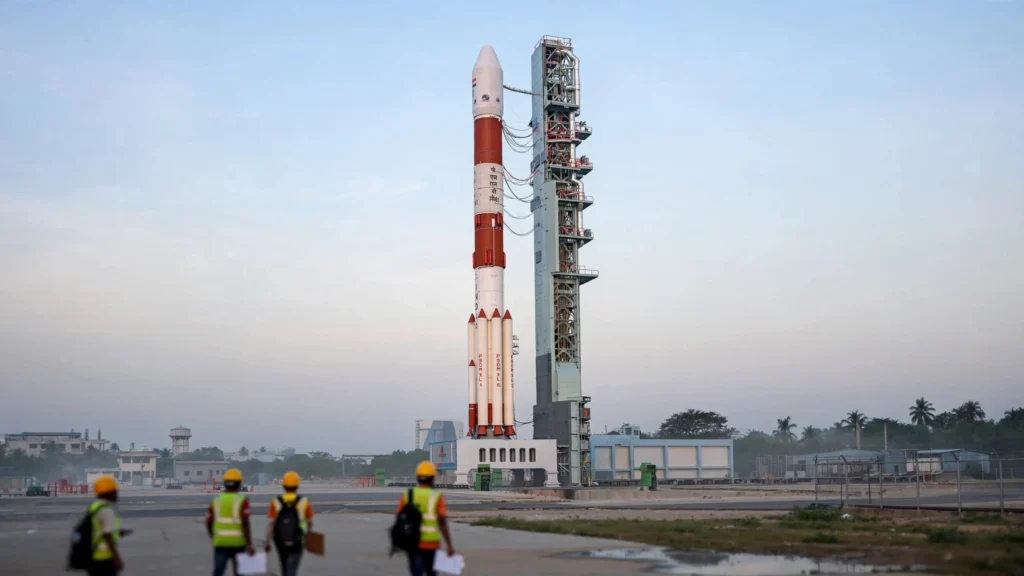
Why it matters
The PSLV-N1 flight is less about one rocket and more about who builds India’s rockets from here on. ISRO’s own launch capacity is limited, and every PSLV it assembles in-house is one it cannot spend on newer programmes such as Gaganyaan and the planned space station. Handing the PSLV line to industry frees ISRO’s engineers for those bigger missions.
The numbers behind the announcement tell the same story. India has 56 space assets in orbit today, a small fleet for a country of its size and ambitions. At the same time, the number of space startups has grown from one to more than 440, according to Narayanan. Those startups need launches regularly, and a private PSLV production line is the most direct way to give them rides to orbit without waiting in ISRO’s queue.
Gaganyaan and the Vikram-32 chip
Narayanan also used the conclave to update two other programmes. He said the Gaganyaan human spaceflight mission is not delayed, calling it a technology-intensive activity in its final phase. The rocket and other items are ready, he said, and work is continuing on the orbital module.
He also said ISRO and the Semiconductor Laboratory in Chandigarh have developed the Vikram-32 processor, and that the chip is set to be inducted. A homegrown processor for space applications fits the same pattern as the PSLV handover: building core capability inside India rather than depending on imports.
Frequently asked questions
What is PSLV-N1?
PSLV-N1 is the first Polar Satellite Launch Vehicle built entirely by Indian industry, by a consortium of HAL and L&T. It is the first of five PSLV rockets the consortium is contracted to build.
When will PSLV-N1 launch?
ISRO chairman V Narayanan said on November 24, 2026 that the maiden launch is targeted for the first quarter of 2027.
How much is the HAL-L&T PSLV contract worth?
The contract, awarded by NSIL in September 2022, is worth Rs 860 crore and covers five PSLV-XL rockets.
Who owns the PSLV-N1 rocket?
ISRO retains ownership of the rockets. The consortium handles manufacturing, assembly and integration under a Government-Owned, Contractor-Operated model.
How many space startups does India have now?
According to the ISRO chairman, the number has grown from one to more than 440.
India’s space programme has spent years opening its doors to private companies. With PSLV-N1, the door is now open all the way to the launch pad. If the rocket flies in early 2027 as planned, it will mark the moment India’s workhorse rocket became a product of Indian industry.