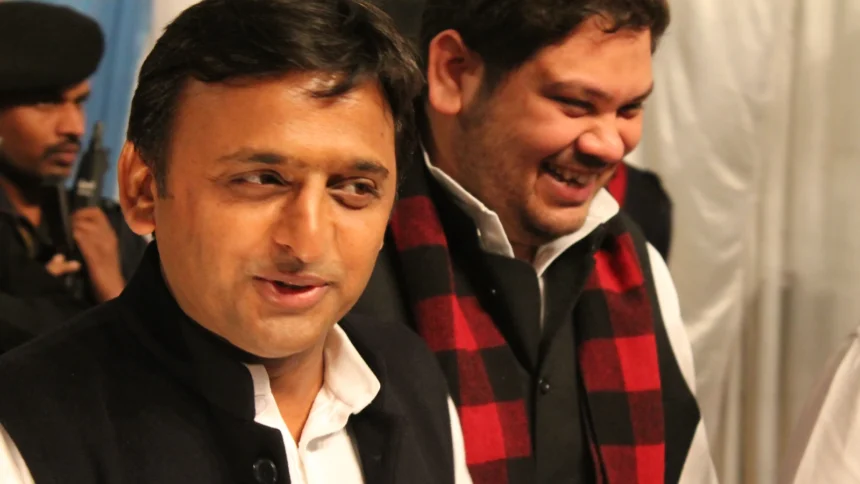
Uttar Pradesh has its first big document of the 2027 Assembly election season. On Constitution Day, November 26, Samajwadi Party chief Akhilesh Yadav released his party’s manifesto in Lucknow, titled “Sattais Ka Sankalp: PDA Ka Pran Patra”, and built it around the two words every party in the state is now chasing: jobs and welfare.
The headline numbers are striking. The manifesto promises 25 lakh government jobs over five years, employment opportunities for two to three crore young people, a monthly allowance of Rs 5,000 for unemployed graduates, meals at Rs 5 through Samajwadi canteens, and an annual pension of Rs 40,000 for elderly women. For farmers, it promises an immediate loan waiver and a legal guarantee for minimum support price on all 23 crops, and milk.
The release comes months before Uttar Pradesh votes in early 2027, and it sets the terms of the campaign the Samajwadi Party wants to fight.
What the manifesto promises
Jobs sit at the centre of the document. Alongside the 25 lakh government jobs and the two to three crore wider employment opportunities, the party has proposed an Urban Employment Guarantee Act for young people in cities, an annual calendar of vacancies and examinations, and a time-bound, transparent recruitment process. The Rs 5,000 monthly allowance would go to unemployed graduates until they find work, and officials and ministers would be held personally accountable for examination paper leaks.
For women and households, Samajwadi canteens would serve meals for Rs 5 to women and economically weaker sections, elderly women would receive Rs 40,000 a year as pension, and the manifesto proposes 33 per cent reservation for women in new police recruitments.
On agriculture, the party promises a farm loan waiver with immediate effect, a legal MSP guarantee for all 23 crops and milk, a price compensation mechanism for produce such as potatoes, tomatoes and onions, free electricity for farm irrigation, and up to 300 units of free electricity for rural domestic consumers. A Rs 15,000 crore corpus fund would ensure sugarcane growers receive payment within 24 hours.
In education, the manifesto promises to reopen 26,000 primary schools that the party says were shut by the current government, revive the free laptop scheme for students passing Class 12, provide free Metro rides for students, and allocate 6 per cent of the state’s gross domestic product to education. On health and social security, it offers Rs 10 lakh health insurance for people below the poverty line and the restoration of the Old Pension Scheme.
The PDA pitch, explained
PDA stands for Pichhda, Dalit and Alpsankhyak, backward classes, Dalits and minorities. It is the coalition Akhilesh Yadav has built his party’s recent politics around, and the manifesto is written as a contract with it.
The social justice section promises a caste census in Uttar Pradesh, 50 per cent reservation for Dalits in government-related opportunities and contracts, a PDA quota in government contracts worth up to Rs 50 crore, a Dalit Development Council chaired by the Chief Minister, and a Dalit Startup Fund. The caste census promise is the sharpest part of the document: it links directly to the national debate over counting caste in the Census, and gives the party a concrete policy to offer the communities it claims to represent, rather than only symbolism.
Why it matters
Manifestos in Indian elections are often dismissed as wish lists, but this one matters for three reasons, and each of them reaches beyond the Samajwadi Party itself.
First, it makes jobs the central question of the Uttar Pradesh election. The state has one of the largest pools of government job aspirants in the country, and recruitment exams and paper leaks have been a live political wound for years. By promising 25 lakh government jobs with an annual recruitment calendar, the party is speaking directly to that anxiety, and forcing every other party to answer with its own jobs number.
Second, the manifesto shows how the PDA formula has matured from a slogan into a governing pitch. In the 2024 Lok Sabha election, the Samajwadi Party won 37 of Uttar Pradesh’s 80 seats on the back of this coalition, its best ever performance in the state. The manifesto converts that coalition into policy: a caste census, reserved shares in contracts, a development council, a startup fund.
Third, the document tests the limits of welfare politics. Rs 5 meals, a Rs 5,000 monthly allowance, a Rs 40,000 pension, a farm loan waiver, free electricity and free laptops together would cost an enormous amount, and the manifesto does not explain how they would be funded. That is the question the party will face through the campaign: whether voters see the promises as a credible plan or as a bidding war. There is also a quiet continuity worth noting: the free laptop scheme revives a programme from the party’s 2012 to 2017 government, and the 300 units of free electricity echoes its 2022 manifesto.
What happens next
The Bharatiya Janata Party has already attacked the document. The Uttar Pradesh BJP chief dismissed it as a “Dhakosla Patra”, a bundle of false promises, and the party is expected to counter with its own record on welfare schemes and infrastructure. The real test will be whether the BJP answers the jobs promise with a number of its own. Seat-sharing talks between the Samajwadi Party and its INDIA bloc ally, the Congress, remain unsettled. With the election due in early 2027, this manifesto is the opening bid, not the final word.
Frequently asked questions
When will the Uttar Pradesh Assembly elections be held?
The elections are due in early 2027. The current Assembly’s term runs to March 2027.
What does PDA mean in the Samajwadi Party manifesto?
PDA stands for Pichhda (backward classes), Dalit and Alpsankhyak (minorities). It is the social coalition the party has built its recent politics around.
What is the Rs 5 meal promise?
The manifesto promises Samajwadi canteens serving meals for Rs 5 to women and economically weaker sections, alongside a Rs 40,000 annual pension for elderly women.
What does the manifesto promise farmers?
An immediate farm loan waiver, a legal guarantee for minimum support price on all 23 crops and milk, free electricity for irrigation, and a Rs 15,000 crore fund to ensure sugarcane growers are paid within 24 hours.
Does the manifesto promise the Old Pension Scheme?
Yes. It promises the restoration of the Old Pension Scheme for government employees, along with Rs 10 lakh health insurance for people below the poverty line.
The 2027 Uttar Pradesh election now has its first full manifesto.