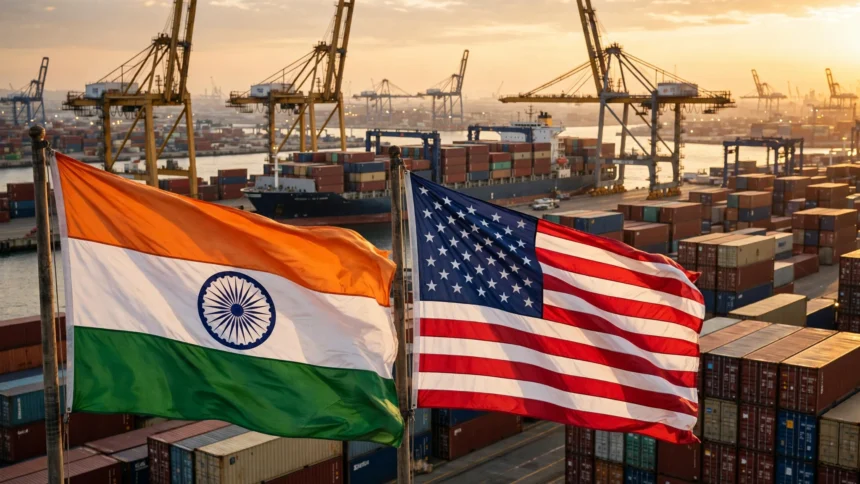
After more than a year of tough, stop-start negotiations, the India-US trade deal is finally within touching distance. That is the message ringing out of New Delhi this week, with both Indian and American officials saying the agreement is in its final stretch and close to being signed.
The strongest signal came on Thursday from US Ambassador to India Sergio Gor, who told business leaders that the negotiations were moving at an “incredible pace” and that the two sides were very close to landing the pact. Hours later, Commerce Minister Piyush Goyal confirmed that the first tranche of the deal has been finalised and is now going through legal drafting.
What was announced on Thursday
Speaking at the Bloomberg New Economy Forum in the capital, Gor said the big issues between the two sides were settled and only the finer details remained. He put it plainly: “The big picture, the big framework, the big items are done.”
Goyal, addressing the SRCC Centenary Conclave in New Delhi the same day, said the first tranche of the bilateral trade agreement was undergoing its “final contours” and legal drafting, adding that he hoped it would be wrapped up soon. He stressed that the deal would be operationalised only once India secured a comparable or competitive advantage over its peer countries.
Trade Secretary Rajesh Agrawal echoed that optimism at a media briefing on trade data. “We anticipate concluding and signing the trade deal at the earliest possible time,” he said, adding that India was pushing for preferential market access and greater tariff stability under the agreement.
The tariff question hanging over the deal
Tariffs remain the heart of the negotiation. Earlier this year, the two sides agreed to a framework that brought the punitive 50 percent tariff on most Indian goods down to 18 percent. That tariff had been imposed in August 2025 after an earlier round of talks collapsed.
Now, India wants to make sure its exporters are not left worse off than rivals. Goyal made it clear that New Delhi will move forward only if Indian goods get a tariff edge over competing economies such as Bangladesh, Vietnam and Indonesia in the US market.
- India’s goods exports to the US rose to $42.79 billion in April-August, up from $40.39 billion a year earlier.
- India recorded a trade surplus of nearly $34 billion with the US in fiscal year 2025/26.
- New Delhi wants its exporters to face tariffs no higher than those imposed on competing economies.
A separate complication is new US legislation that allows President Donald Trump to impose tariffs of up to 100 percent on buyers of Russian oil and gas. Asked about it on Thursday, Gor said the decision rested with Trump and would be taken “over the next few days.” He added that the measure was not aimed at India or any specific country, but designed to pressure Russia to help end the war in Ukraine. “It just happens that India does fall in one of those buckets, along with a lot of other countries,” he said.
Why the timing matters
The flurry of statements comes just ahead of US Secretary of State Marco Rubio’s visit to India, scheduled from October 17 to 22. Rubio is expected to meet government and business leaders to discuss energy cooperation, commercial investment and broader economic ties, with stops in Mumbai and Jamnagar as well.
External Affairs Minister S Jaishankar had set the tone earlier this week, saying he was encouraged by the progress in the talks and that both sides were “heading toward a landing point” after more than a year of negotiations.
The deal is also being framed as part of a much wider partnership. Gor described India as a trusted strategic partner of the United States and pointed to growing American investment in the country, naming Google, Microsoft, Adobe and Micron among the firms deepening their presence. He said expanding cooperation in artificial intelligence, clean energy and civil nuclear power would create new opportunities for both countries.
For Indian exporters, who have lived under tariff uncertainty for over a year, the prospect of a signed deal with stable, preferential access to the world’s biggest consumer market would be a genuine turning point. Whether the finish line is crossed this month or next, the direction of travel is now unmistakable.
FAQs
What is the India-US trade deal about?
It is a bilateral trade agreement under negotiation for about a year and a half, aimed at lowering tariffs, securing preferential market access and giving Indian exporters tariff stability in the US market.
How far have US tariffs on Indian goods come down?
A framework agreed in February brought the punitive 50 percent tariff imposed in August 2025 down to 18 percent on most Indian goods. The ongoing talks aim to lock in further relief.
What is India demanding before signing?
Commerce Minister Piyush Goyal has said India will proceed only if its exporters get a comparable or competitive advantage over rival exporting countries like Bangladesh, Vietnam and Indonesia.
When will the deal be signed?
No date has been announced. Trade Secretary Rajesh Agrawal said both sides anticipate concluding and signing it at the earliest possible time, partly depending on the US formalising its overall tariff structure.
Could US tariffs on Russian oil purchases affect the deal?
New US legislation allows President Trump to impose up to 100 percent tariffs on buyers of Russian oil and gas. US Ambassador Sergio Gor said Trump would decide “over the next few days” and that the measure is not aimed at any specific country.
India’s exporters and policymakers will be watching the coming weeks closely. If the optimism in New Delhi holds, the long wait for a settled India-US trade pact may finally be over.