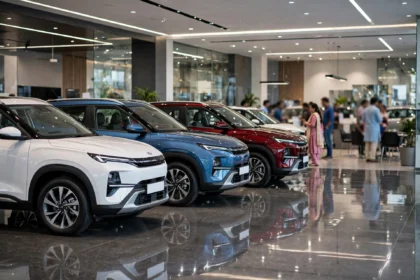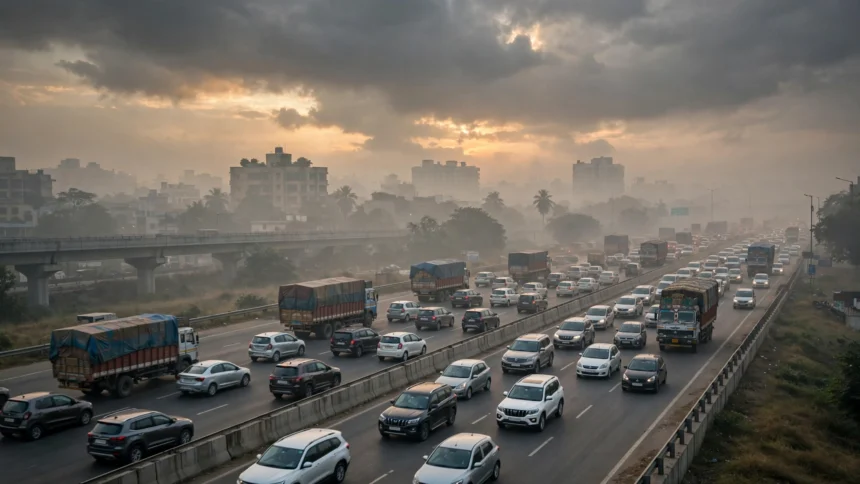
If you thought the BS6 jump was the end of the story for emission norms in India, think again. On Wednesday, the Ministry of Road Transport and Highways released the draft for Bharat Stage 7 (BS7), proposing a phased rollout from April 2029 to 2035. This time the target is bigger than the tailpipe: your brakes, your tyres, and even your EV battery are coming under the scanner.
The draft timeline has been approved in principle, giving automakers roughly two and a half years to prepare. Here is what it changes for cars on the road and the ones in showrooms today.
When BS7 kicks in: a six-year phased rollout
Unlike the overnight BS4 to BS6 switch in April 2020, the government is giving the industry room to breathe:
- April 2029: New passenger vehicles (M1 category) manufactured from this date come under BS7. This is the phase that affects car buyers directly.
- April 2031: Phase two adds requirements for passenger vehicles, while trucks and buses enter the regime.
- April 2035: The final phase completes the transition.
Light commercial vehicles and pickup vans are proposed to move to BS7 in 2030, with further phases in 2032 and 2035, while a separate timeline for two-wheelers will be notified later. The framework is aligned with Europe’s Euro 7 regulations.
For the first time, your brakes and tyres are regulated
Until now, emission norms in India have been all about the exhaust pipe. BS7 extends regulation beyond the tailpipe for the first time, covering pollution from brake particle emissions and tyre abrasion. As vehicles get heavier, especially EVs with big battery packs, the fine dust from brake pads and tyres has become a growing share of traffic-related particulate pollution.
Independent testing agencies will also conduct market surveillance, so a car can be checked for compliance even after it has been sold and driven for years.
Stricter testing, not just stricter limits
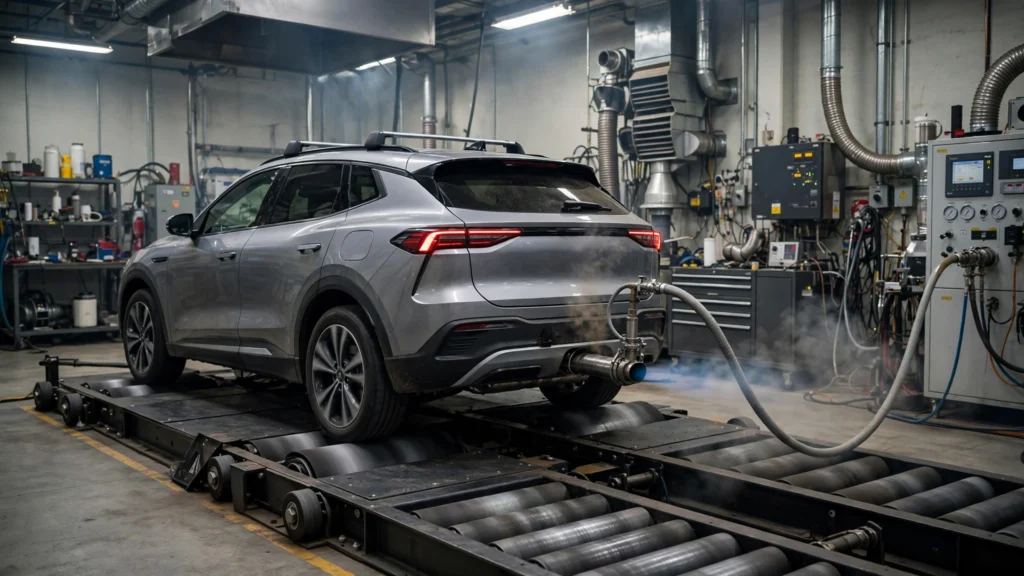
This is where BS7 differs sharply from the BS4 to BS6 leap. The proposed limits for most gaseous pollutants in passenger cars stay largely the same as BS6. What changes is how compliance is enforced.
- Real-world limits tightened: The conformity factor for NOx and particle number is proposed at 1.0, tightened from 1.43 and 1.5 under BS6. What the lab measures must now match what the car emits on real roads.
- Finer particles caught: The minimum particle size counted drops from 23 nanometres to 10 nanometres.
- WLTP testing: Emissions will be tested on the Worldwide Harmonised Light Duty Test Procedure, with on-road testing using portable equipment from April 2030.
- Onboard monitoring: Cars will carry systems that track NOx and particulate emissions and flag levels exceeding 2.5 times the limits. Fuel and electricity consumption data will eventually be shared anonymously over the air.
- Longer accountability: Compliance will be checked over 1,60,000 km or eight years, stretching to 2,00,000 km or ten years for gaseous pollutants.
The proposed limits include NOx at 60 mg/km for petrol and 80 mg/km for diesel, particulate matter at 4.5 mg/km, and carbon monoxide at 1,000 mg/km for petrol cars.
Good news for EV owners: battery durability rules
The draft sets minimum battery durability for EVs and plug-in hybrids manufactured from April 2029: at least 75 percent of original capacity for up to five years or 1,00,000 km, and 67 percent for up to eight years or 1,60,000 km. This tackles the biggest worry of EV buyers: the most expensive part quietly degrading. An environmental vehicle passport is also proposed.
What this means for your next car purchase
If you are buying a car this year or next, relax. Existing vehicles, including everything compliant with BS6, will not be affected. The industry will not need changes to refinery infrastructure this time, so there is no fuel-availability drama ahead. Automakers will still need to upgrade engines and emissions-control systems, which could nudge prices up as 2029 approaches. For heavy-duty vehicles the norms target emission reductions of 20 to 50 percent across major pollutants.
One caveat: this is still a draft, and the proposed requirements and dates can change before the final notification. But the direction is clear: the next generation of cars will be watched long after they leave the showroom.
Frequently asked questions
When will BS7 norms come into effect?
The draft proposes April 2029 for new passenger vehicles, with further phases in April 2031 and April 2035.
Will BS7 affect my current BS6 car?
No. Existing vehicles remain unaffected. The norms apply only to vehicles manufactured on or after the rollout dates.
What is new in BS7 compared to BS6?
For the first time, brake wear and tyre abrasion are regulated. Real-world monitoring is tightened with a conformity factor of 1.0, finer particles down to 10 nm are measured, and cars carry onboard systems tracking emissions through their operating life.
Do BS7 norms apply to electric vehicles?
Yes, in a new way: minimum battery durability of 75 percent capacity up to five years or 1,00,000 km, and 67 percent up to eight years or 1,60,000 km.
Will two-wheelers come under BS7?
A separate timeline for two-wheelers will be notified later. The current draft covers passenger vehicles, light commercial vehicles, trucks, and buses.
That is the full picture for now.