The Congress on Saturday launched a sharp attack on the Centre over its decision to amend the Census Rules for the 2027 headcount, accusing the BJP-led government of pursuing a political agenda through a seemingly routine administrative change. Party general secretary Jairam Ramesh said the move to widen the pool of eligible enumerators carried “much mischief” and could compromise the credibility of the decennial exercise.
The war of words erupted a day after the Ministry of Home Affairs notified the Census (Amendment) Rules, 2026, which allow states and Union Territories to appoint teachers from aided and unaided private institutions, among others, as census officers.
What the new rules change
The gazette notification, issued on Friday by Registrar General of India and Census Commissioner Mrityunjay Kumar Narayan under Section 18(1) of the Census Act, 1948, specifies three categories of people who can now be engaged as enumerators:
- Teachers of any educational institution of the government, local authority, aided or unaided private bodies, societies or trusts;
- Clerks or any official of the central or state government, local authority or establishment, including public sector undertakings, statutory bodies, banks, companies, institutions, societies and trusts;
- Any person whom the state government or Union Territory administration considers suitable for the job.
The amendment replaces the earlier entries against serial number 5 in the table under Rule 3 of the Census Rules, 1990, which had simply said “teachers, clerks or any official or any other person” could be appointed, without explicitly specifying private institutions.

Why the change was made now
The timing is significant. The amendment follows a legal challenge in the Punjab and Haryana High Court, where the Haryana Progressive Schools Conference petitioned against orders deploying teachers from private unaided schools for Census duty. The petitioners argued that the Centre lacked the legislative authority to mandate their deployment, since the 1948 Act and the 1990 Rules were silent on engaging private institution staff.
The High Court stayed the operation of two Haryana government orders and sought details of the availability of teachers for Census duty. With the case’s next hearing scheduled for April 29, 2027, Friday’s amendment appears designed to give the deployment of private school teachers explicit legal backing before enumeration begins.
Congress calls it a job guarantee for RSS workers
Jairam Ramesh took to X on Saturday to fire the first salvo. “The Modi govt has now expanded the list of eligible enumerators for Census 2027. There is much mischief behind it,” he wrote, calling the move a “Rozgar Guarantee Yojana for thousands of RSS/BJP workers” that would “most certainly further contaminate” an “already subverted” Census.
The Congress leader linked the notification to two developments. First, an RSS training camp held in Belgaum from July 10 to 12, 2026, which he claimed focused on preparations for Census 2027. Second, a high-level committee on demographic changes constituted by the Union home ministry on May 26, 2026, which invited public inputs, including from Indian and foreign organisations, on October 14.
“Another institution being destroyed,” Ramesh said, framing the amendment as part of a pattern in which the government weakens independent institutions and fills them with loyalists.
What the 2027 Census looks like
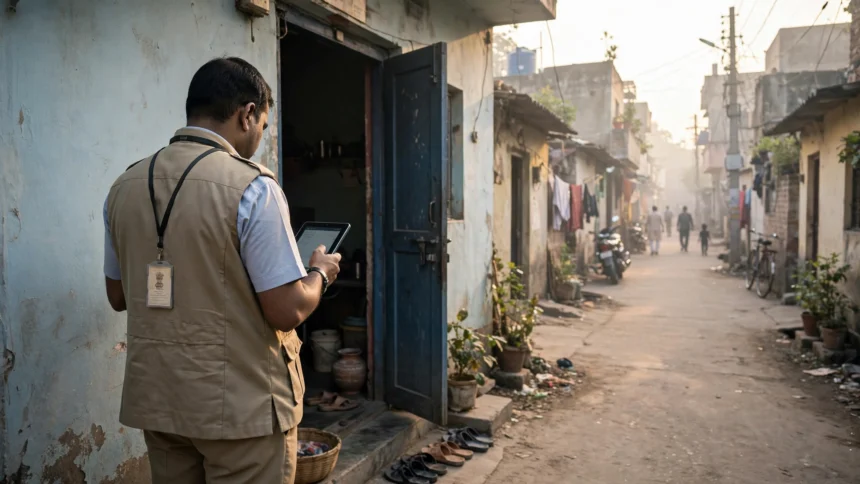
The upcoming exercise, India’s first fully digital Census, will collect demographic, socio-cultural and economic data, along with information on migration and fertility characteristics of individuals in each household. It will be conducted in two phases, with a substantial budget approved for its execution.
Because of upcoming elections, enumeration in certain states is set to begin from December 1, 2026. For the rest of the country, the exercise is likely to start next February.
Why this fight matters
The Census is the backbone of governance in India. Its numbers determine everything from parliamentary seat boundaries to the share of welfare funds states receive. Any question mark over the neutrality of enumerators can quickly turn into a political storm, and the Congress has clearly decided to make this its latest battleground against the Election Commission-adjacent institutions it accuses the BJP of capturing.
The government, for its part, has maintained that the amendment is a practical measure to address staffing shortages and the legal challenge, and that enumeration will be conducted with full integrity. But with the Census now entangled in court cases and political accusations, the headcount of 2027 is shaping up to be the most contested in India’s history.
Frequently asked questions
What did the Centre change in the Census Rules?
It amended the Census Rules, 1990, to explicitly allow states and Union Territories to appoint teachers from aided and unaided private institutions, clerks and officials from various establishments, and any person deemed suitable, as Census 2027 enumerators.
Why did the Congress object to the change?
Congress leader Jairam Ramesh alleged the expanded enumerator pool was a “Rozgar Guarantee Yojana for thousands of RSS/BJP workers” and said the move carried “much mischief” that could compromise the credibility of the Census.
What triggered the amendment?
The Punjab and Haryana High Court stayed Haryana government orders deploying private school teachers for Census duty after a petition argued there was no statutory authority for such deployment. The amendment gives the deployment explicit legal backing.
When will Census 2027 enumeration begin?
In some states, enumeration is set to begin from December 1, 2026, because of upcoming elections. For the rest of the country, it is expected to start next February.
Will Census 2027 be digital?
Yes. It will be India’s first fully digital Census, with enumerators expected to use electronic devices instead of paper schedules for data collection.
As the countdown to the first phase begins, all eyes will be on whether the controversy forces the government to rethink the enumerator roster, or whether the fight over who counts India becomes the story of the Census itself.