The National Medical Commission has drawn a firm line on how doctors and hospitals in India can promote themselves. In a public notice issued on October 6, the NMC’s Ethics and Medical Registration Board released detailed guidelines on ethical advertising and public communication by hospitals, medical institutions and registered medical practitioners, and said the rules come into force with immediate effect.
The official public notice (PDF), signed by NMC Secretary Dr. Raghav Langer, states that the guidelines were framed in view of a Supreme Court writ petition and the Indian Medical Council’s professional conduct regulations of 2002. The stated objectives include preserving the dignity of the medical profession, preventing the commercialization of healthcare, and protecting patients from misleading medical claims.
What the new guidelines cover
The guidelines apply to the professional conduct of registered medical practitioners in relation to advertising, publicity, digital communication and promotional activities. They also cover hospitals and medical institutions, and are meant to address the gap created by the rise of electronic and social media in healthcare marketing.
Crucially, the definition of advertisement is wide. It covers digital, social media, sponsored, targeted and influencer-led promotions, as well as AI-generated or AI-assisted promotional communication, wherever the content or manner of dissemination has a promotional character. The NMC makes it clear that routing an advertisement through a digital platform, third party, advertising agency or influencer does not absolve the doctor or hospital of responsibility for content it authorized or knowingly permitted.
Key prohibitions for doctors and hospitals
The notice lists an extensive set of practices that registered medical practitioners and clinical establishments must avoid:
- No advertisements intended to create unnecessary demand for medical procedures, promote unnecessary diagnostics, or use fear-based marketing.
- No direct or indirect solicitation of patients through self-promotion, and no hiring third parties to market medical services.
- No exaggerated or unverifiable claims such as “guaranteed cures”, “best doctors”, “No.1 specialist”, “100% success”, “painless treatment” or “miracle treatment”.
- No endorsing drugs, devices, remedies or health products using the doctor’s name, photograph, voice or professional status, whether or not money changes hands.
- No publishing cases for promotional purposes, no advertising surgical results, no “before and after” photographs, and no publicizing celebrity patients, except for strictly scientific or educational purposes with anonymized consent.
- No fake, paid or misleading patient reviews, ratings or testimonials. Doctors must not request or share patient testimonials for professional promotion on social media.
- No commission, referral fee, lead-generation fee or other consideration linked to the promotion of medical services.

Strict rules on AI-generated promotions
In a first for Indian medical regulation, the guidelines directly address artificial intelligence. AI-generated promotional campaigns for commercial interest are prohibited. Where AI-generated or materially AI-altered content is otherwise compliant, it must compulsorily carry a source mark explicitly stating that its origin is AI.
The rules further bar using AI to create or manipulate a patient’s image, testimonial, voice or clinical outcome, or to fabricate a synthetic endorsement purporting to be that of an actual patient, doctor or any other person. Any use of patient information as input for an AI system must comply with privacy, data-protection and professional-ethics requirements.
Patient privacy gets strong protection
Patient information, photographs, videos, medical records, clinical images and treatment details cannot be used for advertising unless permitted by law and backed by duly obtained consent. Even where disclosure is lawful, hospitals and doctors must crop, blur or black out birth marks and identification marks, and avoid unnecessary disclosure of names.
Notably, patient consent alone does not make a prohibited testimonial or before-and-after depiction permissible. The guidelines also prohibit sharing identifiable patient data such as names, faces or anomalies on public platforms.
What is still allowed
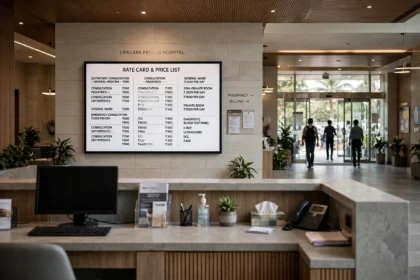
The guidelines are not a blanket ban on communication. Doctors may take part in health awareness programmes, public health campaigns and academic discussions, provided these do not promote personal practice and are not monetized through promotional marketing. Factual information about infrastructure, facilities, equipment and diagnostic services may be shared, as long as it carries no claims of superiority, guaranteed outcomes or comparative boasts.
Hoardings and billboards in public spaces may be used only for factual information. Campaigns on government programmes and schemes in larger public interest are fully exempt from the guidelines.
What this means for patients
For patients, the change should make healthcare advertising more trustworthy. Flashy claims of miracle cures, paid five-star reviews and influencer-promoted treatments will now have a clear regulatory red line. Doctors posting on social media must transparently disclose their name, qualifications, registration status and registration number, so patients can verify credentials before trusting the content.
The notice has been circulated to health secretaries of all states and union territories, registrars of state medical councils, and deans of medical colleges. The full text is available on the NMC’s What’s New page, and compliance is expected from all registered medical practitioners and concerned stakeholders with immediate effect.
Frequently asked questions
When did the NMC issue these advertising guidelines?
The public notice was issued on October 6, 2026, and the guidelines came into force with immediate effect.
Do the rules apply to hospitals as well as individual doctors?
Yes. They apply to registered medical practitioners as well as hospitals and medical institutions, including their digital and influencer-led promotions.
Can doctors share patient testimonials on social media now?
No. Requesting or sharing patient testimonials, reviews or endorsements for professional promotion is prohibited, and patient consent alone does not make it permissible.
What about AI-generated hospital advertisements?
AI-generated promotional campaigns for commercial interest are prohibited. Compliant AI content must carry a clear disclosure that its origin is AI.
Where can I read the official notice?
The official public notice is available as a PDF on the NMC website’s What’s New section.
Doctors, hospitals and patients can read the complete guidelines in the official notice linked above and adjust their communication practices accordingly.