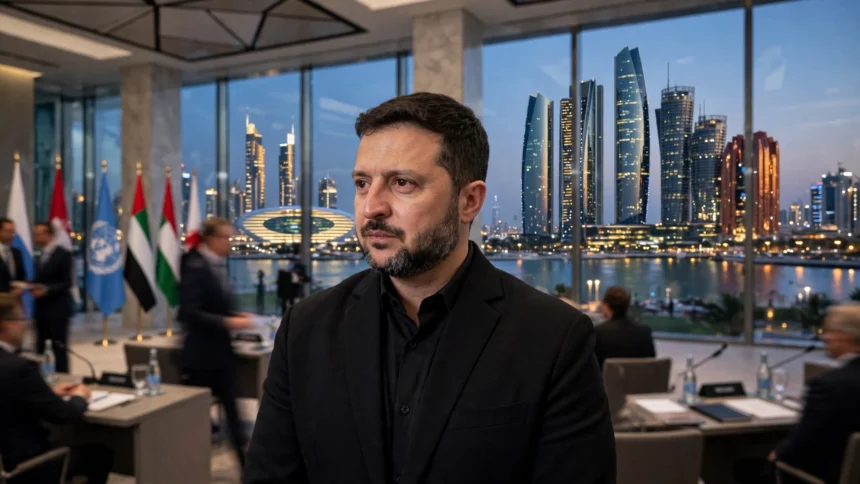
After months of silence on the diplomatic front, the war in Ukraine is back at the negotiating table. The Kremlin announced on Friday that Russia, the United States and Ukraine will hold trilateral peace talks in Abu Dhabi in the first half of November, a significant shift that suggests both Moscow and Kyiv see a window to talk after nearly a year without direct negotiations.
Kremlin spokesman Dmitry Peskov told reporters that the meeting will take place in a trilateral format and focus on what comes after a settlement, not just a pause in the fighting. His words were careful, but the intent was clear: this time, the goal is the architecture of a lasting peace.
What the Kremlin announced
According to Peskov, the talks are planned for early November in the capital of the United Arab Emirates, with security issues for both Russia and Ukraine topping the agenda once a transition to a peaceful settlement begins. He quoted President Vladimir Putin as having “outlined the subject of the negotiations: security issues for both countries, Russia and Ukraine, following the transition to a peaceful settlement.”
Peskov added that while the format is trilateral, the participation of European countries “cannot be ruled out in principle,” leaving the door open for a wider table. The announcement marks the first serious attempt to restart negotiations that have been stalled since the beginning of the year.
How we got here
The announcement did not come out of nowhere. It follows a burst of shuttle diplomacy by US special envoy Steve Witkoff, who has spent the week moving between the two sides.
- Tuesday: Witkoff met Ukrainian President Volodymyr Zelenskyy and European leaders in Oslo, part of Washington’s push to advance negotiations.
- Wednesday: Witkoff held three hours of talks with President Putin in Saint Petersburg.
- Thursday: Putin said in a televised interview that any talks would focus on security arrangements under a final peace agreement, not a short-term ceasefire.
- Friday: Both the Kremlin and Kyiv publicly confirmed readiness to resume US-mediated direct talks.
The sequence matters. Moscow and Kyiv each declared their readiness only after Witkoff had carried messages in both directions, which is why diplomats are treating this as more than a routine announcement.

Kyiv’s position
President Zelenskyy confirmed Ukraine’s readiness for the Abu Dhabi meeting on Friday in an online address to the Hudson Institute, as reported by Interfax-Ukraine. The timing at the negotiating-team level “depends on the Russian side,” he said, but the current plan points to the first half of November.
Zelenskyy also set out two conditions of his own. First, European representatives must take part in the process, a line he has repeated for months as Kyiv insists that Europe’s security is inseparable from any deal. Second, and more pointedly, he wants the talks to move from technical-level meetings to a leaders-level summit, arguing that “key issues can only be resolved at the highest level.”
There is also a visible gap on timing. Moscow has suggested the discussions could happen around November 10, while Zelenskyy has called for them to be held as soon as possible. Bridging that gap may be Witkoff’s first real test of the new round.
What is actually on the table
The substance, as described by both sides, is narrower and harder than a ceasefire. Putin’s emphasis on “security arrangements under a final peace agreement” signals that Moscow wants the end state settled first, including the security guarantees that would bind Russia and Ukraine after the guns fall silent. For Kyiv, the priority is the mirror image: guarantees that any settlement is durable and backed by Ukraine’s partners.
That is where the American mediation becomes critical. The United States has positioned itself as the channel both sides will talk through, and Abu Dhabi was chosen as neutral ground. The UAE has hosted sensitive diplomatic contacts before, and its distance from the European theatre gives both delegations political room.
The stakes are enormous. Russia launched its full-scale invasion in February 2022, and the conflict is now in its fifth year. Millions have been displaced, and the war has redrawn Europe’s security map. A failed round would confirm the pessimists; a productive one could finally open a path neither side has walked in months.
What to watch next
The immediate questions are practical. Will European representatives get a seat, or at least a formal role in the room? Will the two sides agree on the November dates, or will scheduling drift the talks deeper into winter? And perhaps most importantly, will Zelenskyy’s demand for a leaders-level meeting be met, or will this round stay at the level of negotiating teams?
For now, the fact that both Moscow and Kyiv said yes in public, within hours of each other, is the news. After a year of stalled diplomacy, the table is being set again.
FAQs
When will the Russia-Ukraine peace talks be held?
The trilateral talks are planned for the first half of November 2026 in Abu Dhabi. Russia has suggested around November 10; Ukraine wants them as soon as possible.
Who is taking part in the talks?
Russia, the United States and Ukraine in a trilateral format, with the US acting as mediator. The Kremlin has not ruled out European participation, and Zelenskyy insists European representatives must be involved.
What will the talks focus on?
Security arrangements for both Russia and Ukraine under a final peace agreement, rather than a short-term ceasefire, according to both the Kremlin and President Putin.
Why Abu Dhabi?
The UAE capital was chosen as neutral ground. It has hosted sensitive diplomatic contacts in the past, and its location gives both delegations political space away from the European theatre.
When were the last direct talks?
Negotiations have been stalled since the beginning of the year, according to the Kremlin, making the November round the first serious attempt to restart them in months.
Informeia will track the Abu Dhabi talks as dates and details are confirmed.