At least 68 people were killed on Wednesday when a high-speed train ran into the back of a stationary train near Urda in central Spain, in the second deadly railway disaster in the country this year. Rescue teams were still working through twisted carriages, and officials warned the death toll could rise further.
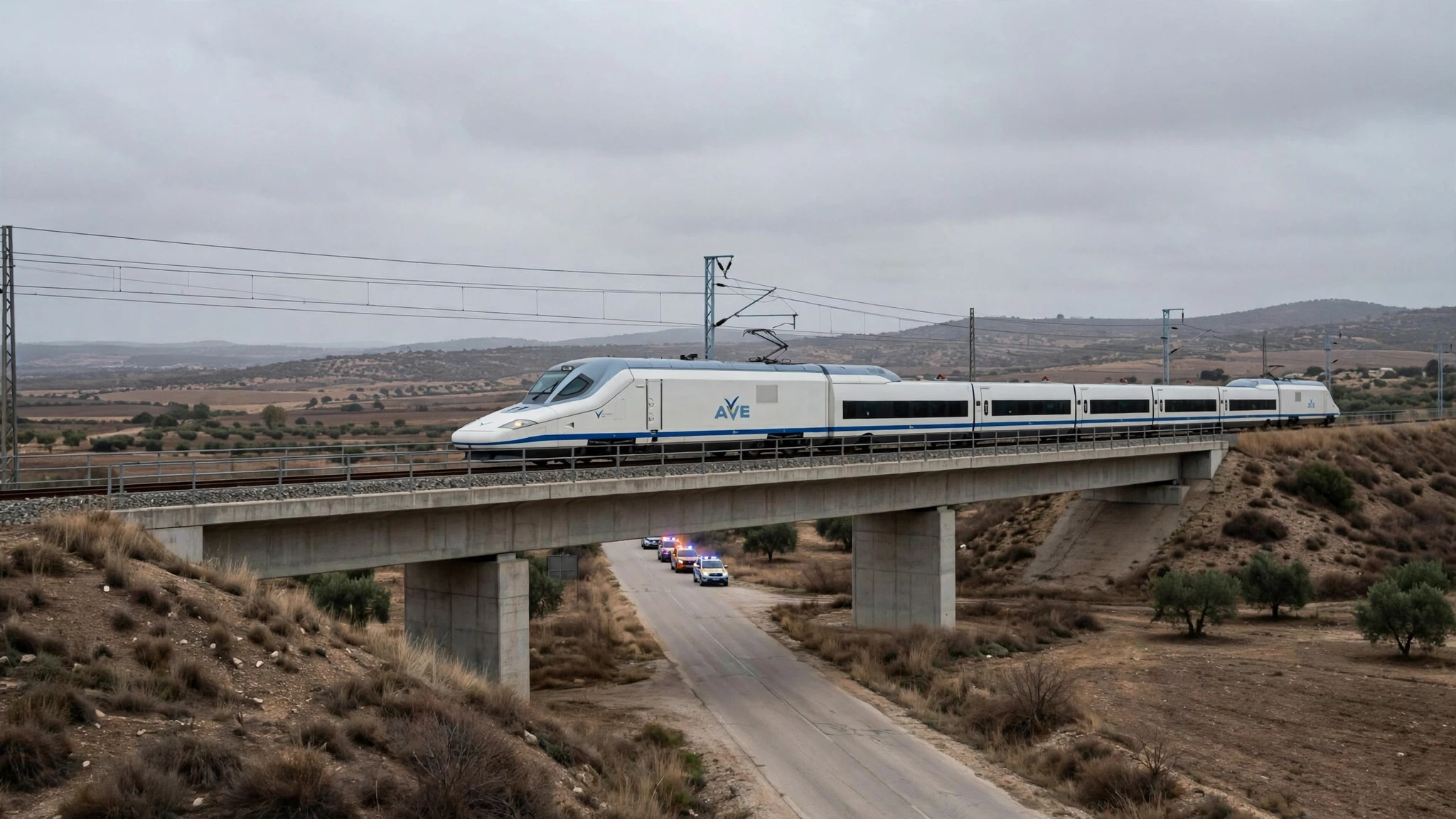
The collision happened shortly before 9am local time on the Madrid to Seville high-speed line, near Urda station in Toledo, about 120 kilometres south of Madrid. A Renfe AVE train struck an Iryo train that had stopped on the track, derailing several carriages. At least three carriages plunged down an embankment beside the elevated line.
Emiliano Garcia-Page, the president of the Castilla-La Mancha region, said 24 of the dead were travelling in the lead carriage of the AVE train and 44 were on the Iryo train, two of whose carriages were destroyed. Another 58 people were taken to hospital, 15 of them in a very serious condition. More than 540 passengers were on the two trains combined, according to regional officials.
Passengers who escaped described a sudden, violent impact. Miguel, who was travelling with colleagues in a rear carriage, told COPE radio: “We heard a massive roar, a truly enormous thud that went on for 10 seconds, as if the train were about to derail. Through the right-hand window, we could see a wrecked train.”
Survivors walked along a road near the scene, some with bandaged injuries, others wheeling suitcases while volunteers handed out water donated by neighbouring towns. Hundreds of ambulances and helicopters gathered beside the track as crews searched for people trapped in the wreckage.
What happened on the track
Early accounts agree on the basic sequence, even as the precise chain of decisions remains under investigation. The Iryo train had stopped near Toledo on instructions from Adif, the rail infrastructure manager, because of a signal fault. The Renfe train then struck it from behind at high speed.
Transport Minister Oscar Puente said the LZB control and safety system failed at around 8.30am because of a communication fault in three computers, leaving a 63-kilometre stretch without the system and automatically stopping six trains. The Adif control centre at Madrid Atocha then took over and authorised the AVE train to resume normally, despite a red signal and with no speed restriction, according to the minister.
Puente said the train travelled about 25 kilometres at close to 200 kilometres per hour before the impact. He added that the driver of another train corrected the controller, saying the order should have been to proceed “on sight”, at a maximum of 40 kilometres per hour. “A rear-end collision on the Spanish network is truly implausible,” Puente said, describing the control centre decision as inexplicable.
Renfe said after being authorised to continue its journey, its train had crashed into the Iryo train, which had remained stationary “for reasons we don’t know”. “The exact sequence of events will have to be established by the investigation,” the company said.
Rescue effort and national mourning
The Military Emergencies Unit sent 200 personnel to search the wreckage, and medical helicopters flew the most seriously injured to hospitals in Toledo and Alcazar de San Juan.
Prime Minister Pedro Sanchez said he was shocked by the accident, travelled to the scene, and declared three days of official mourning. “We will get to the bottom of this and, if there has been negligence, it will be known,” he said.
The crash is Spain’s second deadly rail accident of 2026. In January, 46 people were killed near Adamuz in Cordoba. It is also the country’s worst rail disaster since 2013, when 80 people were killed after a train derailed in north-western Spain.
The high-speed line between Madrid and Andalusia remains suspended, with no date given for reopening. The train drivers union Semaf kept in place a strike called for Thursday over rail safety. Political parties cancelled scheduled activities on Wednesday as condolences poured in.
Help for passengers and families
Renfe activated its crisis team and its assistance plan for victims and their families, and published a support telephone number, 900 10 10 20. Iryo published its own assistance number, 900 001 403. Travellers due to use the Madrid to Andalusia corridor were advised to check with their operator before travelling.
Frequently asked questions
Where did the Spain train crash happen?
Near Urda station in Toledo province, about 120 kilometres south of Madrid, on the Madrid to Seville high-speed line.
How many people were killed?
At least 68 people were killed, according to the president of Castilla-La Mancha, Emiliano Garcia-Page. Officials said the toll could rise as rescue teams continued to search the wreckage.
Which trains were involved?
A Renfe AVE high-speed train and a private Iryo train. The Renfe train struck the rear of the Iryo train, which had stopped on the track.
What caused the crash?
The cause is under investigation. Officials have pointed to a signal fault and a failure of the LZB safety system, followed by an authorisation for the Renfe train to resume at speed.
Is the Madrid to Andalusia line running?
No. High-speed services on the line were suspended after the crash, with no reopening date announced. Passengers should check with Renfe or Iryo before travelling.
Our thoughts are with the victims, their families, and everyone caught up in this tragedy. We will update this story as officials confirm more details.