
India’s school exams are quietly getting a rethink. The Council for the Indian School Certificate Examinations (CISCE) has rolled out SHINE 2026, a nationwide digital assessment that looks beyond marks to find out how children actually learn. Within 48 hours of its November 15 launch, the platform had logged more than 30 lakh student responses, with nearly 450 schools beginning testing.
The response is striking because SHINE is not an exam in the usual sense. There is no pass or fail and no rank, and the results will not be added to a student’s annual examination score. Instead, it diagnoses strengths and weaknesses at key stages of schooling, so teachers can act before small gaps become big ones.
What is SHINE 2026?
SHINE stands for Student Holistic Insight and Nurturing Evaluation, a free and mandatory diagnostic assessment for schools affiliated to CISCE, the board that runs the ICSE and ISC examinations. It marks a shift towards competency-based evaluation, in line with the National Education Policy (NEP) 2020, which places understanding, application and critical thinking above rote learning.
It is aligned with the National Curriculum Framework for School Education (NCF-SE) 2023 and CISCE’s own learning outcomes, and its findings are meant to help teachers adapt their methods to individual learning needs, rather than relying only on examination scores.

Who takes the test and what it covers
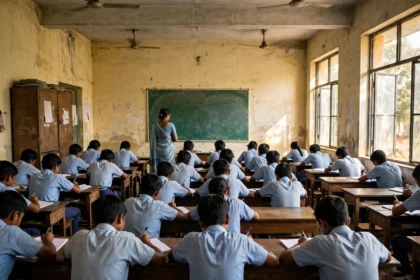
The assessment covers students of Classes IV, VI and IX, testing the competencies they are expected to have acquired by the end of Classes III, V and VIII respectively. It assesses four areas:
- English: reading, comprehension and language use
- Mathematics: foundational knowledge, reasoning and problem solving
- Science: conceptual understanding and application
- Socio-emotional competencies: how students respond to learning situations and interact with others
Class IV students take a game-based assessment, while Classes VI and IX sit a digital one. The window stays open until December 15, and schools can test in multiple batches, with different questions for each batch.
From a small pilot to a nationwide rollout
SHINE 2026 follows a pilot last year, in which around one lakh students from 273 schools took part. The scale this time is very different: about 1,800 of the Council’s 3,000-plus affiliated schools had registered by early October, and the first two days alone produced more than 30 lakh responses, thirty times the pilot’s entire student count.
CISCE chief executive and secretary Joseph Emmanuel said: “Our vision is to ensure that assessment is not merely about measuring what students know but understanding how they learn and where they need support.”
Why it matters
For parents, the most important detail is what SHINE does not do: it does not rank children, and it does not feed into board results. That separation removes the fear that usually surrounds any new test. A child who struggles with a concept in Class IV can be helped in Class IV, instead of the gap surfacing years later in a board examination.
For schools, the real value lies in the reports. Each student gets scaled scores, proficiency levels and competency bands, shown against the school average and the CISCE average. A school can therefore see not just that its Class VI students are weak in mathematics, but which specific competencies are weak, and whether the problem is shared across the board or limited to a few classrooms. A conventional report card never provides that detail.
There is a larger question here too. CISCE is also preparing to benchmark its schools against international standards through a separate study with the Organisation for Economic Co-operation and Development (OECD), drawing on SHINE and PISA for Schools. If that goes ahead, SHINE becomes the baseline against which Indian private-school learning is measured globally.
What parents and students should know
- No extra preparation is needed: the test measures what children have already learnt, not what they can memorise for a new exam.
- Results stay diagnostic: reports highlight strengths and gaps; they do not change annual results.
- Timing is flexible: schools can run it in batches until December 15, so no child faces a single-day test.
- Younger children play, older ones test: Class IV students get a game-based format, while Classes VI and IX take the digital version.
FAQs
What is CISCE SHINE 2026?
A free, mandatory digital diagnostic assessment by CISCE for students of Classes IV, VI and IX in its affiliated schools, measuring competencies in English, mathematics, science and socio-emotional skills.
Is SHINE 2026 an exam that affects board results?
No. It is diagnostic only: results are not added to annual examination results and are used to identify learning gaps and guide teaching.
When is the SHINE 2026 assessment held?
The window opened on November 15, 2026, and stays open until December 15, 2026. Schools can conduct it in multiple batches.
How many students have taken SHINE 2026 so far?
More than 30 lakh responses in the first 48 hours, with nearly 450 schools beginning testing, according to CISCE.
Who conducts SHINE 2026?
The Council for the Indian School Certificate Examinations (CISCE), which conducts the ICSE and ISC examinations, in line with NEP 2020 and the National Curriculum Framework for School Education 2023.
As the window runs into December, the numbers will keep growing. The more interesting figure will come later: what schools actually do with the gaps SHINE finds.