India has developed its first homegrown vaccine against H5N1 bird flu, and it will be dedicated to the nation on Friday, November 20. Union Agriculture Minister Shivraj Singh Chouhan will launch the vaccine at the ICAR-National Institute of High Security Animal Diseases (NIHSAD) in Bhopal, where it was developed.
The timing could hardly be sharper. Fresh outbreaks have been reported in Tamil Nadu and Andhra Pradesh in recent weeks, with tens of thousands of birds culled. Until now, India had no made-in-India vaccine against this strain, and control depended almost entirely on surveillance, culling and movement restrictions.
What the vaccine is
The vaccine is an inactivated H5N1 vaccine that targets clade 2.3.2.1a of the virus, the strain behind most recent bird flu outbreaks in chickens in India. It was developed by ICAR-NIHSAD in Bhopal, the country’s high-security animal disease laboratory.
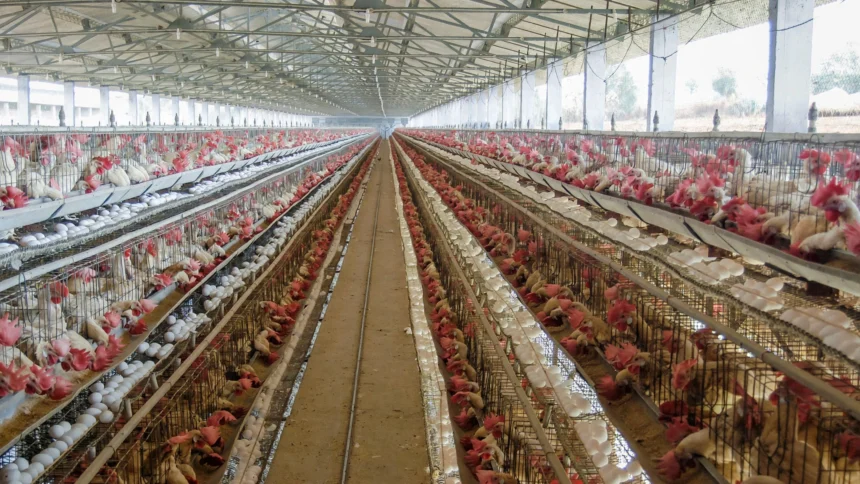
According to the government announcement, a single dose provides protection for up to six months. That makes it suitable for layer and breeder chickens, the birds that stay on farms for long production cycles.
Officials have pointed out that no specific commercial vaccine was available against the H5N1 virus of this clade until now. The indigenous vaccine adds another tool to India’s efforts to control outbreaks, alongside surveillance, testing, biosecurity and culling.
Outbreaks behind the launch
The vaccine arrives in the middle of an active outbreak season. In Tamil Nadu’s Cuddalore district, H5N1 infection was confirmed in November after sudden bird deaths at poultry farms. As of November 13, 35,647 birds had died in the affected zone, and around 40,000 chickens were culled within a one-kilometre radius. Poultry movement was restricted in the area.
Andhra Pradesh reported an outbreak in October in Anantapur district, where the state government declared infected and surveillance zones and restricted poultry movement.
Kerala is also culling thousands of birds after bird flu was confirmed at two poultry farms, with around 26,000 birds set to be culled on Wednesday. The Department of Animal Husbandry and Dairying’s 2025-26 annual report lists avian influenza outbreaks in Maharashtra, Chhattisgarh, Jharkhand, Andhra Pradesh, Madhya Pradesh, Telangana, Karnataka and Bihar.
Since the disease was first detected in India in 2006, more than 500 combined H5N1 and H5N8 outbreaks have been reported.
Why it matters
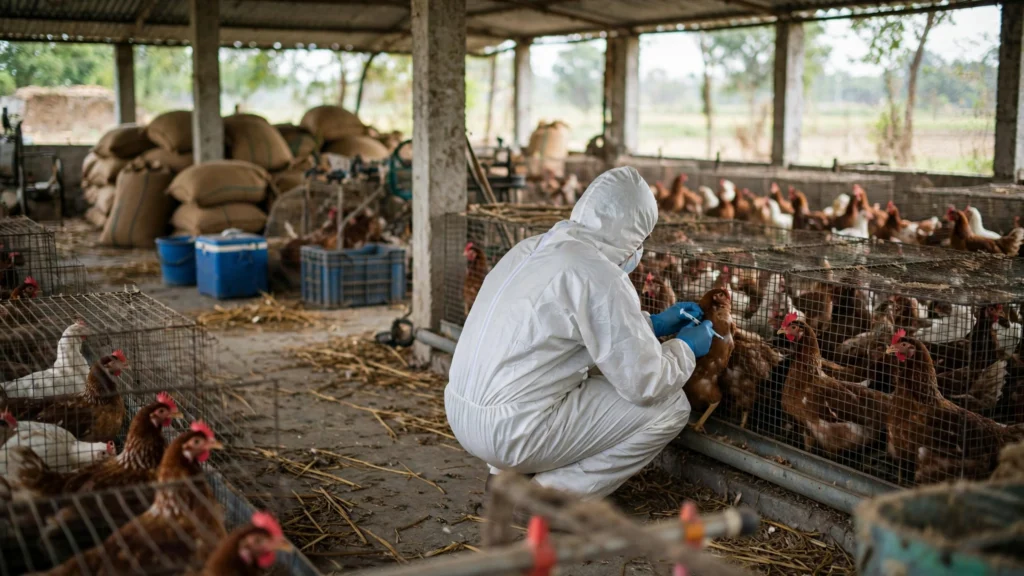
For poultry farmers, this vaccine changes the maths of an outbreak. Every H5N1 detection so far has meant the same response: birds culled, farms sealed, movement stopped, and weeks of lost income while a farm restarts from scratch. Culling protects the wider flock, but it is the farmer who absorbs the loss. A vaccine that protects a layer flock for six months with one dose gives farmers something they have never had against this strain: a way to protect birds before the virus arrives, rather than only reacting after it does.
The timing also matters for the poultry trade. India is one of the world’s largest egg and chicken producers, and repeated outbreaks disrupt supply chains and push up prices for consumers. A domestically made vaccine keeps the response faster and cheaper, and it reduces dependence on foreign suppliers at exactly the moment outbreaks are spreading across states.
There is a public health angle too. The H5N1 clade 2.3.2.1a strain has been detected in different animal species, including mammals, as well as in three human cases in India, according to the government. The World Health Organization has reported 1,003 human cases of H5N1, including 479 deaths, across 25 countries since 2003. Human infections remain rare, but every outbreak in birds is a chance for the virus to keep circulating, so controlling it in poultry is also the first line of defence for people who work with birds.
What happens next
The formal launch takes place on November 20 in Bhopal. Details on production, pricing and how the vaccine will reach poultry farmers are expected to follow the launch. For now, the existing containment measures stay in place: surveillance, testing, biosecurity and culling remain the front line, and the vaccine will work alongside them rather than replacing them.
FAQs
What is H5N1 bird flu?
It is a highly pathogenic avian influenza virus that mainly infects birds. It causes severe disease and high mortality in poultry, and outbreaks often lead to large-scale culling.
Is this vaccine for humans or chickens?
It is a poultry vaccine, designed to protect chickens from the H5N1 strain. It is not a human vaccine.
When will the vaccine be available to farmers?
The vaccine will be formally launched on November 20. Production and distribution details are expected to be announced after the launch.
Is it safe to eat chicken and eggs during a bird flu outbreak?
Properly cooked poultry meat and eggs are considered safe to eat. The risk comes from contact with sick or dead birds, not from cooked food. Anyone who finds dead birds should report them to local veterinary authorities instead of handling them.
How serious is bird flu for people?
Human cases are rare. The WHO has recorded 1,003 human cases and 479 deaths across 25 countries since 2003. The main risk is for people in close contact with infected birds, which is why controlling the virus in poultry matters for public health as well.
India’s poultry sector has lived with bird flu for two decades. With its own vaccine now ready, it finally has a homegrown shield to go with the surveillance and culling that carried the fight so far.