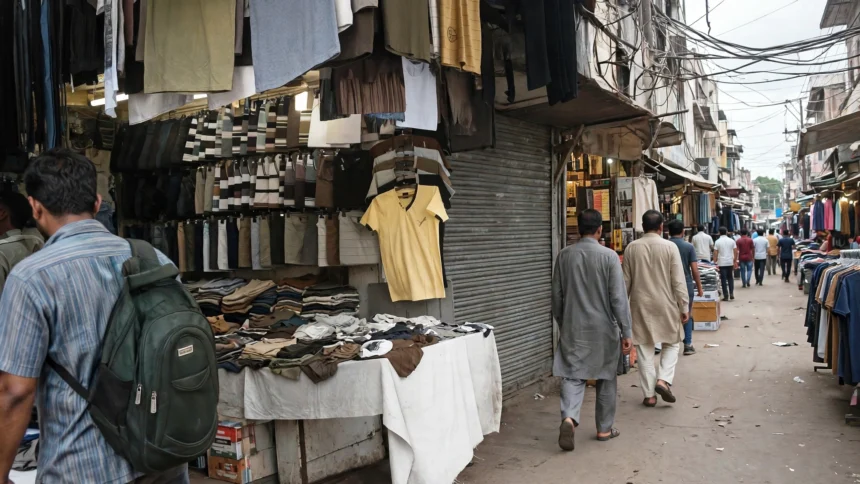
Shops were busy in August, and the official numbers now back up what many shopkeepers felt on the ground. Retail trade grew 19.9 per cent from a year earlier, the fastest rise among nineteen services sectors tracked by the government, in data released by the National Statistics Office (NSO) on Thursday, October 29.
The figures come from the trial Index of Services Production (ISP). Thirteen of nineteen sub-sectors recorded double-digit growth, up from ten in July. Seventeen expanded in all. Only air transport and arts, entertainment and recreation shrank.
Services are the largest part of the Indian economy, yet until recently there was no monthly production index for the sector to match the factory-focused Index of Industrial Production. The ISP, which uses 2024-25 as its base year and covers close to 60 per cent of services output, is meant to fill that gap.
Retail led the way, and it was not close
Behind retail came real estate and repair services, both up 17.6 per cent from a year earlier. Insurance grew 16.5 per cent and banking services rose 14.9 per cent, quickening from 12.3 per cent in July. The official data links that banking and insurance strength to a higher level of economic activity. When shops sell more, when homes change hands and when businesses borrow and insure, those service lines tend to move together.
EY India chief policy adviser D. K. Srivastava put overall ISP growth at 14 per cent in August, up from 13.5 per cent in July. The rest of the double-digit list shows how broad the month was:
- Professional, scientific and technical services, including research and development: up 14.2 per cent
- IT and computer-related services: up 13.8 per cent
- Postal and courier services: up 13.2 per cent
- Administrative and support services: up 13.1 per cent
- Accommodation and food services: up 11.9 per cent
- Telecommunications: up 11.8 per cent
- Warehousing and support activities for transportation: up 11.2 per cent
- Wholesale trade: up 10.2 per cent
Growth was more modest, but still positive, in road transport at 9.4 per cent and water transport at 9.5 per cent. According to Business Standard, eleven sub-sectors recorded a faster year-on-year growth rate in August than in July, which underlines that this was a broadening recovery rather than one strong sector carrying the rest.
The two exceptions worth watching
Air transport contracted 9.6 per cent in August compared with a year earlier, the weakest reading in the release. Arts, entertainment and recreation services fell 4.7 per cent. Those two falls sit oddly against the rest of the table, and they matter precisely because the rest of the table is so strong.
For air travel, the contrast with road and water transport is striking. For arts and entertainment, a single month does not make a trend. The next monthly release will show whether either fall was a blip or the start of something longer.
What it means on the street
For shoppers, the retail number matches everyday experience. A 19.9 per cent rise in retail trade output does not mean every shop had a record month, and the index measures output rather than profits. It does suggest that footfall and sales held up well in August, in a month when households were also dealing with higher prices for some everyday goods.
For workers, the breadth of the growth is the encouraging part. Jobs in services are spread across retail, transport, hospitality, telecom, IT and back-office work. When thirteen of nineteen lines grow in double digits, the demand for staff tends to follow, even if hiring lags the headline by a few months.
There are limits to what one month can prove. The ISP is new and August is a single reading in a series that is still being tested. The September print will be the first check on whether August was the peak of a strong patch or the middle of one.
What to watch next
Three questions will shape the coming months. Does retail stay in front as the festive season works through the data? Does air transport recover while road and water transport keep growing? And does the breadth hold, with thirteen or more sub-sectors still in double digits?
For now, August gives the services economy a clear headline: busy shops, busy banks, busy couriers, and only two sectors going backwards. The next release will tell us whether it lasts.
Frequently asked questions
What is the Index of Services Production?
It is a trial monthly index from the National Statistics Office that tracks output across nineteen services sub-sectors, using 2024-25 as the base year. It covers close to 60 per cent of services output.
Which services sector grew fastest in August 2026?
Retail trade, up 19.9 per cent from August 2025, followed by real estate and repair services, both up 17.6 per cent, and insurance, up 16.5 per cent.
How many services sectors grew in double digits?
Thirteen of nineteen sub-sectors grew in double digits in August, up from ten in July. Seventeen sub-sectors expanded overall.
Which sectors contracted in August?
Air transport fell 9.6 per cent and arts, entertainment and recreation services fell 4.7 per cent, the only two contractions in the release.
Informeia will follow the next ISP release and what it means for jobs, shops and prices across India.