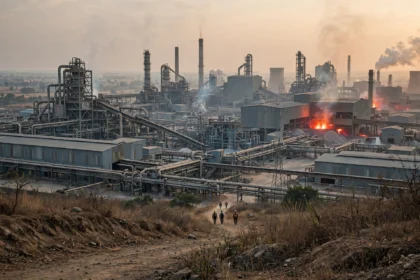
India has set itself a steep climb in steel. The government wants the country to produce 300 million tonnes of steel a year by 2030 and 500 million tonnes by 2047, nearly trebling current output. Union Coal and Mines Minister G Kishan Reddy announced the targets on Friday after the two-day 4th Conference of Mining Ministers in Goa, saying the push is meant to keep steel affordable for ordinary families as demand keeps rising.
India currently produces around 168 million tonnes of steel a year. Reaching 300 million tonnes in four years would mean adding more than 130 million tonnes of annual capacity, roughly the output of several large steel plants. The longer goal, 500 million tonnes by 2047, lines up with the centenary of Independence, when the government expects a much larger economy with far bigger infrastructure and housing needs.
What was announced in Goa
Reddy made the announcement at a press conference in Panaji after the mining ministers’ conference ended, in the presence of Goa Chief Minister Pramod Sawant. He said Prime Minister Narendra Modi had set the targets and that the government is working to strengthen the mining sector to support them, by expanding exploration, raising mineral production and keeping the process transparent.
The minister linked the targets directly to housing. Steel is an essential part of construction, and Reddy said growing demand is tied to the aspirations of people across income groups to own a house. Higher domestic production, he said, would help make steel affordable for the common man rather than leaving prices at the mercy of imports and global swings.
India is already the world’s second-largest producer of steel, and its manufacturing value added grew 7.72 per cent in the first quarter and 9.13 per cent in the second quarter of 2025-26.
Why the target matters
Steel sits at the base of almost everything India is building: houses, highways, railways, ports, factories and power plants. Domestic steel use is already closing in on 100 million tonnes a year, and every new metro line, expressway and housing project adds to that demand. If supply does not keep pace, prices rise and projects slow down.
A larger domestic industry also changes the jobs picture. Steel plants, mines and the downstream units that cut, shape and fabricate steel employ lakhs of people directly and many more indirectly, from truck drivers to small fabrication workshops. There is an export angle too: India already ships steel abroad, and a bigger, more efficient industry could compete harder in world markets.

The iron ore question
Steel cannot grow without its raw material, and that is where the plan meets its first real test. Reddy used the Goa visit to press the state government to approach the Supreme Court for raising Goa’s annual iron ore production ceiling, which is currently capped at 20 million tonnes. Goa’s mining sector has been working through a long legal and regulatory tangle, and the minister argued that more ore is needed to feed the steel expansion.
The same logic applies across mining states. Raising steel output to 300 million tonnes will need far more iron ore and coking coal, much of which India still imports. Clearances, environmental safeguards and state-level politics will decide how fast new mines actually open.
What it means for homebuyers and builders
For a family planning to build or buy a house, the most practical part of the announcement is the promise of affordable steel. When steel prices spike, construction costs follow, and builders pass much of that on to buyers. A steady, larger domestic supply should soften those spikes, though it will not remove them entirely, since global prices and coal costs still matter.
Builders and infrastructure companies will watch the follow-through closely. Targets are easy to announce; what counts is whether mines open, plants get built and raw material reaches furnaces on time. The next signals to look for are fresh mining auctions, steel capacity announcements by large producers and any movement on the iron ore cap in the Supreme Court.
FAQs
What is India’s steel production target?
India aims to produce 300 million tonnes of steel a year by 2030 and 500 million tonnes by 2047, up from around 168 million tonnes today.
Who announced the steel targets?
Union Coal and Mines Minister G Kishan Reddy announced them on November 6, 2026, after the 4th Conference of Mining Ministers in Goa.
Why does India need more steel?
Demand is rising from housing, highways, railways and factories, and domestic steel use is already nearing 100 million tonnes a year. More local production should keep prices steadier.
What could slow the plan down?
Raw material supply is the biggest constraint. India needs more iron ore and coking coal, and Goa’s iron ore output is capped at 20 million tonnes a year by the Supreme Court.
Is India already a big steel producer?
Yes, India is the world’s second-largest producer of steel, and its manufacturing sector grew 7.72 per cent in Q1 and 9.13 per cent in Q2 of 2025-26.
India’s steel ambition is now on the record. The next test is not the announcement, it is the mines, the plants and the tonnes that follow.