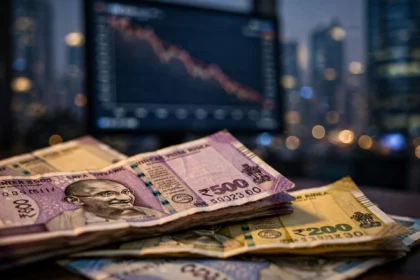
The Reserve Bank of India has rolled out its most aggressive currency defence in recent memory, and the rupee is already responding. The central bank has announced a special dollar window for the country’s three oil marketing companies, a move that took effect this morning and steadied the currency in early trade on Monday.
The rupee opened around 80 paise stronger at roughly 95.82 to the dollar, pulling back from Friday’s close near 96.7, which had left it uncomfortably close to its all-time weakest level of 96.96 touched earlier this year.
What the dollar window actually does
The centrepiece of the package is a dedicated facility through which the RBI will meet the entire daily dollar requirements of Indian Oil Corporation, Hindustan Petroleum and Bharat Petroleum. The three oil marketing companies import the bulk of India’s crude, and their routine dollar purchases are one of the largest single sources of demand in the foreign exchange market.
Under the arrangement, which runs from October 12 until further notice, the RBI will sell dollars to the three companies directly through designated banks. In practice, this takes a huge chunk of buying pressure off the open market, though it will show up as a drawdown on the RBI’s foreign exchange reserves.
This is not a new tool. The RBI has opened similar windows for oil companies during previous episodes of currency stress. Each time, the message was the same: the central bank would rather supply dollars from its reserves than let disorderly buying push the rupee into a tailspin.
The fine print: tougher forex rules
The RBI did not stop at the dollar window. Alongside it, the central bank announced regulatory measures aimed at tightening discipline in the foreign exchange derivatives market:
- No rebooking of cancelled contracts: dealers can no longer allow users to rebook any rupee forex derivative contract cancelled with any dealer. Rollovers on maturity remain permitted.
- Lower threshold without underlying exposure: the limit for forex derivative transactions without establishing an underlying exposure has been slashed from 100 million dollars to 5 million dollars.
- Exchange-traded curbs: positions in exchange-traded currency derivatives involving the rupee are now capped at 5 million dollars equivalent across all recognised stock exchanges.
- New risk reserve: dealers must maintain a foreign exchange risk reserve equal to 20 per cent of the notional amount of large rupee derivative contracts, held in cash.
Taken together, the measures close off avenues traders have used to build leveraged bets against the rupee.

Why the rupee was hurting
The RBI’s move comes after weeks of strain. Foreign portfolio investors have sold Indian equities for eleven straight sessions. The central bank has already raised dollars and hiked its policy rate, but the currency kept sliding, and the shift to a “calibrated tightening” stance signalled a deeper hiking cycle than markets expected.
Bond markets feel it too. The benchmark 10-year government bond yield ended last week at 7.2994 per cent, its eighth consecutive weekly rise. Foreign investors have been net sellers of Indian bonds in seven of the last eight weeks.
There is some relief on the crude front. Brent slipped to around 103 dollars a barrel after the US president announced that Ukraine and Russia had agreed to halt attacks on each other’s energy facilities. Cheaper oil is good news for India, which imports the overwhelming share of its crude.
All eyes on today’s inflation data
The timing of the RBI’s intervention is no coincidence. September retail inflation data is due at 4 pm today, with a Reuters poll projecting it at 5.40 per cent. Wholesale inflation follows on Wednesday. Any upside surprise could force the RBI’s hand on further rate hikes under its “calibrated tightening” stance.
For now, the RBI has chosen to fight the currency battle first. If the rupee holds its early gains and inflation prints in line with expectations, the central bank may have bought itself valuable breathing room.
Frequently asked questions
What is the RBI’s special dollar window?
A facility under which the RBI directly supplies dollars to meet the daily import payment needs of Indian Oil, HPCL and BPCL, keeping their large purchases out of the open forex market. It started on October 12, 2026.
Why did the RBI step in now?
The rupee was trading near its all-time low after weeks of foreign investor selling and persistent dollar demand, so the central bank combined the dollar window with tighter forex derivative rules ahead of key inflation data.
How does this affect ordinary people?
A stable rupee helps keep imported fuel and goods cheaper, which feeds into inflation. If the RBI steadies the currency, it could reduce pressure on prices and on further interest rate hikes, which affect home and auto loan rates.
What is the foreign exchange risk reserve?
A new requirement that dealers hold cash equal to 20 per cent of the notional value of large rupee derivative contracts, raising the cost of speculative positions against the currency.
Will the RBI take more steps?
The dollar window stays until further notice and traders expect continued intervention. The bigger question is rates: September inflation data due today will shape whether “calibrated tightening” turns into more hikes.
The rupee’s rally this morning is a good start, but currency battles are rarely won in a day. What happens after 4 pm, when the inflation numbers land, will tell us whether the RBI’s weekend gamble has real staying power.