US Secretary of State Marco Rubio landed in Mumbai on Tuesday for his second visit to India this year, carrying a message New Delhi has waited months to hear. After his bilateral meeting with External Affairs Minister S Jaishankar, Rubio said the two countries are close to finalising a long-awaited trade agreement, adding that an announcement could come soon.
The visit comes at a delicate moment. Over the past year, the relationship has absorbed real strain: US tariffs, restrictions affecting Indian professionals, and Washington’s growing engagement with Pakistan have all weighed on the strategic partnership. Rubio’s trip is widely seen as an effort to steady the course and give the trade negotiations the final push they need.
Trade deal near the finish line
Speaking after his talks with Jaishankar, Rubio said the trade agreement was close to finalisation and that he hoped it could be sealed shortly. The Ministry of External Affairs confirmed that both sides welcomed the progress made in negotiations, signalling that months of back-and-forth may finally be converging.
The optimism is not new, but the setting gives it weight. A Secretary of State does not make a three-day trip to Mumbai and Gujarat to announce nothing. The discussions covered the full sweep of the partnership: trade, energy, defence, technology, critical minerals, and regional stability.
US Ambassador Sergio Gor, who travelled with Rubio, set the ambition out loud: a target of $500 billion in bilateral trade over the next three years. It is a bold number, and hitting it would transform the economic spine of the relationship.
Jamnagar and the energy question
Rubio flies to Jamnagar on Wednesday morning, where he will tour Reliance Industries’ sprawling refining complex in Gujarat. The visit is no sightseeing detour. The refinery is one of the world’s largest, and it is a major processor of Russian oil, a fact that sits at the centre of the current friction.
Ahead of the trip, Rubio described India as a refining superpower and said the delegation would discuss Venezuelan oil with Reliance, whose purchases are controlled by the Trump administration. The refinery visit also feeds into Reliance’s own plans to invest in a large new refinery project in Texas, which has been described as the first of its kind in the United States in five decades.
Rubio also linked the trade talks to considerations around national security waivers issued by US President Donald Trump in connection with penalties targeting buyers of Russian energy. Balancing economic interests with energy security, he suggested, remains one of the trickiest parts of the final stretch.
A solemn stop at the Taj memorial
Shortly after landing, Rubio laid a wreath at the 26/11 memorial inside Mumbai’s Taj hotel, paying tribute to the victims of the 2008 terror attacks that killed 166 people, including six American citizens. Jaishankar thanked him for the gesture and used the moment to reiterate India’s call for zero tolerance towards terrorism.
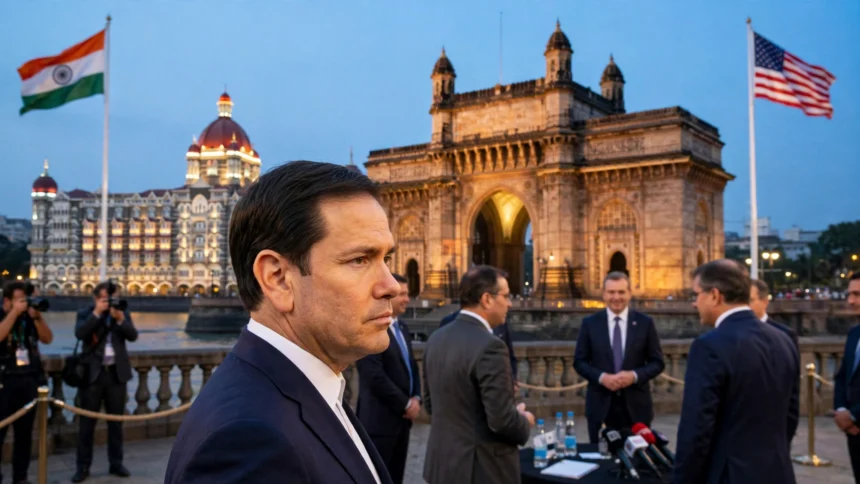
Rubio also visited the Gateway of India with Maharashtra Chief Minister Devendra Fadnavis, who briefed him on the monument’s history. Later in the evening, the delegation attended the “Freedom 250” reception at the Jio World Convention Centre, marking milestones in American history and the bilateral relationship.
What the tensions still are
For all the upbeat messaging, the fault lines have not disappeared:
- Tariffs and trade: Months of negotiations have been complicated by US tariff policies and India’s continued purchases of Russian oil.
- Indian professionals: Restrictions affecting Indian professionals in the US remain a sore point for New Delhi.
- The Pakistan factor: Washington’s recent engagement with Pakistan has drawn quiet concern in New Delhi, and the two sides will have had to address it.
- Energy waivers: Any trade deal will have to sit comfortably with Washington’s sanctions architecture around Russian and Venezuelan energy.
The meeting is also expected to set up possible leadership-level encounters on the sidelines of upcoming multilateral events, including the Asean Summit in Manila next month and the G20 Summit in Florida.
FAQs
Why is Marco Rubio visiting India?
Rubio is in India from October 20 to 22 for bilateral talks with S Jaishankar, engagements in Mumbai and Jamnagar, and discussions on trade, energy, defence and technology. It is his second visit this year.
Is the India-US trade deal finalised?
Not yet. Rubio said on Tuesday that the deal is close to finalisation and could be sealed shortly, and the MEA welcomed the progress in negotiations.
Why is Rubio visiting the Jamnagar refinery?
The Reliance refinery in Jamnagar is one of the world’s largest and a major processor of Russian oil. The visit ties into discussions on energy security, oil supplies and Reliance’s planned refinery investment in Texas.
What was discussed with Jaishankar?
The talks covered the strategic partnership, trade, energy, defence, technology, critical minerals, regional stability, and the conflicts in Ukraine and West Asia.
Will Rubio meet other Indian leaders?
He has already met Maharashtra Chief Minister Devendra Fadnavis in Mumbai. Possible leadership-level meetings are being planned on the sidelines of the Asean Summit in Manila next month and the G20 Summit in Florida.
The next few weeks will tell whether Tuesday’s optimism converts into ink. For now, the message from Mumbai is clear: both sides want the deal, the gaps are narrowing, and the clock is ticking. Watch this space.