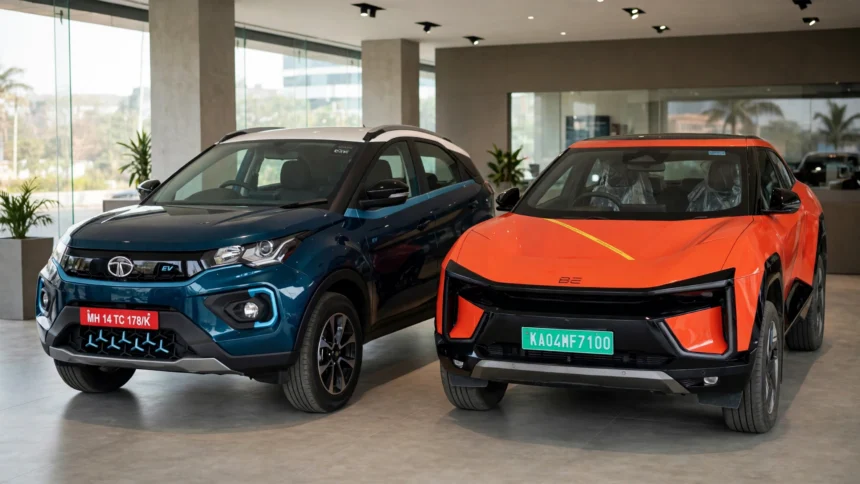
There is a new rivalry at the top of India’s car market, and it is turning into the most closely watched contest in the industry. Tata Motors and Mahindra are fighting for the No. 2 spot in passenger vehicle sales, and after seven months of this financial year, Tata is ahead by 28,124 vehicles. The gap looks comfortable, but the story underneath is far tighter, and electric vehicles are the reason Tata is still in front.
Data from the Federation of Automobile Dealers Associations (FADA), reported by Business Standard on November 9, shows Tata registered 417,559 passenger vehicles between April and October, against Mahindra’s 389,435. Maruti Suzuki remains far ahead in first place, while Hyundai, the traditional No. 2, has slipped to fourth behind both Indian rivals.
A race that keeps flipping
The lead has changed hands more than once this year. Tata began the financial year ahead by 2,452 registrations in April, stretched the gap to 4,233 in May, then saw it narrow through June and July. August brought a wider margin of 7,596, but September delivered the twist of the season: Mahindra edged ahead by just 89 vehicles.
October restored Tata’s advantage. Tata’s registrations rose 28.3 per cent month on month to 73,449 units, while Mahindra grew 13.3 per cent to 64,982. That gave Tata a monthly lead of 8,467 vehicles and a market share of 14.47 per cent, against Mahindra’s 12.80 per cent. FADA president Sai Giridhar said: “A close race is going on between Tata and Mahindra for the No. 2 slot. This time Tata has overtaken Mahindra way ahead and has a healthy margin of around 9,000 vehicles.”
Electric vehicles are doing the heavy lifting
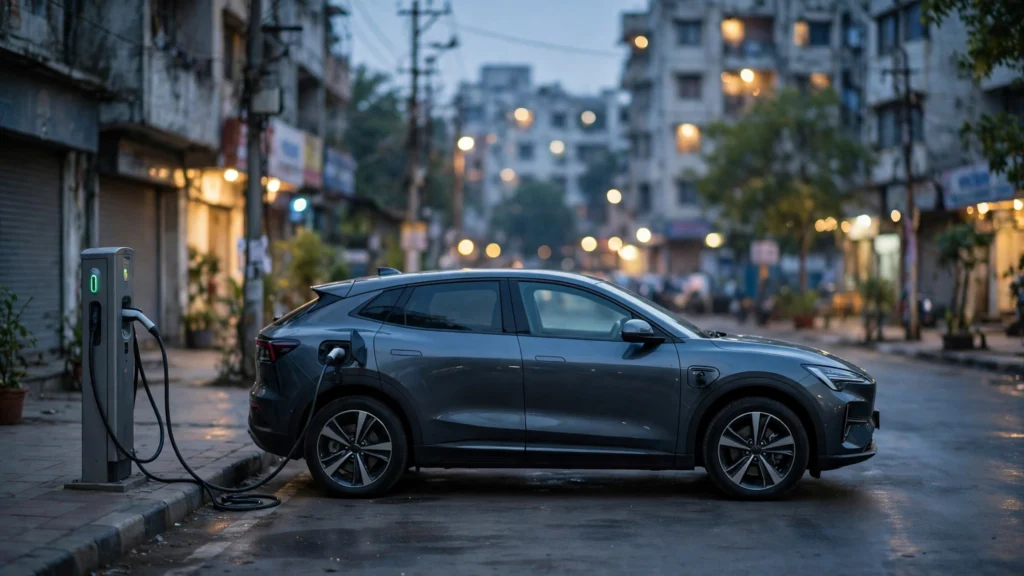
Strip out electric vehicles and the picture reverses. Between April and October, Tata registered 88,125 electric passenger vehicles, more than Mahindra’s 50,322, an advantage of 37,803 units. Without EVs, Mahindra actually leads: 339,113 non-electric registrations against Tata’s 329,434. In other words, Tata’s entire lead in the No. 2 race comes from its electric range.
The mix tells the same story. EVs make up about 21.1 per cent of Tata’s passenger vehicle registrations this financial year, compared with 12.9 per cent for Mahindra. In October alone, Tata sold 14,669 electric cars against Mahindra’s 8,538, though the monthly EV gap narrowed to 6,131 units from 7,011 in September.
Tata’s electric and CNG models together now account for 51 per cent of its volumes. Its EV sales crossed 47,000 units in the September quarter, up 90 per cent year on year, and the company says it has sold more than 130,000 EVs over the past year, holding over 40 per cent of India’s electric car market.
What each side is banking on
Tata’s volume drivers remain the Punch and Nexon, supported by the Harrier, Safari and the newer Sierra. The Punch is India’s highest-selling SUV. The July to September quarter was Tata’s best ever, with 201,723 units sold, up 40 per cent year on year, and total October sales including exports crossed 75,000 for the first time.
Mahindra’s answer is its SUV range: the XUV 7XO, XEV 9S, Thar and Scorpio-N. The XEV 9S was India’s highest-selling EV in the September quarter with 13,275 units. Mahindra says it measures leadership differently, pointing to its No. 1 position in SUV revenue market share at 24.3 per cent in the September quarter.
Production is where Mahindra is making its biggest bet. The company ran at over 103 per cent capacity utilisation and dispatched every vehicle it built, leaving dealer stock at an all-time low of eight to nine days. It exited the first half of the financial year with monthly SUV capacity of 68,000 units and plans to add 14,000 more by the January to March quarter. That should rise to 92,000 by the end of 2027-28 and 132,000 by the end of 2030-31, including its proposed Nagpur plant.
The wider market is still growing
The October numbers came against a 14.23 per cent year-on-year fall in overall passenger vehicle retail registrations to 5,07,768 units, but FADA attributes that almost entirely to the festive calendar. Diwali fell in October last year and in November this year, so the year-ago base was unusually strong. Month on month, registrations rose 18.86 per cent, and for April to October, industry retail registrations grew 16.41 per cent to 3.07 million units.
FAQs
Who is India’s No. 2 carmaker right now?
Tata Motors, with 417,559 passenger vehicle registrations between April and October, ahead of Mahindra’s 389,435, according to FADA data.
How big is Tata’s lead over Mahindra?
The cumulative lead is 28,124 vehicles. In October alone, Tata led by 8,467 units, after Mahindra had edged ahead by just 89 vehicles in September.
Why are EVs so important in this race?
Tata registered 88,125 electric cars between April and October against Mahindra’s 50,322. Without EVs, Mahindra would be ahead by nearly 10,000 vehicles, so Tata’s electric range is carrying its lead.
Which models are driving sales for each company?
Tata leans on the Punch, Nexon, Harrier, Safari and Sierra, while Mahindra’s demand comes from the XUV 7XO, XEV 9S, Thar and Scorpio-N.
Will Mahindra catch up?
It is adding production capacity fast, from 68,000 SUVs a month now to a planned 132,000 by the end of 2030-31, and its EV gap with Tata narrowed in October. The next few months of festive sales should show whether the momentum shifts.