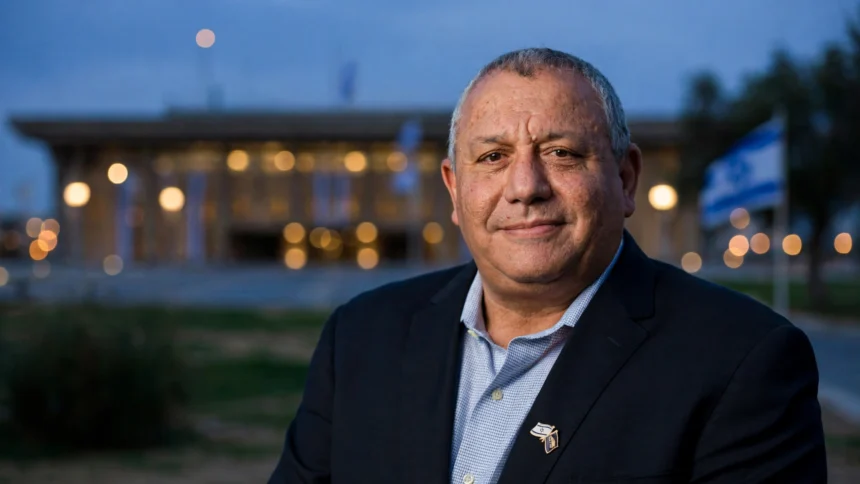
Israel moved a step closer to a new government on Thursday, as opposition leader Gadi Eisenkot emerged from two days of presidential consultations with the backing of 67 of the Knesset’s 120 members. President Isaac Herzog will announce on Sunday, November 8, who gets the first chance to form the next government.
The tally gives Eisenkot, who leads the Yashar party, a clear edge over Prime Minister Benjamin Netanyahu, who was recommended by 46 lawmakers. Seven members of the ultra-Orthodox United Torah Judaism party declined to recommend either candidate. It is the largest number of recommendations any candidate has received since 2015.
Herzog wrapped up the consultations at the President’s Residence in Jerusalem on Thursday evening after meeting every faction elected to the 26th Knesset. He said he would hold private talks with several party leaders over the weekend before making his decision.
“I intend to task a member of Knesset with forming the government this coming Sunday,” Herzog said in televised remarks. “In these talks, I intend to leave no stone unturned in an effort to reach out and build a stable and good government for the people of Israel.”
How Eisenkot reached 67
Eisenkot’s total is built from two very different groups. Four Jewish-led opposition parties, holding 48 seats between them, recommended him: his own Yashar, Naftali Bennett and Yair Lapid’s B’Yachad, Yair Golan’s Democrats, and Avigdor Liberman’s Yisrael Beytenu.
The other 19 came from the two Arab-led parties, Ra’am and the Joint List, which won a record combined 19 seats in the October 27 election. Both endorsed Eisenkot during the consultations, a first for Arab parties at this scale. Their recommendations, however, do not commit them to joining his coalition, and several opposition leaders have drawn a red line against governing with them.
Netanyahu’s 46 recommendations came from his own Likud plus Shas, Religious Zionism, Zehut and Otzma Yehudit. United Torah Judaism, a longtime coalition partner of Netanyahu, broke with tradition by abstaining, a move that helped Eisenkot’s side and reflected reported tensions between the ultra-Orthodox party and the prime minister.

Why Herzog is waiting until Sunday
Despite the clear numbers, Herzog said the picture was not simple. “The results may appear clear, but the authority vested in me by law is to determine who has the ability to form a government, and that is not entirely clear, given the mutual vetoes between the blocs and within the blocs themselves,” he said.
The warning points to the hard maths behind the recommendations. Eisenkot has the backing of a majority of lawmakers, but turning recommendations into a working coalition is another matter. His four Jewish-led supporting parties hold only 48 seats, well short of the 61 needed for a majority, and potential partners have opposed relying on Arab party support. At the same time, some in his camp have ruled out any unity government with Netanyahu.
During the consultations, members of Bennett’s B’Yachad party firmly rejected a unity deal. “No unity with people who hold fascist worldviews,” MK Ram Ben-Barak said, while MK Merav Cohen argued that past experience in a unity government had done more harm than good.
Likud’s delegation, meanwhile, argued that the mandate should go to Netanyahu as leader of the largest party, and warned it would be dangerous for a coalition to rely on support from the Joint List. Yashar urged Herzog to hand Eisenkot the task as soon as possible.
What Eisenkot has promised
Eisenkot, a former chief of staff of the Israel Defense Forces, has said he would first try to form what he calls an “emergency national government” to repair what he describes as the damage done under Netanyahu’s administration. He has set out four conditions for parties joining his coalition, including the full disarmament of Hamas.
Ra’am leader Mansour Abbas told Herzog during the talks that his party supports the full disarmament of Hamas. “Arab society, and I as an individual, as well as Arab citizens as a whole, we are a bridge,” Abbas said. “Let’s not destroy that bridge.”
The road from here
The October 27 election left Israel deadlocked. Netanyahu’s bloc won 53 seats, the opposition bloc 48, and the Arab parties 19, with no side reaching the 61-seat majority needed to govern. The Central Elections Committee certified the results on Wednesday, November 4, after finding no evidence that the vote’s integrity had been compromised, despite a Shin Bet investigation into suspicions that foreign entities funnelled money to influence voting in Arab communities.
Once Herzog names his candidate on Sunday, that person will have 28 days to assemble a coalition, with a possible 14-day extension. If the attempt fails, the president must decide within three days whether to give the task to another lawmaker. A second candidate would get 28 days with no extension. If that also fails, 61 lawmakers get 21 days to jointly request a candidate of their choice, who would then have 14 days. Should every route fail, Israel would head to another election early next year.
The new Knesset is due to be sworn in on November 10, whatever happens in the coalition talks. Until a new government wins a confidence vote, Netanyahu’s outgoing government stays on in a caretaker capacity.
For now, all eyes are on Herzog’s weekend meetings. The numbers point to Eisenkot, but in Israeli politics, recommendations are only the start of the story.
Frequently asked questions
Who is Gadi Eisenkot?
Eisenkot is a former chief of staff of the Israel Defense Forces who now leads the Yashar party. He heads the opposition bloc that is trying to replace Prime Minister Benjamin Netanyahu.
How many recommendations did Eisenkot receive?
He was recommended by parties representing 67 of the 120 Knesset members, while Netanyahu was recommended by 46. Seven members of United Torah Judaism abstained.
When will Israel’s president announce his decision?
President Isaac Herzog said he will announce on Sunday, November 8, which lawmaker gets the mandate to form the next government.
How long does the mandate holder get to form a government?
Under Israeli law, the candidate gets 28 days, with a possible extension of up to 14 days. If that fails, the process moves to a second candidate and eventually, if nothing works, another election.
When is the new Knesset sworn in?
The new Knesset is scheduled to be sworn in on November 10, regardless of how the coalition talks are going.
Photo: Gadi Eisenkot (Ronen Horesh / Wikimedia Commons, CC BY-SA 4.0; background composite).