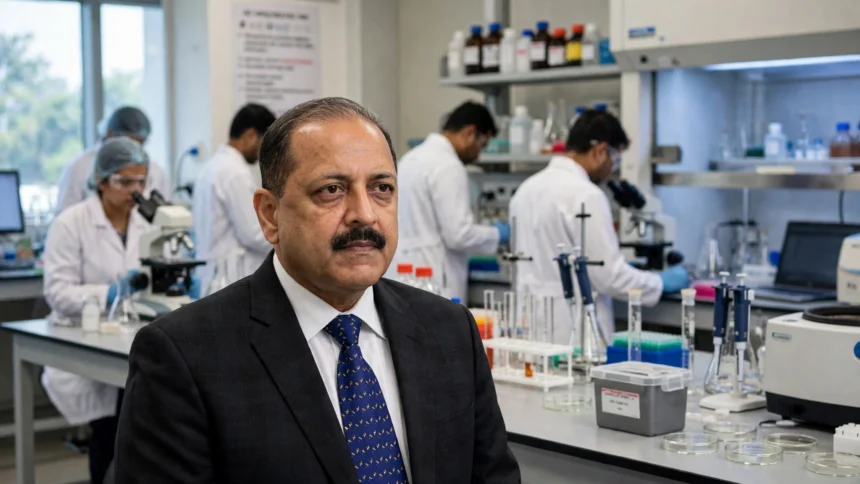
India has taken a significant step towards turning cannabis into a regulated medicine. Union Minister Dr Jitendra Singh announced on Monday that pre-clinical trials of cannabis-based drug candidates will be carried out in collaboration with Mumbai’s Tata Memorial Centre, with the aim of developing export-quality painkillers from the plant.
The announcement came during a review of the country’s first-of-its-kind Cannabis Medicinal Research Project at the CSIR-Indian Institute of Integrative Medicine (IIIM) in Jammu. The project is now moving into formal pre-clinical evaluation, where drug candidates are tested in laboratories and animal models before any human trial is considered.
“It is expected to pave the way for the development of export-quality medicines for neuropathies, cancer, epilepsy and Acute Respiratory Distress Syndrome (ARDS),” Singh said, underlining that the work is aimed squarely at the medicinal and life-science uses of cannabis, not at recreational use.
What the project will test
The research focuses on cannabis-derived compounds for some of the hardest pain problems in medicine: chronic nerve pain, known as neuropathy, pain linked to cancer treatment, severe epilepsy and ARDS, a serious lung condition in which patients struggle to breathe.
Cannabis contains compounds such as THC and CBD, which interact with the body’s pain and inflammation pathways. The CSIR-IIIM team is working to isolate and standardise these compounds into formulations that can be measured, reproduced and tested like any other medicine.
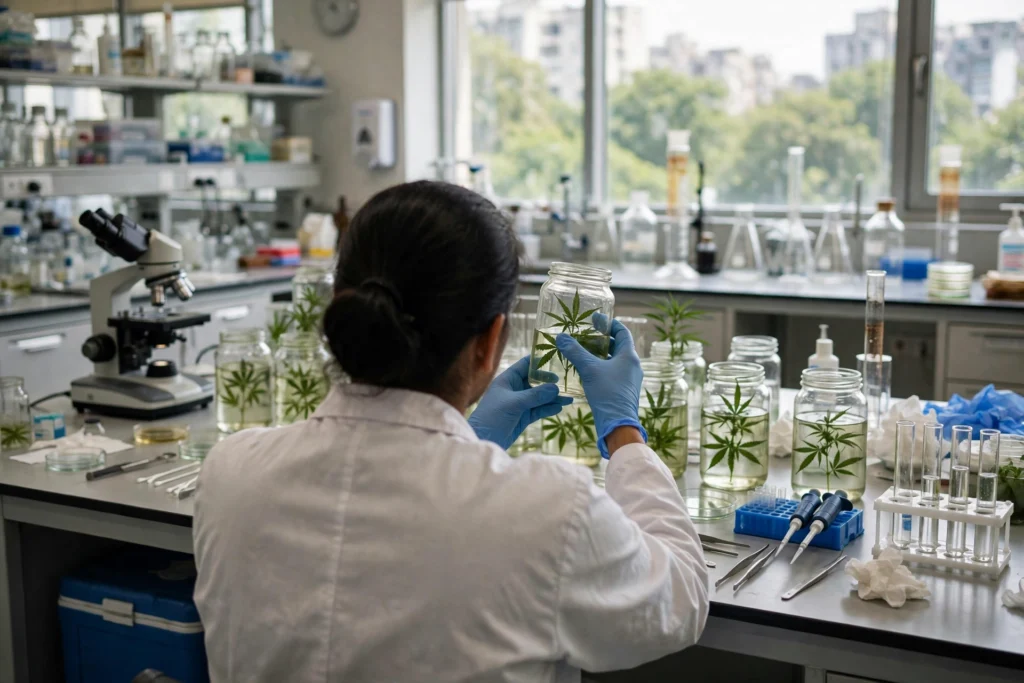
The institute says it has built a germplasm bank of more than 500 distinct cannabis varieties, giving researchers a wide base of plant material to screen for the most promising medicinal compounds.
From cultivation to the laboratory
The Jammu and Kashmir government gave permission for the scientific cultivation of cannabis in 2017, and CSIR-IIIM has since built secure cultivation facilities for the research.
The project runs under a public-private partnership model, with a French pharmaceutical company involved alongside the Government of India and the Jammu and Kashmir administration.
Before the pre-clinical work can go ahead at full pace, regulatory paperwork still has to be completed. CSIR-IIIM Director Dr Zabeer Ahmed said the institute has applied to the Jammu and Kashmir Excise Department for permission to process, formulate and transport cannabis extracts under Good Manufacturing Practice conditions, the quality standard that governs how medicines are made.
Tata Memorial Centre, one of India’s leading cancer hospitals and research institutions, will bring its oncology expertise to the partnership, testing how the standardised extracts behave against cellular targets and in animal models.
What pre-clinical trials actually mean
To be clear about where this research stands: pre-clinical trials are laboratory and animal studies. They are not human trials, and the drug candidates are not approved medicines. No patient can receive these formulations yet.
Only if the pre-clinical studies show the candidates are safe and effective will the project move towards human trials, governed in India by the Central Drugs Standard Control Organisation under the New Drugs and Clinical Trials Rules, 2019.
Singh also addressed the perception problem: cannabis is still widely associated with drug addiction, and the minister said the initiative aims to look beyond that association and harness the plant’s medicinal properties for pain relief.
Why cannabis, and why now
Chronic pain is one of the most common and most poorly treated health problems in India. Cancer patients and people with diabetic nerve damage often rely on opioid-based drugs such as morphine, which carry risks of dependence and side effects. A plant-derived alternative that is less habit-forming would be a major advance, if the science supports it.
The evidence is still developing, and researchers are careful not to overpromise. A Cochrane systematic review published in January 2026, which examined 21 randomised trials involving 2,187 adults with chronic nerve pain, concluded that high-quality evidence remains insufficient to confirm that cannabis-derived medicines provide reliable, long-term pain relief. That is exactly why the pre-clinical stage matters: it is where hopeful compounds are either validated or set aside.
For now, the Jammu project is a statement of intent backed by institutional weight: a government research institute, a premier cancer centre and an industry partner working on the same problem, aiming for medicines that meet international standards and can be exported.
Frequently asked questions
Are cannabis-based painkillers available in India now?
No. The drug candidates are in the pre-clinical stage, which means laboratory and animal studies. They are not approved medicines and cannot be prescribed to patients yet.
Does this mean cannabis is now legal in India?
No. The project works under specific government permissions for scientific cultivation and research. Recreational use of cannabis remains illegal, and this research does not change that.
Which conditions are being targeted?
Neuropathic and chronic pain, cancer-related pain, epilepsy and Acute Respiratory Distress Syndrome (ARDS) are the main targets named by the project.
Who is running the research?
The CSIR-Indian Institute of Integrative Medicine in Jammu is leading the project, in partnership with Tata Memorial Centre in Mumbai and a French pharmaceutical company under a public-private partnership.
When could patients actually get these medicines?
There is no timeline yet. The pre-clinical studies must first be completed successfully, followed by regulatory clearance and human clinical trials. That process typically takes years.
The coming months will show whether the Jammu project’s drug candidates clear their first scientific hurdle. For patients living with chronic pain, that first result will be worth watching.