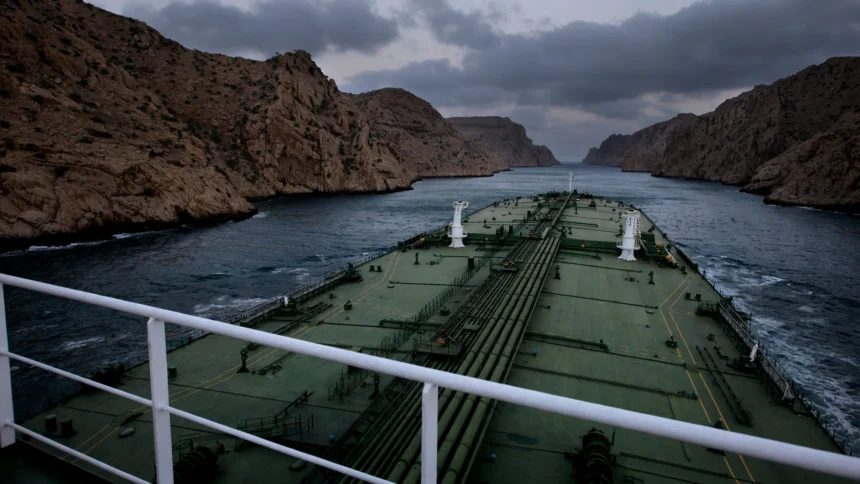
Four oil tankers have been hit by explosions in the Strait of Hormuz in the space of two days, and a fifth vessel, a tanker carrying liquefied natural gas, struck a naval mine in the same waterway on Friday. The incidents have pushed one of the world’s most important shipping lanes back to the centre of the war between the United States, Israel and Iran, and raised fresh questions about how safe Gulf oil exports really are.
Iran’s military said on Thursday that four oil tankers were hit by explosions after the vessels ignored warnings and entered what Tehran calls restricted areas of the strait. Two supertankers were disabled in explosions on Wednesday, and two more vessels were reportedly struck by mines on Thursday. Then, on Friday morning, Iran’s Revolutionary Guards navy said an LNG tanker hit a mine and suffered an explosion while using what it described as an “unauthorised and dangerous route”. No details of that tanker were immediately available.
What happened in the strait this week
The week began with shipping still moving through the strait, the narrow channel between Iran and Oman through which crude from the Gulf reaches the rest of the world. By Wednesday, that picture had changed. Two supertankers were disabled after explosions, and by Thursday two more vessels had been hit. Iran’s military then said publicly that four tankers had been struck, blaming the ships for ignoring its warnings.
Independent confirmation has been hard to come by. Reuters reported that it could not immediately verify the Iranian accounts. Britain’s maritime agency, UK Maritime Trade Operations, said separately that a vessel leaving the strait was hit by an unidentified projectile, causing an engine-room fire, which matches the pattern of the week’s incidents.
The Friday incident added a new element. The vessel involved was carrying liquefied natural gas, not crude oil, and Iran’s Revolutionary Guards navy said it had struck a naval mine. State media carried the announcement, but no name, flag or casualty details were given.
A waterway under sustained attack
The week’s incidents are not isolated. At least 10 ships were hit in the first 10 days of November, and October saw 37 attacks, the highest monthly tally since the conflict began in late February, according to data from the Washington Institute for Near East Policy. The US-Israel war on Iran is now in its ninth month, and shipping through the strait has become one of its main pressure points.
Traffic through the strait had actually rebounded in recent weeks, and oil prices had been falling on expectations that the war might de-escalate. The attacks have put that fragile calm under strain. Tankers are still facing attacks across the strait even as more ships return to the route, and insurers and shipowners are watching every new incident.
Oil prices fall, but the risk premium stays
Oil markets have reacted with a mix of nerves and relief. Brent crude was little changed on Friday at $95.41 a barrel, with West Texas Intermediate at $88.52, but both benchmarks are set for their second weekly decline. Brent is down 2.4 percent this week after plunging 16 percent the previous week, while WTI is set for a 2.5 percent drop after falling 13 percent.
The declines reflect a view in the market that the US plans to continue its blockade of Iran rather than launch a new round of large-scale fighting, which reduces the chance of a sudden supply shock. But the week’s tanker attacks are a reminder that the danger to shipping has not gone away.
US President Donald Trump added to the uncertainty on Thursday, saying on Truth Social that a deal with Iran was “not necessary” to end the war, and signalling that Washington will stick with its blockade on oil shipments and trade and economic sanctions.
The wider war spills over
The same day the tankers were hit, Yemen’s Iran-aligned Houthis said they had attacked a pumping station on the Saudi East-West oil pipeline, an oil facility in the Saudi Red Sea city of Yanbu, and an Aramco building in the capital, Riyadh. The Houthis have also hit Saudi Arabia’s East-West pipeline before, and the strikes show the conflict reaching beyond the strait itself.
On the diplomatic front, there is little sign of a breakthrough. US Secretary of State Marco Rubio has called Iran’s demands “outrageous and ridiculous”, while Tehran says there are no negotiations and the strait will stay closed until its seven conditions are met. A Qatari-Pakistani proposal had briefly revived talk of a deal, including the return of nuclear inspectors and the reopening of the strait, but Iran’s security chief has since dismissed claims of ongoing negotiations.
Why it matters for India
For India, which buys much of its crude from Gulf producers, the Strait of Hormuz is not a distant waterway. Any disruption there feeds straight into import costs, and from there into fuel prices at home. The week’s incidents have not yet cut supplies, and prices are actually falling, but the pattern of attacks means the risk to India’s energy lifeline is real and growing.
The coming days will show whether this week was another flare-up in a long-running shadow war at sea, or the start of something worse. For now, the tankers keep sailing, the mines stay in the water, and the world’s most important oil chokepoint remains on edge.
FAQs
How many tankers were hit in the Strait of Hormuz this week?
Iran’s military said four oil tankers were hit by explosions on Wednesday and Thursday, and the Revolutionary Guards navy said an LNG tanker struck a mine on Friday, taking the week’s total to five vessels.
What does Iran say caused the explosions?
Iran says the tankers ignored warnings and entered restricted areas of the strait, and that the LNG tanker was using an “unauthorised and dangerous route”. Reuters said it could not immediately verify the Iranian accounts.
How many ships have been attacked in the strait recently?
At least 10 ships were hit in the first 10 days of November, after 37 attacks in October, the highest monthly tally since the conflict began in late February, according to Washington Institute data.
What happened to oil prices?
Brent crude traded near $95.41 a barrel on Friday and West Texas Intermediate near $88.52. Both are set for a second weekly decline, with Brent down 2.4 percent this week after a 16 percent plunge the week before.
What is the US position on a deal with Iran?
President Donald Trump said on Thursday that a deal with Iran was “not necessary”, indicating the US will continue its blockade on Iranian oil shipments along with trade and economic sanctions.
The situation in the Strait of Hormuz is still developing, and this story will be updated as more details are confirmed.