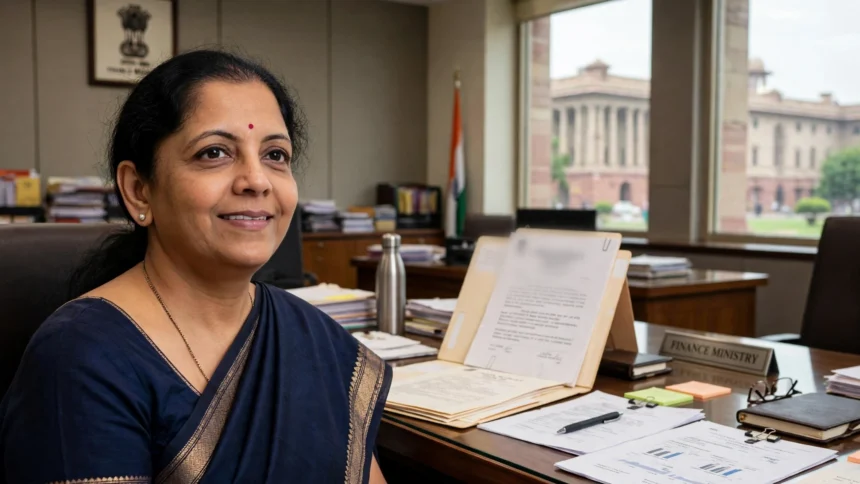
New Delhi has begun the countdown to Union Budget 2027-28. Finance Minister Nirmala Sitharaman chaired the first pre-Budget consultation with leading economists on Monday, November 16, opening talks that run until November 26 and will shape next year’s spending and tax plans.
The meeting was attended by Department of Economic Affairs Secretary Anuradha Thakur, Chief Economic Adviser V Anantha Nageswaran and senior officials, the Finance Ministry said. A second consultation, with agriculture experts, followed on Tuesday. The Budget is expected on February 1, 2027, a Monday.
What happened on day one
Monday’s session opened the Finance Ministry’s annual exercise of gathering views before finalising the Budget. Economists were asked for their assessment of the economy and suggestions on growth, fiscal consolidation and taxation, amid high inflation, a wide trade gap and volatile energy prices.
The economists urged the government to stay on its debt reduction path despite rising spending pressures. The government aims to bring the debt to GDP ratio down to 50 per cent, plus or minus one per cent, by 2030-31. The 8th Pay Commission and the West Asia oil shock were also discussed.
Capital gains tax takes centre stage
The sharpest debate so far is over capital gains tax on equities. The PHD Chamber of Commerce and Industry, in proposals submitted on November 10, urged the government to scrap long term capital gains tax on equities and cut short term capital gains tax to 10 per cent from 20 per cent. It also sought duty cuts on fuel feedstocks.
The economists who met Sitharaman took the opposite view. Most said long term capital gains tax should not be cut, and advised her to retain the levy. Their argument is that the government needs the revenue, and cutting the tax would send the wrong signal while the fiscal math is already tight.
The ministry has not committed either way. Central Board of Direct Taxes Chairman Ravi Agrawal said it is examining various aspects of capital gains tax, and any changes would come through the Budget itself. The issue will stay live until February 1. It will be one of the most closely watched decisions in the Budget.
A Gen Z session, and a packed calendar
This year’s round has one unusual feature. Alongside the customary meetings with industry, trade unions, state governments and the social sector, the ministry has planned a special session with youth representatives, experts and bureaucrats. The Gen Z session is a first for the pre-Budget process, a sign the government wants the Budget to speak to younger Indians.
After November 26, ministries must submit expenditure proposals through the Union Budget Information System. The ministry will then spend December and January drafting the Budget for Parliament on February 1.
The economic backdrop
The consultations are taking place at a complicated moment. Retail inflation rose to 6.09 per cent in October, above the RBI’s 6 per cent tolerance limit, while wholesale price inflation jumped to 12.29 per cent on higher fuel and power prices. The trade deficit widened to a 12 month high of 39.88 billion dollars in October.
Growth forecasts, though, have been moving up. Moody’s Ratings raised India’s 2026-27 growth forecast to 7 per cent from 6.5 per cent last week, and the Reserve Bank has projected 7.1 per cent. Foreign investors have pumped a record 9.53 billion dollars into Indian equities so far in November. The RBI raised its repo rate to 5.50 per cent in October, its first hike in over three years.
Why it matters
For ordinary readers, the pre-Budget consultations are where the Budget is really decided, long before the speech in Parliament. The choices made in these rooms determine whether tax slabs move and how much the government spends on jobs and welfare.
The capital gains debate is the first real fault line of Budget 2027-28. Industry wants the tax scrapped to lift market sentiment. Economists want it kept to protect revenues. If the economists prevail, investors should not count on a capital gains cut on February 1, and the Budget’s message will be one of fiscal discipline rather than giveaways.
The Gen Z session matters for a different reason. Budgets have traditionally been written by and for the establishment, and a formal hearing for young people is a small but real change. Whether it produces anything concrete will test if it was genuine or a gesture.
FAQs
When will Union Budget 2027-28 be presented?
The Budget is expected on February 1, 2027, a Monday. Sitharaman presented this year’s Budget on February 1, 2026.
What did economists recommend on capital gains tax?
Most economists who met her on November 16 advised retaining long term capital gains tax on equities, with no reduction. Industry body PHDCCI had urged the government to scrap it.
What is the Gen Z session?
A special consultation with youth representatives, experts and bureaucrats, planned as part of this year’s pre-Budget round. It is the first time such a session has been included.
How long will the consultations run?
They began on November 16 and continue until November 26, covering economists, industry, states, agriculture experts and trade unions.
Who attended the first meeting?
Sitharaman chaired it, with DEA Secretary Anuradha Thakur, Chief Economic Adviser V Anantha Nageswaran and senior officials attending.
The road to February 1 has begun. The coming weeks will show whether the government heeds the economists’ caution or industry’s demands.